
1. Executive Summary
On 8 October 2026, Socket reported a new burst in the GhostAction credential-theft campaign. Two GitHub maintainer accounts were reportedly used to add a workflow named .github/workflows/security-audit.yml to repositories where those identities had write access.
The reported workflow did more than inspect CI/CD secrets. This wave also searched the repository working tree and full Git history for credentials, including cloud, AI, SaaS and source-control tokens, then sent collected data to a hard-coded external IP over unencrypted HTTP.
The available public reporting supports a serious credential-exposure lead. It does not establish that every repository executed the workflow, that every secret was exfiltrated, or that downstream misuse occurred in every affected environment.
2. What Researchers Reported
| Observation | Reported detail | Boundary |
|---|---|---|
| Workflow | .github/workflows/security-audit.yml | Reported by Socket in the October 8 wave. |
| Maintainer identities | henrywoo and kitao | Reported as compromised identities; this does not mean the account owners knowingly conducted the activity. |
| Repository count | Socket: 346; StepSecurity: 345 in its summary | Published totals differ in how the Uber-owned repository is counted. |
| Reported destination | 193.32.204[.]199 over plain HTTP | An indicator from public research; validate against current intelligence and local telemetry. |
| Downstream package abuse | Socket had not observed malicious package versions published to PyPI or crates.io from this activity as of 9 October. | A dated observation, not a guarantee that no later activity occurred. |
Socket’s breakdown describes 318 repositories associated with the henrywoo sweep, 27 associated with kitao, and an Uber-owned repository, uber/athenadriver, to which the Henry Wu account reportedly retained write access. StepSecurity’s total is one lower and describes the Uber repository within the Henry-linked sweep. The reports should be cited separately rather than force-fitted into a single count.
3. Attack Flow — From Trusted Identity to Credential Exposure
The supplied research brief includes the following illustrative flow. It describes the reported mechanism and defensive priorities; it is not proof that every stage happened in every listed repository.
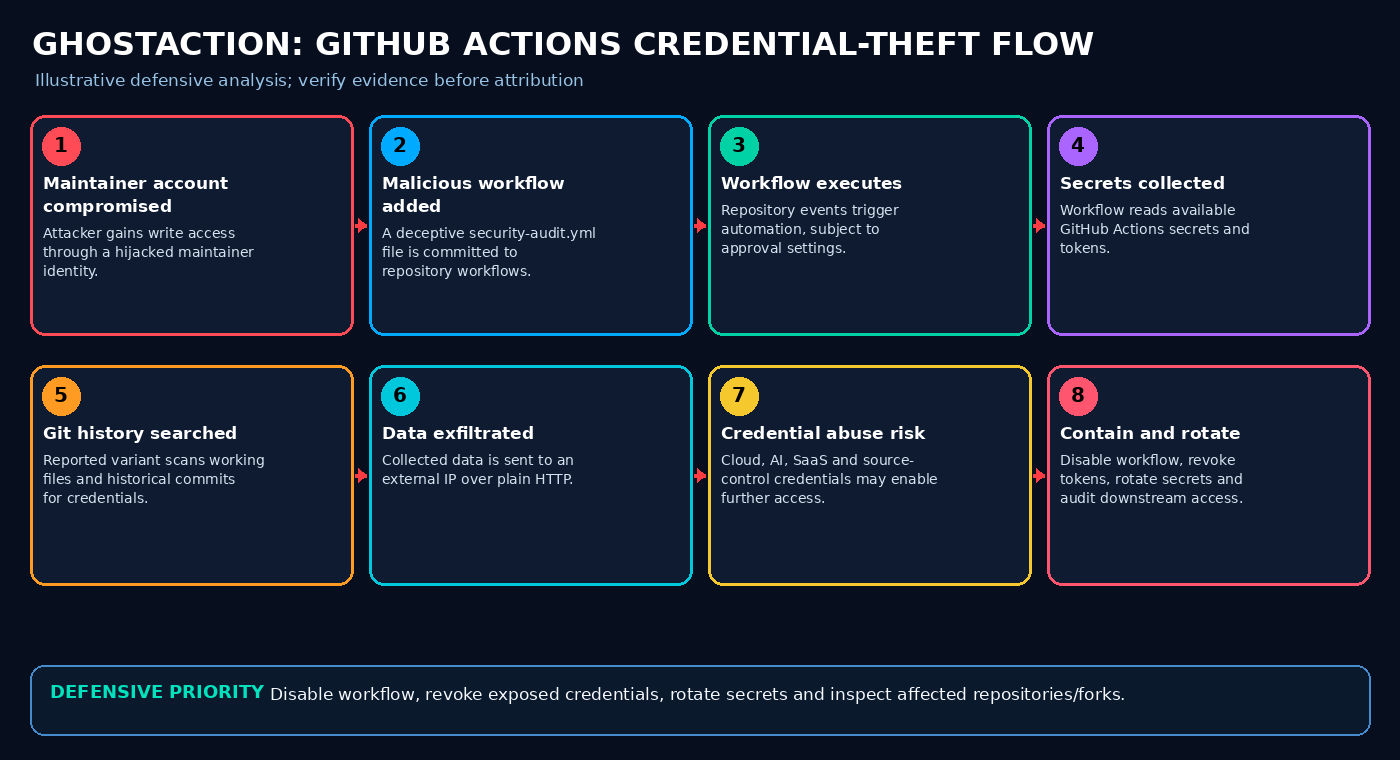
GitHub Actions workflows can run with permissions granted by repository configuration and workflow context. A malicious workflow committed under a trusted maintainer identity can therefore exploit trust in the development process without requiring a newly disclosed GitHub platform vulnerability.
4. How the Workflow Expands the Blast Radius
Step 1 — Abuse of maintainer write access
Researchers described commits made under the affected maintainer identities. A workflow change in a repository where the account can write may be accepted by the normal repository trust model, especially if the change does not require a pull request or an independent review.
Step 2 — Defensive-sounding file name
The name security-audit.yml looks benign. The actual workflow behavior is what matters: unexpected access to secrets, scans for credential patterns, access to commit history and outbound network calls should receive immediate review.
Step 3 — Search beyond configured CI secrets
The October wave was reported to combine GitHub Actions secret collection with searches of checked-out files and the full Git history. A credential deleted from the current tree may still be recoverable from an earlier commit.
Step 4 — External transfer
The reported workflow sent collected data to 193.32.204[.]199 using unencrypted HTTP. Treat this as a high-priority hunting indicator, not as a standalone proof that a particular host sent data.
5. What Is Supported — and What Remains Unconfirmed
Reported by researchers
Malicious workflow files were observed across hundreds of repositories; credential collection included GitHub Actions secrets and, in the October variant, working-tree/Git-history searches; a hard-coded external HTTP destination was reported.
Not established for every victim
Whether every listed workflow executed; the exact number of secrets exfiltrated in the October wave; complete downstream credential abuse; the initial method used to compromise the maintainer sessions; and a confirmed identity or sponsorship for the operator.
The repository count describes the scope observed in reporting, not a count of confirmed secret leaks. Separate indicators such as a workflow file, a successful run, evidence of outbound transfer and confirmed credential use should not be treated as interchangeable findings.
6. GhostAction Timeline — Keep the Waves Separate
- September 2025: GitGuardian documented an earlier campaign affecting 817 public repositories across 327 GitHub users and reported at least 3,325 secrets exfiltrated.
- 31 August–30 September 2026: GitGuardian reported a further wave affecting 772 public repositories belonging to 373 GitHub users and organisations and targeting 2,577 secrets.
- 8 October 2026: Socket reported the new burst across 346 repositories; StepSecurity described the activity as 345 repositories. The October variant added working-tree and historical-commit credential searches.
- 9 October 2026: Socket and StepSecurity published technical reporting. Their counts and observation windows should be retained with attribution.
7. Detection and SOC Hunting
- Search repositories, forks and mirrors for unexpected
.github/workflows/security-audit.ymlfiles and related commits from 8 October onward. Also search for legacy names such as.github/workflows/github_actions_security.yml. - Review commit history and GitHub audit logs for workflow creation/updates, unusual maintainer sessions, token creation, permission changes, unexpected pushes and workflow runs.
- Inspect workflow YAML and related scripts for broad secret access, checkout or traversal of full Git history, credential-pattern searches, hard-coded external destinations and outbound HTTP.
- Review runner, firewall, proxy and DNS telemetry for connections to
193.32.204[.]199and unusual plaintext HTTP from CI workloads. Confirm the indicator against current threat-intelligence sources before blocking or attributing. - Inventory secrets available to affected workflows and examine cloud, SaaS, source-control and package-provider audit logs for use after the suspected exposure period.
- Check downstream repositories and organisations that a maintainer account could write to; do not limit hunting to the person’s own namespace.
8. Containment, Recovery and Hardening
- Disable or remove the malicious workflow after preserving a copy and relevant commit/run evidence. Temporarily restrict workflow execution if the exposure scope is still unclear.
- Revoke and rotate every credential that may have been accessible, prioritising cloud-admin keys, GitHub tokens, deployment secrets and package-publishing credentials. Rotate secrets that were ever committed to Git history, even if later deleted.
- Invalidate suspicious sessions and tokens, secure the affected maintainer accounts and enforce phishing-resistant MFA where supported.
- Audit all repositories, forks and organisation projects where the identities had write access, including cross-organisation repositories.
- Minimise
GITHUB_TOKENpermissions, use required workflow approvals where appropriate, protect workflow files with CODEOWNERS/review rules, pin third-party actions to verified full commit SHAs and restrict CI runner egress. - Use secret scanning and push protection; keep short-lived credentials where feasible and prefer narrowly scoped credentials over long-lived tokens.
- After containment, verify the repository, runner and downstream identity logs before declaring the incident closed.
9. MITRE ATT&CK Perspective — Analytical Mapping
These mappings are investigation hypotheses based on reported behavior. Validate them against the workflow, commit data and telemetry before using them as confirmed adversary techniques.
| ID | Technique | Relevance and limitation |
|---|---|---|
T1078 | Valid Accounts | Potentially relevant to the reported use of compromised maintainer identities. |
T1552.001 | Credentials in Files | Relevant to the reported search for credentials in working files and Git history. |
T1195 | Supply Chain Compromise | Analytical mapping for abuse of repository and workflow trust to affect development/build processes. |
T1567 | Exfiltration Over Web Service | Broad candidate mapping only. Validate the precise technique against the observed transfer and current ATT&CK taxonomy; plain HTTP to an IP is not by itself enough to confirm a specific sub-technique. |
CyberRakshakLabs Assessment
Assessment: HIGH. The reported behavior combines a trusted maintainer identity, CI/CD execution and broad credential discovery. If a workflow executes with access to sensitive secrets, compromise can reach cloud, AI, SaaS, source-control and deployment environments beyond the affected repository.
Confidence statement: Confidence is high that multiple independent security researchers published detailed reports on the October 2026 activity. The precise deduplicated victim count, per-repository execution, number of credentials exfiltrated, downstream abuse and operator attribution remain unconfirmed by the supplied evidence alone.
Key takeaway: A trusted maintainer can become the supply-chain entry point. Disable the workflow, establish what it accessed, revoke and rotate exposed credentials, inspect Git history and investigate downstream use before declaring recovery complete.
Think Before You Click. Stay Aware. Stay Secure.
Sources & Verification Notes
Primary technical reporting: Socket Research Team — “New GhostAction Wave Hits Hundreds of Repos, Expanding Beyond CI/CD Secrets to Cloud Credentials” (9 October 2026) ↗. Supports the reported workflow, repository breakdown, credential-search behavior and network destination.
Independent technical reporting: StepSecurity — “GhostAction Returns: Malicious ‘Security Audit’ Workflows Now Mine Credentials from Entire Git Histories” (9 October 2026) ↗. Its summary uses a total of 345 repositories; that count is retained with attribution rather than silently merged with Socket’s count.
Historical campaign context: GitGuardian — “The campaign that never stopped: tracking GhostAction from 2025 to 2026” (7 October 2026) ↗. Supports the historical repository and secret counts for the earlier waves.
The research brief supplied for this article was used as the primary drafting source. Public reports were consulted for corroborating context. CyberRakshakLabs did not independently execute, test or reproduce the reported workflow. Repository counts, observed execution and impact are attributed to the publishing researchers; defensive recommendations are CyberRakshakLabs analysis.
CyberRakshakLabs — Threat Intelligence for a Safer Tomorrow.