
🔐 Mother of All Breaches: 26 Billion Records — What We Know and What Attackers Can Do
January 2024 discovery | Approx. 12 TB | 26+ billion reported records
Executive summary
The “Mother of All Breaches” (MOAB) was reported in January 2024 as an approximately 12-terabyte compilation containing more than 26 billion records associated with many services, including Tencent, Weibo, MySpace, X/Twitter, LinkedIn, Adobe, Canva and others. MOAB was not established as one newly executed breach compromising 26 billion unique people or every named platform at once. Researchers described it as an aggregation of data from numerous earlier breaches and leaks, with possible additional or previously unseen material.
The number of unique individuals and the proportion of genuinely new records were not established in the initial report. The central risk is the concentration and reusability of identity and credential data: credential stuffing, password spraying, phishing, impersonation and account takeover.
1. What MOAB was — and was not
- Reported scale: approximately 12 TB and more than 26 billion records, discovered/reported in January 2024 by CyberNews researchers and security researcher Bob Diachenko of SecurityDiscovery.
- MOAB was described as a compilation / repository combining datasets from many historical breaches, leaks and circulated collections.
- The 26-billion figure counts records, not verified unique people. Duplicate entries, multiple accounts and repeated appearances across collections can inflate record totals.
- A company or service appearing in the compilation does not prove it suffered a new breach in January 2024.
- Researchers reported both previously exposed material and some potentially new or not previously observed records; the exact fraction was not conclusively established in the supplied brief.
- The source does not establish that every record was a valid current password or that every account remained vulnerable.
2. Reported data sources and scale
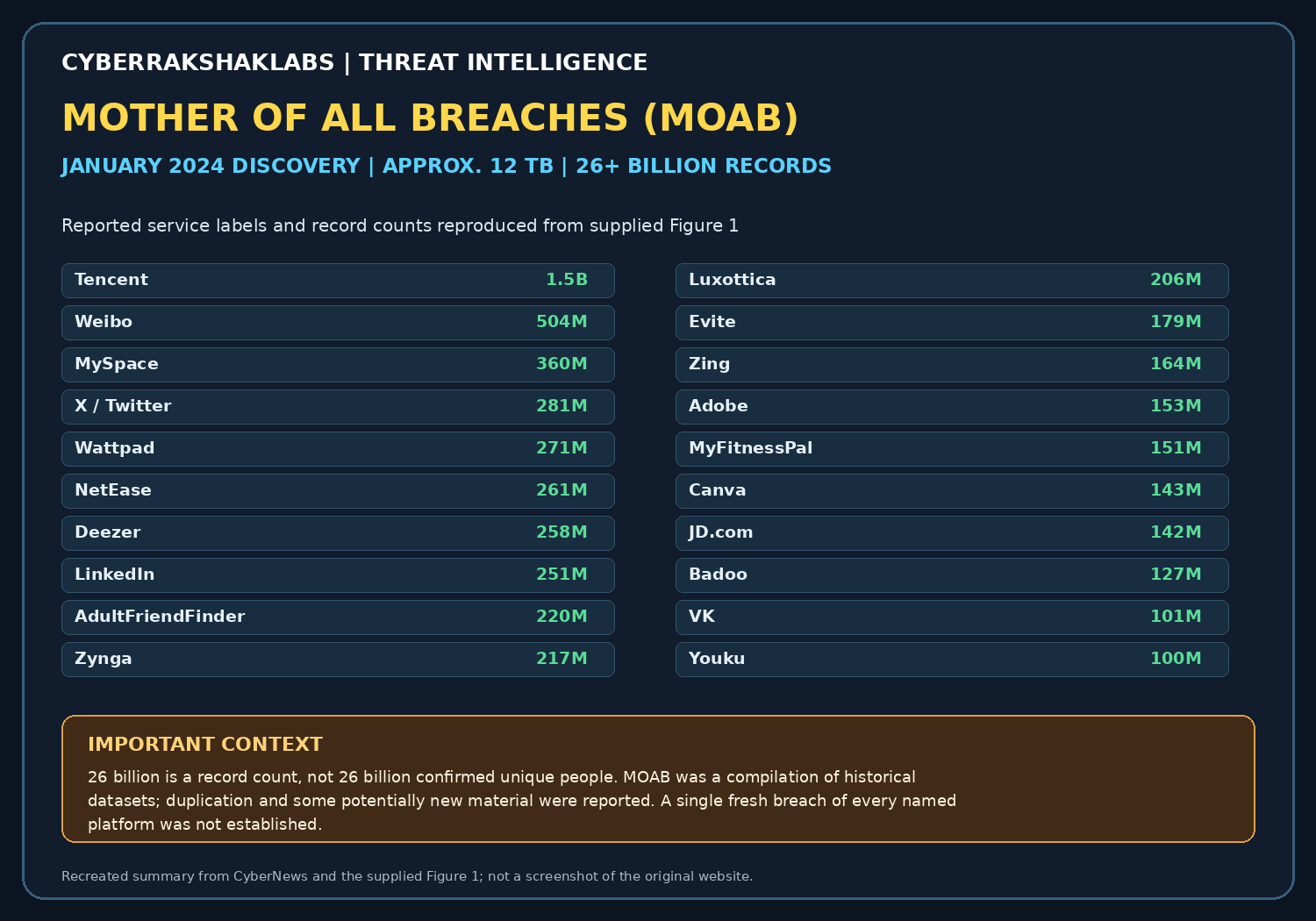
The supplied Figure 1 reproduces a CyberNews table listing high-volume labels such as Tencent (1.5B), Weibo (504M), MySpace (360M), X/Twitter (281M), Wattpad (271M), NetEase (261M), Deezer (258M), LinkedIn (251M), AdultFriendFinder (220M), Zynga (217M), Luxottica (206M), Evite (179M), Zing (164M), Adobe (153M), MyFitnessPal (151M), Canva (143M), JD.com (142M), Badoo (127M), VK (101M) and Youku (100M).
These are reported record counts associated with source labels, not verified unique-person counts or proof of fresh compromise at each named company.
3. Discovery timeline
| Date | Event |
|---|---|
| 23 Jan 2024 | CyberNews publishes its report describing the approximately 12 TB / 26-billion-record collection identified by its researchers and Bob Diachenko. |
| 24 Jan 2024 | Security researchers and media outlets publish analysis and protective guidance; the dataset becomes widely known as MOAB. |
| Late Jan 2024 | Follow-up reporting discusses the historical nature of the compilation, duplicate / previously circulated data and uncertainty about the original compiler. |
| 13 Mar 2024 | IT Brew interviews Bob Diachenko, who describes MOAB as a compilation rather than one new breach and says it included both old and new material; he estimated about 10% had not previously been exposed. |
| 2024 onward | MOAB remains an example of how historical credential data can be repackaged and reused in later account attacks. |
4. Historical context: Collection #1 and credential compilations
MOAB follows a longer pattern of credential compilation. Collection #1, reported in January 2019, combined credentials from thousands of earlier breaches and contained hundreds of millions of unique email addresses and tens of millions of unique passwords. Such collections are not necessarily new intrusions: they aggregate the output of many earlier incidents into searchable or downloadable packages.
MOAB expanded this pattern in volume and breadth, showing that old breach data can remain operationally useful long after the original incident.
5. Threat actor and motive assessment
There is no single confirmed threat actor responsible for all source breaches represented in MOAB. The underlying incidents occurred at different times, involved different organisations and likely had different perpetrators and root causes. The identity of the person or group that assembled or exposed the MOAB repository was not established in the supplied source.
Reporting discussed the possibility of a data broker or underground collector repackaging datasets for resale, access, profiling or status, but these remain hypotheses. Do not attribute MOAB to one ransomware group, nation-state or named actor.
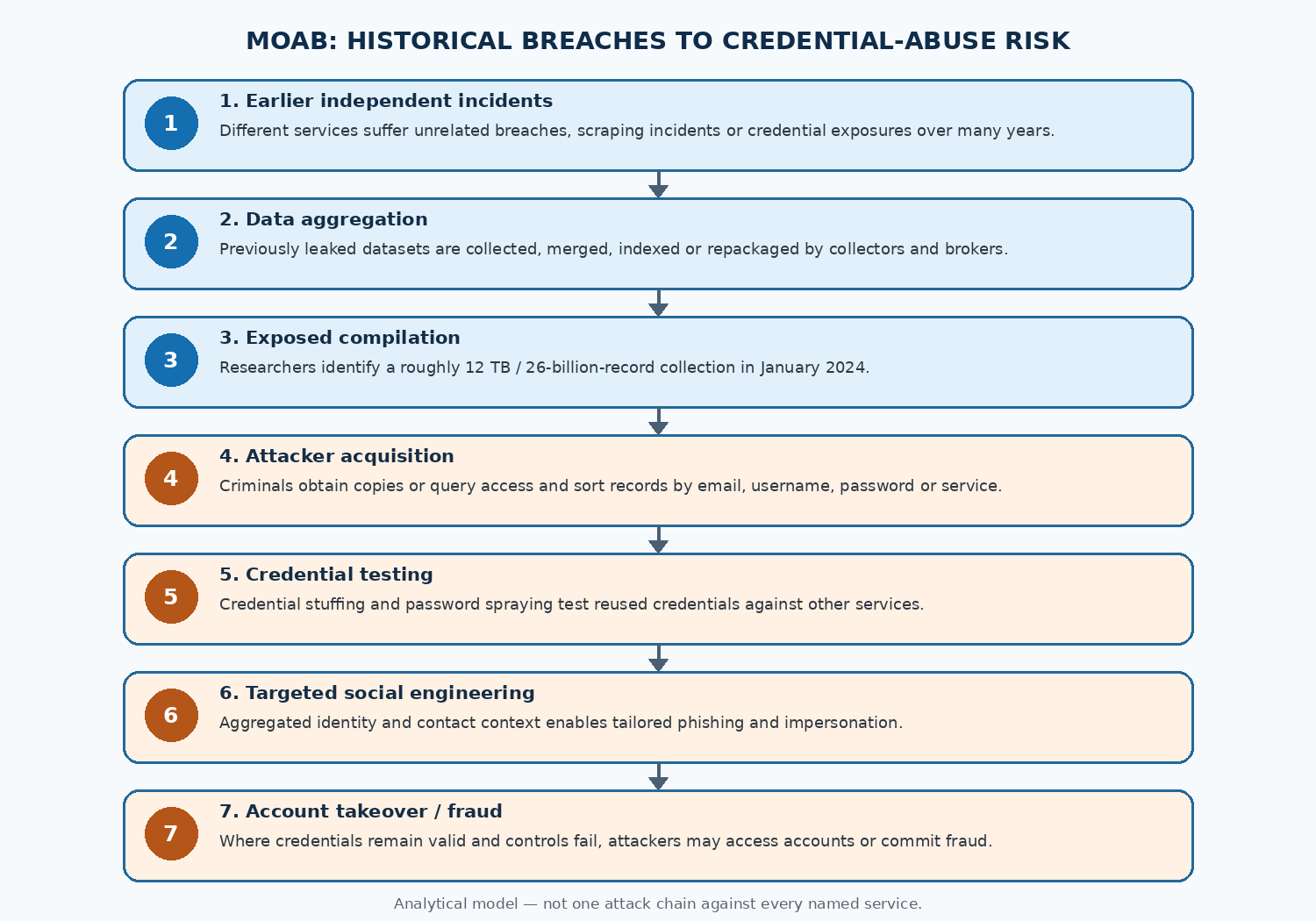
6. How attackers can operationalise the data
- Credential stuffing: automated testing of username/password pairs from one service against other services, exploiting password reuse.
- Password spraying: testing a small set of common passwords against many accounts, using exposed email/username lists to identify targets.
- Targeted phishing: combining names, email addresses, phone numbers, employer details or service history to create convincing messages.
- Account recovery abuse: using personal details to support fraudulent recovery requests where controls are weak.
- Identity and financial fraud: combining contact and identity data with other sources to impersonate victims or support fraudulent transactions.
- Corporate intrusion: exposed employee credentials may be tested against VPN, email, SaaS, remote access and administrative portals.
- Profiling: linking multiple records can build a more complete picture of a person's online identity and relationships.
7. Detection and hunting
- Monitor authentication telemetry for high-volume failures, distributed password spraying, credential stuffing patterns and unusual successful logins after repeated failures.
- Correlate logins by source IP, ASN, device fingerprint, user-agent, geography, account and time window.
- Alert on impossible travel, unfamiliar devices, new MFA registrations, suspicious password resets, OAuth grants and unusual session/token creation.
- Review VPN, identity provider, email, SaaS and privileged-access logs for use of legacy credentials.
- Use reputable enterprise breached-password screening; do not upload raw employee password lists to untrusted breach-checking websites.
- Prioritise privileged, service, administrator and third-party accounts.
8. Protection for individuals
- Use a unique, randomly generated password for every account; a reputable password manager makes this practical.
- Change reused passwords or passwords known to have appeared in a breach. Prioritise primary email, financial services, cloud storage and work accounts.
- Enable phishing-resistant MFA / passkeys where available; otherwise use authenticator-based MFA when practical.
- Review account activity, active sessions, recovery email/phone settings and registered devices; revoke unfamiliar sessions.
- Be cautious of messages claiming your account appeared in MOAB or offering urgent breach checks. Attackers may exploit breach anxiety with fake checkers and password-reset lures.
- Never share OTPs, recovery codes or password-manager master passwords with callers or websites reached through unsolicited links.
9. Protection for organisations
- Enforce MFA for email, VPN, cloud consoles, remote access and privileged accounts; prefer phishing-resistant methods for administrators.
- Screen new/reset passwords against known compromised-password lists.
- Apply rate limiting, bot detection, breached-credential detection and risk-based step-up authentication.
- Remove legacy authentication where feasible and monitor exceptions.
- Use least privilege, separate administrator accounts and privileged access management.
- Monitor identity and SaaS logs centrally; maintain detection playbooks for credential stuffing, spraying and account takeover.
- Train employees not to trust unsolicited breach notices or links to credential-checking pages.
10. Evidence limits and confidence
High confidence: January 2024 public reporting described a roughly 12 TB compilation with more than 26 billion records and multiple service labels. It was an aggregation of datasets from many earlier incidents rather than one newly executed compromise of all named services.
Uncertain: unique-person count, exact number of new records, original compiler identity, provenance of every dataset, and whether every listed record was accurate or current. The source does not support a single threat-actor attribution or a unified technical root cause.
11. Conclusion
MOAB matters not because it proves that 26 billion people were newly hacked in one event, but because it shows how historical identity and credential data can be consolidated and weaponised. The practical risk is downstream reuse: password spraying, credential stuffing, targeted phishing and account takeover.
Unique passwords, MFA/passkeys, monitoring and careful verification of breach-related messages remain the most effective protections.
References
- CyberNews, “Mother of all breaches reveals 26 billion records: what we know so far”: CyberNews report.
- IT Brew, “Meet the lead researcher who discovered the mother of all breaches,” 13 Mar 2024: IT Brew interview.
- SecurityInfoWatch, “How to interpret the hype surrounding the Mother of All Breaches,” 5 Feb 2024: SecurityInfoWatch analysis.
- McAfee, “26 Billion Records Released in ‘The mother of all breaches’,” 24 Jan 2024: McAfee Labs.
- Troy Hunt, “The 773 Million Record Collection #1 Data Reach”: Collection #1 analysis.