
🚨 SBI Data Exposure: What Customers Must Do to Keep Their Bank Accounts Safe
SBI reported a data-loss incident after a preliminary review of approximately 375,000 records identified 3,897 customer records containing PII. Source, completeness and extent remained under investigation.
1. Executive Summary
State Bank of India (SBI) reported an incident involving loss of certain data after alerts on 16 October 2026. In its 21 October stock-exchange disclosure, the bank said preliminary analysis of approximately 375,000 records found on the dark web identified 3,897 customer records containing personally identifiable information (PII). The bank said a detailed investigation was needed to establish authenticity, completeness, source and extent.
The reported exposure is serious for privacy and fraud risk, but it should not be described as proof that customer accounts or core banking systems were taken over. SBI said the incident had no material impact on core operations, financial performance or business continuity.
2. What is Known—and What Is Not
- Reported: alerts were received from SBI's threat-intelligence provider, the Defence Cyber Agency and CERT-In on 16 October 2026.
- Reported: a preliminary review of roughly 375,000 records identified 3,897 records containing customer PII.
- Reported data fields included names, registered mobile numbers, dates of birth, gender, email and residential addresses, branch/CIF identifiers, lead IDs and metadata linked to loan or lead records.
- Not established in the public reporting cited here: the initial access method, the system or supplier from which the data originated, the actor's identity, the exact exfiltration date, or whether every field in the dark-web dataset was authentic and complete.
- Some public reporting may speculate about a named group or seller. Do not attribute this incident to a threat actor unless SBI or reliable evidence confirms the attribution.
3. Illustrative Risk Flow — Not a Confirmed Reconstruction
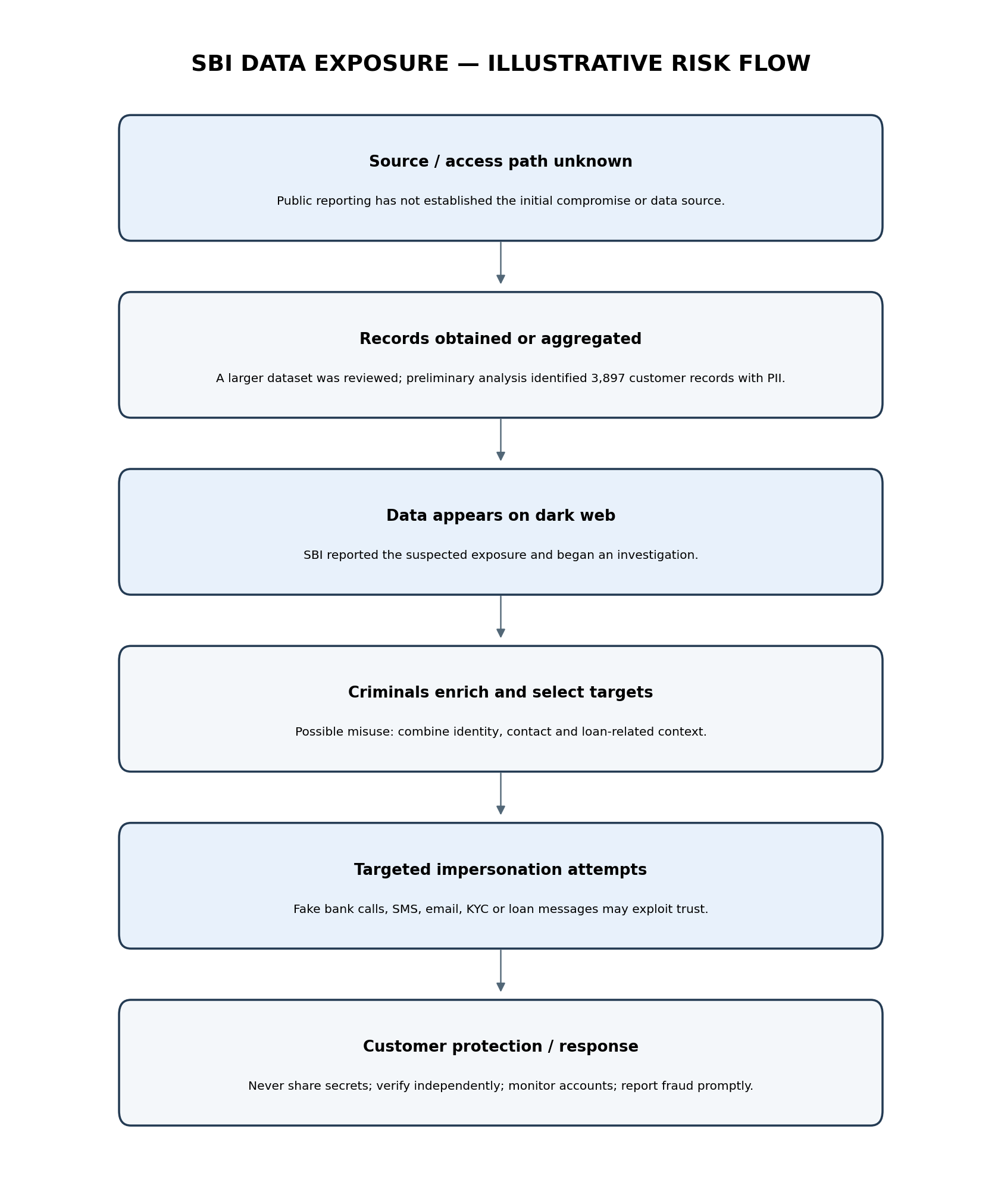
Possible stages are: data becomes accessible through an as-yet-undetermined source; an unauthorized party obtains or aggregates records; records are posted or offered on a dark-web forum; criminals enrich the data and identify targets; victims receive tailored calls, messages or fake links; fraud succeeds only if additional controls are bypassed or a victim is manipulated. The public record cited here does not establish the first stages technical details.
4. How Exposed Data May Be Abused
Personal data can be combined with publicly available information and used to make scams appear credible. A caller may know a person’s name, phone number, branch or loan-related context and use that familiarity to pressure the victim into sharing an OTP, PIN, password, card details or installing a remote-access app.
- Targeted phishing and smishing: messages imitate bank alerts, KYC updates, loan servicing or account-security notices.
- Vishing and impersonation: callers claim to be bank staff, investigators or loan officers and create urgency.
- Loan or identity fraud: exposed identity and lead metadata may help criminals impersonate a customer or make fraudulent applications.
- Credential theft and account takeover: attackers attempt to obtain authentication secrets through fake portals or social engineering. PII alone does not prove they can log in.
- Follow-on fraud: stolen details may be resold, enriched with other leaks or used to target relatives and business contacts.
5. Timeline
- 16 October 2026 — SBI reportedly received alerts from its threat-intelligence provider, the Defence Cyber Agency and CERT-In.
- 21 October 2026 — SBI disclosed the data-loss incident to stock exchanges; preliminary analysis identified 3,897 customer records with PII among approximately 375,000 records.
- As of the cited reports — an independent CERT-In-empanelled cybersecurity agency was engaged; authenticity, source and extent remained under investigation.
6. What Customers Should Do Now
- Never share OTPs, UPI PINs, ATM PINs, passwords, CVV or full card credentials with anyone—even a caller who knows your personal details.
- Do not click unexpected KYC, loan, refund or account-blocking links. Open the official bank app or type the bank’s official website address yourself.
- End suspicious calls and independently contact SBI through a number printed on your card, passbook or official website. Do not call back a number supplied by the caller.
- Do not install APKs, screen-sharing tools or remote-access apps at a caller’s request.
- Review transactions and alerts. If money is lost, immediately contact your bank and report the cyber financial fraud through India’s official helpline 1930 and cybercrime.gov.in.
- If credentials or card details were disclosed, contact the bank promptly to block/reset affected access, change reused passwords and preserve messages, phone numbers and transaction references.
7. Technical Recommendations for Banks and Organizations
- Trace data lineage across production systems, backups, exports, analytics, vendors and third-party processors; preserve evidence and validate the exposed dataset without unnecessarily redistributing PII.
- Audit privileged access, bulk export paths, service accounts, database queries, cloud storage permissions, API authorization and vendor connectivity.
- Apply least privilege, strong MFA for administrative access, encryption at rest/in transit, key rotation, data minimization and time-limited access.
- Alert on unusual bulk reads, repeated queries, mass exports, anomalous service-account activity and data movement outside approved destinations.
- Use data loss prevention and egress controls where appropriate; retain tamper-resistant logs and test incident-response playbooks.
- Communicate verified facts and practical customer guidance. Do not imply that all records in a larger dataset are confirmed customer records.
8. Historical Context and Lessons
Banking data exposures have repeatedly shown that leaked identity data can be valuable even when it does not directly contain passwords. Criminals can use it to make social-engineering attempts more convincing, while breached data can persist and circulate long after an initial incident. The lesson is to treat identity information as an enabler for follow-on fraud and to verify the provenance of leaked datasets before making technical or actor-attribution claims.
9. Evidence Note
This article separates reported facts from analytical scenarios. The SBI incident's source, completeness and authenticity remained under investigation in the cited reporting. The AI-agent flow is a risk model based on CERT-In's advisory, not a claim that every stage occurred in every incident.