
1. Executive Summary
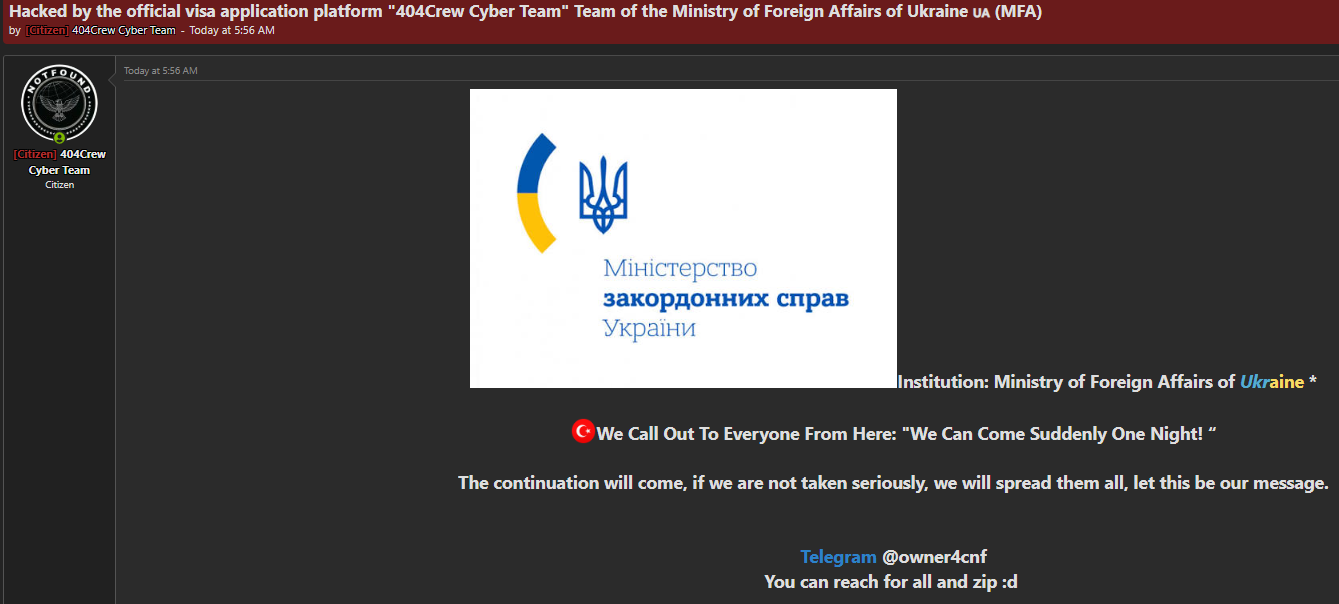
A dark-web forum post supplied with the research input claims that an official visa application platform associated with Ukraine’s Ministry of Foreign Affairs (MFA) was compromised by a group identifying itself as 404Crew Cyber Team. The actor claims access to application data and threatens wider publication.
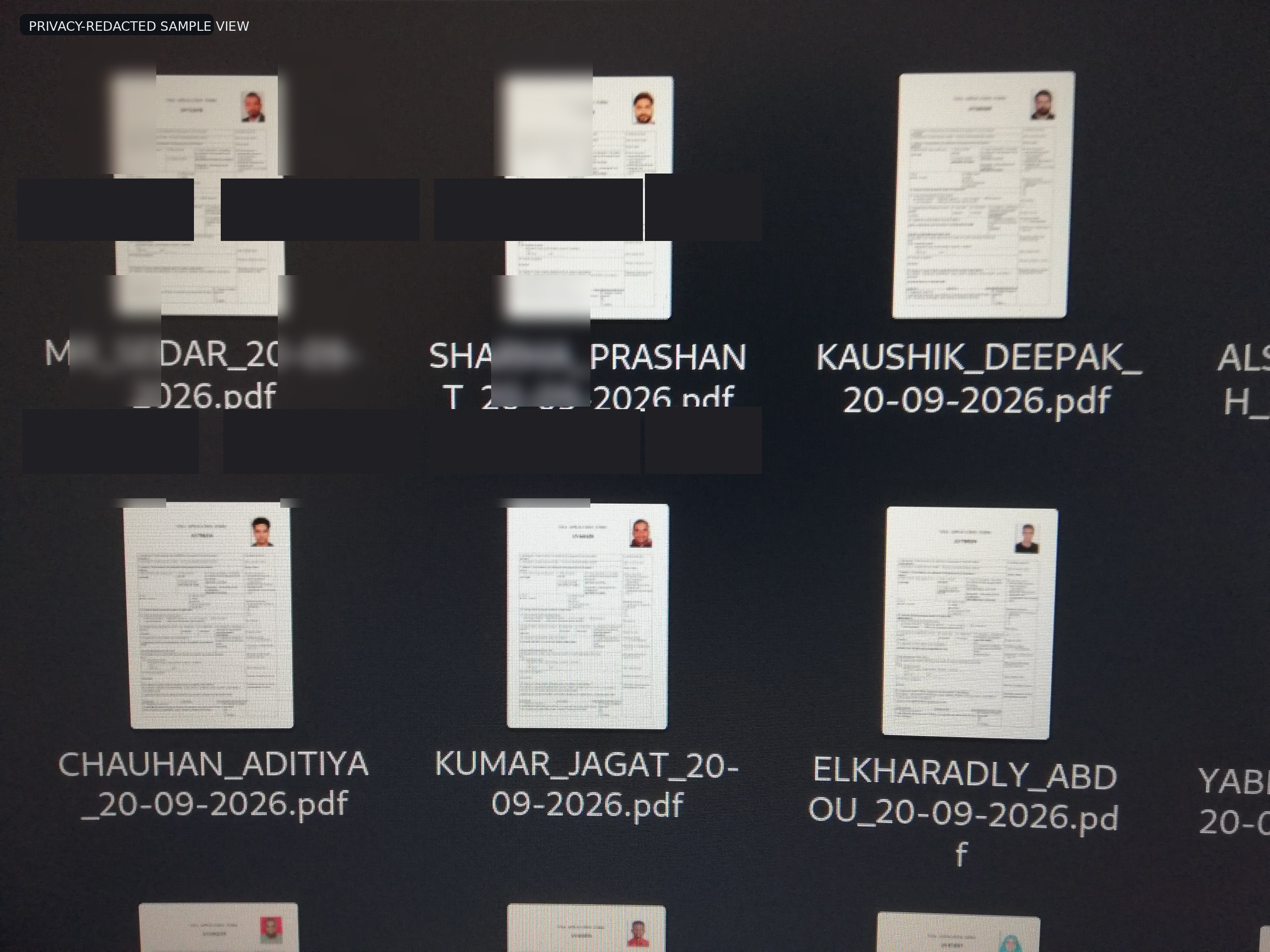
The supplied evidence consists of the forum URL, an attacker screenshot using Ukrainian MFA branding, and a second screenshot showing multiple document files presented as alleged samples. The evidence supports the existence of the claim and the displayed material; it does not independently prove the breach, the source of the documents, the intrusion path, or the full scope.
Assessment: treat this as a credible threat-intelligence lead requiring validation, not as a fully confirmed breach.
2. Source Material and Observed Evidence
The supplied document identifies the target as a Ukraine MFA visa application platform and provides the original forum URL plus two screenshots. The supplied document is the primary evidence basis for the incident narrative.
Threat actor named in supplied material: 404Crew Cyber Team. Claimed victim: Ministry of Foreign Affairs of Ukraine / visa application platform.
The supplied screenshot shows Ukrainian MFA branding, an attacker statement and a Telegram contact reference. The Telegram identifier is not reproduced here as a contact channel.
3. Evidence Figure 2 — Sample Documents
The second supplied screenshot shows multiple PDF files presented as alleged samples. The filenames appear to contain individual names and a common date pattern. This may be consistent with application or visa-related records, but the screenshot alone cannot establish that the files originated from the claimed MFA system.
Because the image contains apparent personal information, the sample-document screenshot is not reproduced in the public article. The defensive task is to validate provenance internally rather than publish applicant data.
Useful validation checks include matching filenames, timestamps, templates, document metadata and corresponding records against authoritative internal systems.
4. Threat Actor and Campaign Context
Public threat-intelligence indexing adds context around the actor name. VECERT currently shows 18 tracked posts for 404Crew Cyber Team, with first presence on 15 May 2026 and the latest listed post on 3 October 2026. Its graph includes multiple government or institutional targets, including a visa application platform, but this context does not independently validate the Ukraine claim.
A separate public Telegram-channel directory also uses the 404CREW CYBER TEAM name. Because threat actors can impersonate or reuse names, such channel evidence should be treated as attribution context rather than proof of identity.
5. What the Evidence Supports — and What It Does Not
| Finding | Assessment | Confidence |
|---|---|---|
| Dark-web post exists | Supported by supplied screenshot/source URL | High |
| Actor claims compromise of Ukraine MFA visa platform | Supported by supplied post | High |
| Sample files are displayed | Directly visible in supplied screenshot | High |
| Samples genuinely originate from victim | Not independently established | Low–Medium |
| Exact initial access vector | Unknown from available evidence | Low |
| Full database exfiltration | Claimed/implied, not independently verified | Low |
| Persistent web-shell access | Not demonstrated by supplied evidence | Low |
| Complete victim scope | Unknown | Low |
6. Technical Analysis — Likely Attack Surface
The supplied evidence does not reveal the actual vulnerability. A visa application platform can expose several high-value attack surfaces; these are analytical possibilities, not confirmed attack paths in this case.
- Public-facing application compromise — exploitation of an application weakness could provide access to application functions or data.
- Authentication compromise — stolen credentials, session abuse, or authentication weaknesses could expose privileged interfaces.
- File/document handling — insecure upload or processing logic can create a route to unauthorized file access or server-side execution.
- API abuse — poorly protected application APIs may allow enumeration or bulk retrieval of applicant records.
- Administrative compromise — privileged access could enable data extraction, website modification or persistence.
7. Potential Attack Chain
A defensible hypothetical chain, pending forensic confirmation, is:
This is an investigation model, not a claim that each stage was observed in the supplied evidence.
8. Why the Sample Documents Matter
The sample-file screenshot is strategically important because it is intended to convert a textual claim into apparent proof. From a defender’s perspective, the key question is whether provenance can be demonstrated.
- Compare sample records against authoritative application records using non-public identifiers.
- Check filenames, timestamps and document templates against the real application workflow.
- Review document-generation metadata and server-side file naming conventions.
- Search application and database logs for access to the corresponding records.
- Determine whether the same records were previously exposed elsewhere.
- Do not publish complete samples because visa documents may contain identity and travel information.
9. Potential Impact if the Claim Is Confirmed
If the claim is confirmed, potential consequences could include:
- Exposure of applicant identity and travel-document information.
- Targeted phishing or social-engineering campaigns against applicants.
- Identity fraud or document impersonation.
- Privacy and regulatory consequences for the affected organisation.
- Reputational damage to a government visa service.
- Secondary targeting of officials, applicants or partner organisations.
- Potential diplomatic or national-security implications depending on the actual data scope.
10. Defensive and DFIR Priorities
- Preserve web, WAF, reverse-proxy, application, authentication and database logs before retention windows expire.
- Identify every internet-facing application and administrative endpoint associated with the visa platform.
- Review authentication anomalies, privileged logins, session creation and account changes.
- Search for unexpected file creation, web shells, modified application code and new scheduled tasks.
- Review database access for unusual bulk reads, exports and enumeration patterns.
- Correlate outbound network traffic with large archive creation or unusual data transfers.
- Validate sample documents against internal records without exposing their contents publicly.
- Rotate credentials and tokens for affected administrative/service accounts if compromise is confirmed.
- Hunt for persistence before rebuilding or restoring the affected application.
- Monitor for reuse of exposed applicant information in phishing and identity-fraud campaigns.
11. MITRE ATT&CK Perspective — Potential Techniques Only
These techniques are investigation hypotheses and should not be treated as confirmed TTPs without forensic evidence.
| ID | Technique | Use in this assessment |
|---|---|---|
| T1190 | Exploit Public-Facing Application | Potential initial access |
| T1078 | Valid Accounts | Potential if compromised credentials were used |
| T1505.003 | Web Shell | Relevant only if server-side shell access is confirmed |
| T1005 | Data from Local System | Potential collection from application/database systems |
| T1119 | Automated Collection | Potential bulk collection of records |
| T1567 | Exfiltration Over Web Service | Potential if external web services were used for transfer |
12. Official MFA Platform Context
Ukraine’s Ministry of Foreign Affairs publicly documents online visa application registration through visa.mfa.gov.ua and e-Visa processing through its MFA web platform. This establishes that the MFA operates online visa-related application infrastructure; it does not establish that the specific platform referenced in the dark-web claim was compromised.
The official MFA visa information page also describes online application registration and supporting-document requirements, which explains why a genuine compromise of a visa application system could expose sensitive applicant information. This is contextual risk analysis, not evidence of this incident’s impact.
13. CyberRakshakLabs Assessment
The dark-web post is an intelligence lead supported by screenshots and alleged samples. The correct next step is validation of provenance, access logs, application integrity and data-exfiltration evidence — not immediate acceptance of the actor’s full claim.
The incident also illustrates a broader underground operating model: forums can be used for public claims, messaging channels for communication, sample files for credibility, and threatened publication as leverage. The monetisation and distribution layer can therefore matter as much as the alleged technical compromise.
14. Conclusion
The supplied evidence indicates a recent dark-web claim by 404Crew Cyber Team involving an alleged compromise of a Ukrainian MFA visa application platform. The actor presented a website screenshot and a sample-document image to support the claim. Public threat-intelligence indexing also shows that the 404CREW name has appeared in multiple 2026 government and institutional targeting claims.
However, the exact intrusion mechanism, authenticity of all samples, volume of data obtained, persistence and actual exfiltration remain unverified. For defenders, the most valuable response is to treat the claim as a high-priority investigation lead and validate it through server, application, identity, database and network evidence.
Recommended CyberRakshakLabs Headline
Ukraine MFA Visa Platform Allegedly Compromised: 404Crew Claims Access and Threatens Data Publication
Subtitle: A dark-web post attributed to 404Crew Cyber Team claims compromise of a Ukraine MFA visa application platform and presents alleged document samples. The evidence warrants validation, not assumption.