
Executive Summary
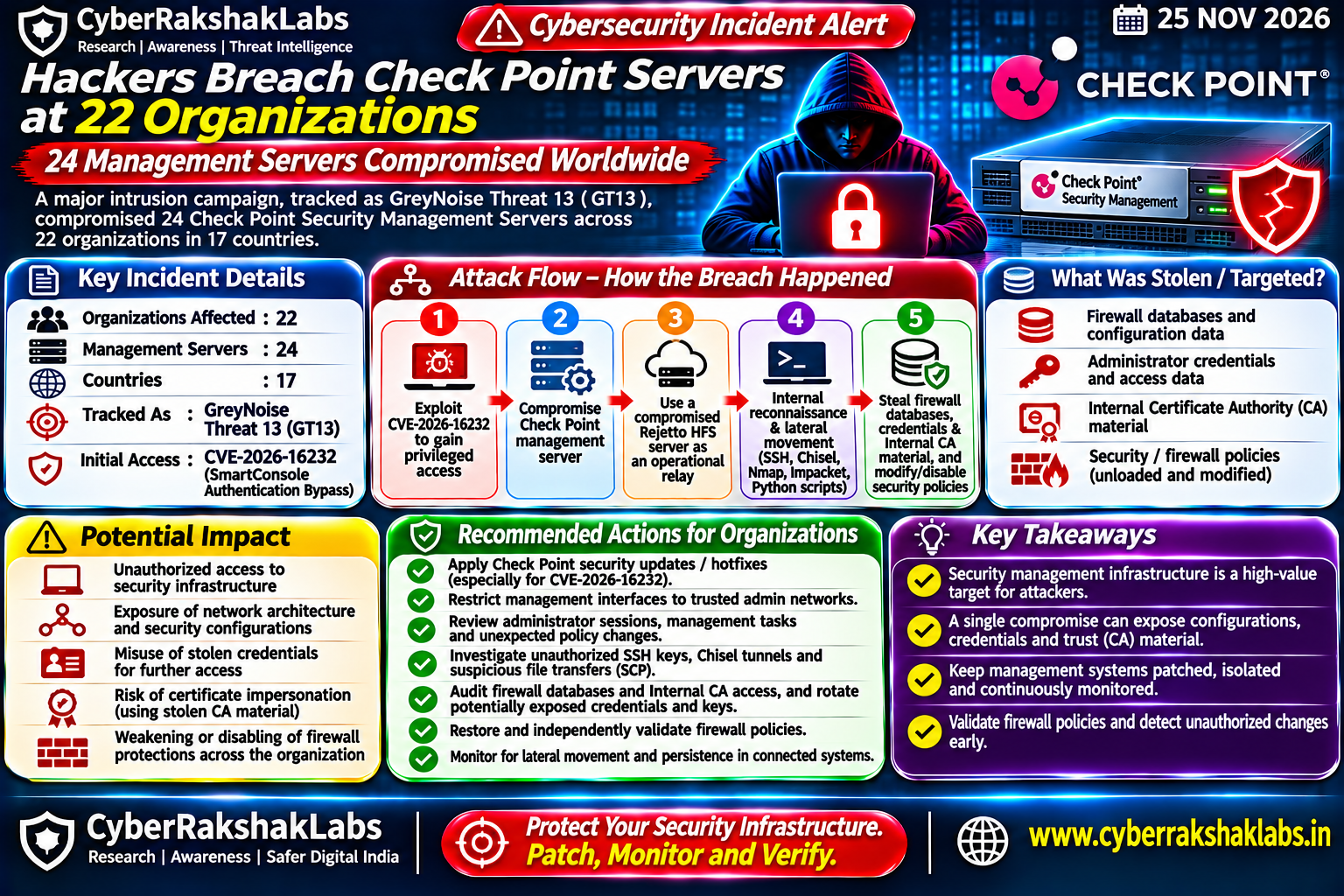
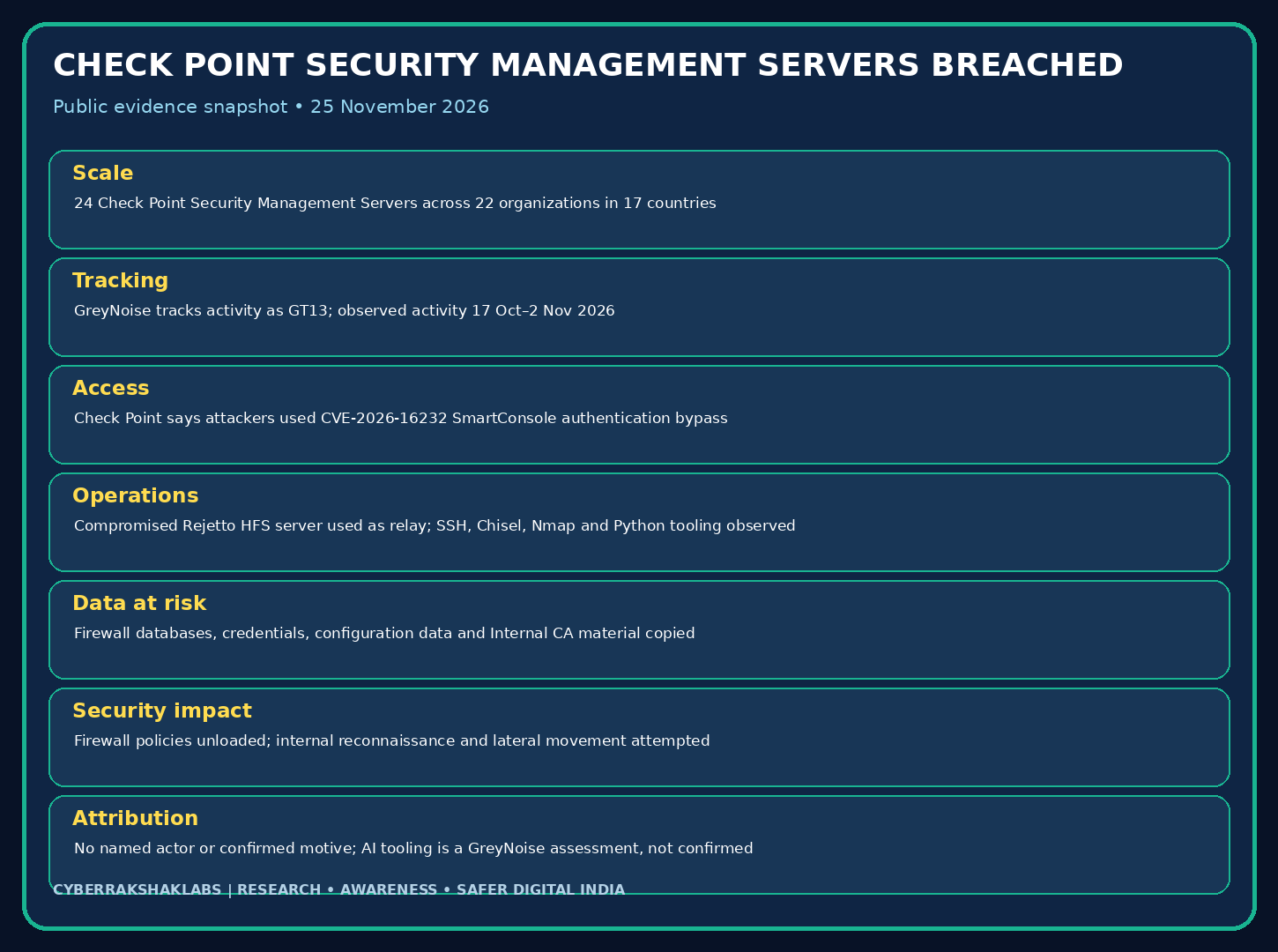
GreyNoise reported an intrusion campaign tracked as GreyNoise Threat 13 (GT13) that compromised 24 Check Point Security Management Servers across 22 organisations in 17 countries. GreyNoise's confirmed observation window ran from 17 October through 2 November 2026, when its visibility ended. Researchers believe access may persist and activity may continue.
The attackers copied firewall databases, credentials, configuration data and Internal Certificate Authority (CA) material; generated a certificate in one victim environment; unloaded security policies, effectively disabling firewall protections; and conducted reconnaissance and attempted lateral movement. A compromised Rejetto HTTP File Server (HFS) was used as an operational relay.
On 25 November, Check Point told BleepingComputer that attackers used CVE-2026-16232, a SmartConsole authentication-bypass vulnerability disclosed in July 2026, and adapted a publicly available Metasploit module. Attribution and motive remain unknown. GreyNoise assessed likely use of LLM/agentic systems, but AI use is not confirmed.
1. Scope, Victimology and Campaign Scale
GreyNoise identified assets belonging to 22 organisations across 17 countries: the UK, Ireland, France, Netherlands, Greece, Germany, Austria, Bulgaria, Poland, India, Thailand, Vietnam, South Korea, Hong Kong, China, Australia and the United States. Reported sectors included financial services, energy, government, transportation, mining, engineering and manufacturing.
GreyNoise observed 99 source IP addresses, described as ExpressVPN egress addresses or compromised victim Check Point devices. Its telemetry included more than 1,400 network sessions, 800 command-line artifacts and 1,200 files downloaded, uploaded or created.
The 99 source IPs should not be treated as 99 distinct threat actors or permanent malicious hosts. VPN egress addresses are shared and time-sensitive; correlate them with timestamps and the complete GreyNoise IOC context.
2. Initial Access and CVE-2026-16232
GreyNoise's original report states that the actor already had access to victim Check Point Security Management Servers before compromising the Rejetto HFS relay. GreyNoise could not determine the exact time or method of initial access from its telemetry.
On 25 November, Check Point told BleepingComputer that the attackers used CVE-2026-16232, a SmartConsole authentication-bypass vulnerability publicly disclosed in July 2026 and previously observed in the wild. Check Point said the attackers adapted a publicly available Metasploit module. Public reporting does not reconstruct the first successful access event for every server.
During post-compromise activity, GreyNoise observed CVE-2026-16232 being used to obtain an application login token and authenticate with administrator privileges, enabling Run Script and other management-task activity. Other vulnerabilities were used or attempted against systems in the first victim's wider environment.
3. Rejetto HFS Relay: Exploitation and Operational Setup
On 2 October, GT13 scanned a Rejetto HTTP File Server and exploited CVE-2026-61500. GreyNoise describes repeated login requests that exposed predictable session-cookie material. The actor reconstructed the V8 pseudo-random generator state and forged an administrator session cookie.
On 5 October, HFS command hooks appended an SSH key to /root/.ssh/authorized_keys. On 19–20 October, the server was prepared as an operational relay: an unauthenticated HTTP receiver and an exfiltration directory were created, and Nmap and Chisel were installed.
Using SSH, Chisel tunnels, Python scripts, Nmap, Impacket and Paramiko, the actor scanned internal networks, attempted privilege escalation and lateral movement, and interacted with compromised Check Point devices. The source diagram on page 3 illustrates the operational relay and movement between infrastructure and victim management servers.
4. Attack Flow and Post-Compromise Operations
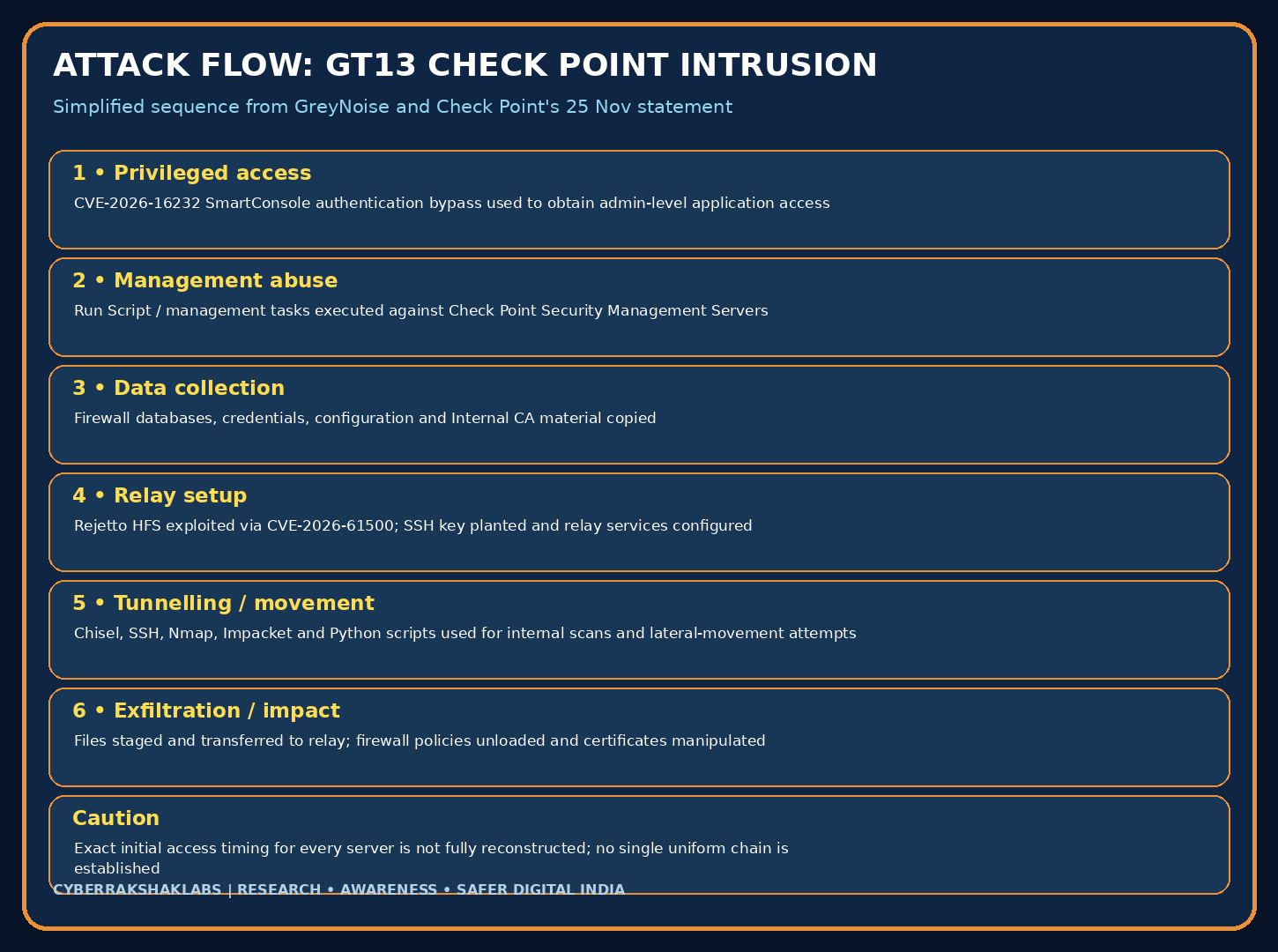
- Privileged access: CVE-2026-16232 SmartConsole authentication bypass was used to obtain administrator-level application access.
- Management abuse: Run Script and management tasks were executed against Check Point Security Management Servers.
- Data collection: Firewall databases, credentials, configuration information and Internal CA material were copied.
- Relay setup: Rejetto HFS was exploited through CVE-2026-61500; SSH keys, relay services and tooling were configured.
- Tunnelling and movement: Chisel, SSH, Nmap, Impacket and Python tooling supported internal scans and lateral-movement attempts.
- Exfiltration and impact: Data was staged and transferred to the relay; firewall policies were unloaded and certificates were generated.
The diagram on page 3 of the supplied technical research presents this as a simplified sequence. The exact initial access timing for every server is not fully reconstructed, so the stages should not be interpreted as a single fully proven timeline for every victim.
5. Data Theft and Security Impact
GreyNoise observed more than 100 management tasks in one victim environment. Actions included copying firewall databases and Internal CA material, minting a new certificate named pivot.p12, and unloading security policies.
Data was staged through compromised Check Point devices and transferred via SCP to the relay. Reported stolen material included:
- Firewall databases and configuration data.
- Administrator credentials and other credentials.
- Internal Certificate Authority files and related material.
The actor also probed Citrix NetScaler, Ivanti Connect Secure, VMware vCenter, Microsoft Exchange, Oracle TNS and domain controllers.
Stolen Internal CA material and generated certificates could support impersonation and access to protected network segments. Policy unloading could weaken or disable firewall enforcement, while stolen configurations and credentials could facilitate further manipulation and lateral movement. These are potential consequences of the observed access and theft, not proof that every possible downstream impact occurred.
6. Timeline (UTC)
| Date | Observed activity |
|---|---|
| 2 October | HFS scanning and exploitation via CVE-2026-61500; forged administrator-cookie activity observed. |
| 5 October | HFS command hooks used to append an SSH key to root's authorized_keys. |
| 17 October | GreyNoise's confirmed campaign activity against Check Point servers began within its observation window. |
| 19–20 October | HFS server configured as operational relay; HTTP receiver, exfiltration workflow, Nmap and Chisel installed. |
| 20–26 October | Management-task exploitation, reconnaissance and lateral movement; more than 100 tasks observed in one victim environment. |
| 26 October | Bulk certificate-management task issued to 24 compromised Check Point servers. It failed, but responses and victim IP information were collected. |
| 2 November | GT13 checked CVE-2026-98432 exposure and attempted nftables filtering on its relay; GreyNoise visibility ended. |
| 23 November | GreyNoise published its findings. |
| 24 November | BleepingComputer and SecurityWeek reported the campaign. |
| 25 November | Check Point confirmed use of CVE-2026-16232 and an adapted Metasploit module. |
7. Threat Actor Attribution and AI Assessment
GreyNoise tracks the activity as GT13 and explicitly says it does not attribute it to a known threat group. It lacks enough information to assess motive or nation-state alignment. BleepingComputer described activity resembling cyberespionage; this is not confirmed espionage attribution.
GreyNoise believes LLMs and agentic systems were likely used for vulnerability scanning, exploit development and automated interaction alongside hands-on-keyboard activity. BleepingComputer notes that AI use remains unconfirmed.
8. Indicators of Compromise and Detection
GreyNoise indicators cited in the research
- Domains:
newpayapp[.]com,data-zt.newpayapp[.]com,api-zt.newpayapp[.]comand2ev5.newpayapp[.]com. - User-Agent strings:
Mozilla/5.0 (X11; Linux x86_64) researchandMozilla/5.0 research. - OpenSSH HASSH:
eeca2460550b9ded084ecf2f70a75356. GreyNoise warns this hash is common and useful only when combined with other context.
GreyNoise also lists numerous ExpressVPN-associated IP addresses and timestamps. VPN egress IPs are shared and time-sensitive; use the complete GreyNoise IOC table with context rather than treating every IP as a permanent malicious host.
Hunt for
- Unexpected Check Point management tasks, Run Script activity and unexplained administrator application tokens.
- Policy unload operations, unexpected policy changes and new certificate issuance.
- Firewall database exports, Internal CA file access and SCP transfers.
- Altered SSH
authorized_keys, especially unexpected root keys. - Chisel tunnels, suspicious HTTP listeners, Nmap, Impacket, Paramiko and Python reconnaissance tooling.
- Relay-like HTTP services and unexplained outbound connections from management infrastructure.
Correlate indicators with timestamps, device roles, authentication events and network telemetry. A single HASSH or shared VPN IP is not sufficient evidence of compromise.
9. Defensive Response and Recommended Actions
- Patch and verify: Verify current Check Point hotfix and patch status for CVE-2026-16232. Follow Check Point's current advisory and hardening guidance.
- Restrict management access: Limit SmartConsole and management interfaces to trusted administrator networks, VPN or jump hosts. Do not expose management planes directly to the internet.
- Review management activity: Examine administrator authentication, application tokens, audit logs, Run Script tasks, policy changes, certificate issuance and Internal CA access across the relevant period.
- Rotate secrets: Rotate exposed administrator credentials, SSH keys, API/service credentials and other secrets. Assess Internal CA trust; revoke or reissue certificates where compromise is indicated.
- Validate firewall enforcement: Review firewall databases, exported configurations, policy unload events and unauthorised changes. Restore known-good policies and independently validate enforcement.
- Hunt for relay activity: Search for Chisel tunnels, suspicious HTTP listeners, unauthorised root SSH keys, Nmap/Impacket/Paramiko tooling and SCP staging.
- Improve resilience: Segment management servers, enforce MFA where supported, apply least privilege, maintain immutable configuration backups and alert on management-plane changes.
- Respond carefully: If compromise is suspected, preserve forensic evidence, isolate affected management servers carefully and coordinate with Check Point and relevant CERTs.
10. Confirmed Findings vs. Uncertain Assessments
Confirmed or directly reported in the supplied sources
- GreyNoise identified 24 compromised Check Point Security Management Servers across 22 organisations.
- GT13 activity was observed during the 17 October–2 November window.
- A compromised Rejetto HFS relay was used.
- Firewall, configuration, credential and Internal CA material was stolen; security policies were unloaded.
- Reconnaissance and lateral-movement attempts were observed.
- Check Point's 25 November statement confirmed use of CVE-2026-16232 and an adaptation of a public Metasploit module.
Not established
- A named threat actor, nationality, definitive motive or nation-state alignment.
- Confirmed use of AI/LLM systems.
- The exact initial compromise timeline across all 24 servers.
- Total downstream victims or successful exploitation of every probed secondary vulnerability.
GreyNoise lost visibility on 2 November and believes access may persist. This means the end of its observation window is not proof that the intrusion campaign ended.
11. Conclusion
GT13 demonstrates the strategic risk posed by compromise of centralised security-management infrastructure. Access to Check Point management servers can expose firewall configurations, credentials and internal trust material, while policy unloading can undermine network protections. The reported use of a compromised HFS relay, tunnelling and common administration tools also shows how an intrusion can extend beyond the initial management plane.
Organisations should prioritise patch verification for CVE-2026-16232, restrict management interfaces, audit management tasks and certificate operations, rotate exposed secrets, and validate firewall policy enforcement. Treat the GreyNoise indicators as time-sensitive investigative leads and correlate them with endpoint, authentication and network telemetry.
12. Sources and Further Reading
- GreyNoise — Check Point Security Management Servers Intrusion Campaign (23 November 2026)
- BleepingComputer — Hackers Compromise Check Point Servers in 22 Organizations (24 November 2026; updated 25 November with Check Point statement)
- SecurityWeek — Check Point Security Management Servers Hacked in AI-Assisted Campaign (24 November 2026)
- User-provided CyberRakshakLabs_Check_Point_GT13_22_Organizations_Technical_Research_2026-11-25.docx, including the attack-infrastructure diagram on page 2 and attack-flow / evidence graphics on pages 3 and 5.
Analyst caveat: Observed activity, vendor statements, researcher assessments and potential consequences are distinguished. Attribution and motivation are not established unless explicitly stated.