
CVE-2026-0322 is a serious PAN-OS vulnerability, but the available reporting does not describe a no-authentication exploit. Defenders should patch the exact software branch, restrict management access, and investigate suspicious administrator activity.
1. Executive Summary — What Is Confirmed?
Palo Alto Networks published its CVE-2026-0322 advisory on 14 October 2026. The issue affects PAN-OS management-interface functionality and can allow an authenticated attacker with network access to execute arbitrary code with root privileges on a vulnerable firewall.
Vendor-confirmed facts
CVSS 4.0 score 8.6 (High), vendor urgency marked Highest, CWE-94 code injection, and very limited exploitation observed.
Primary response
Apply the branch-specific fixed release and limit management access to trusted internal addresses or a dedicated jump host.
The vendor lists PA-Series and VM-Series firewalls, along with Panorama virtual and M-Series appliances, as affected product families. Cloud NGFW and Prisma Access are listed as not affected. This article separates vendor-confirmed details from analytical investigation guidance.
2. CVE-2026-0322 in Plain Language
The management interface is a privileged administrative surface used to configure firewall appliances. The vendor describes a code-injection flaw that may be abused to run attacker-controlled code with root privileges.
- The attacker needs an authenticated account or equivalent authenticated access.
- The attacker needs network access to the PAN-OS management interface.
- The flaw's impact can be severe because execution occurs with root privileges on the firewall.
This is not described by the vendor as an unauthenticated remote-code-execution issue. However, stolen or abused administrator credentials and broadly reachable management interfaces can make an otherwise privileged management surface a high-value target.
3. Affected Products and Exposure Conditions
- Affected: PAN-OS on PA-Series firewalls.
- Affected: PAN-OS on VM-Series firewalls.
- Affected: Panorama virtual and M-Series appliances.
- Not affected according to the advisory: Cloud NGFW and Prisma Access.
The vendor states that no special configuration is required for a product to be affected. The practical exposure condition remains important: an attacker needs authentication and network reachability to the management interface. Internet-reachable management access increases risk; the sources do not establish that every deployment exposes this interface publicly.
Inventory systems by product, exact software branch, and current build. Do not infer exposure status from product family alone, and do not assume that a device is protected merely because its management interface is not intentionally advertised externally.
4. Affected Versions and Vendor Fixes
The vendor's branch-specific solution table lists the following fixed releases. Choose the applicable fix for the installed minor version and review the live advisory before making a production change.
| Software branch | Fixed releases listed by vendor |
|---|---|
| PAN-OS 12.2 | 12.2.4 or later |
| PAN-OS 12.1 | 12.1.4-h12, 12.1.7-h8, or 12.1.10-h2 or later, depending on installed minor version |
| PAN-OS 11.2 | 11.2.4-h22, 11.2.7-h21, 11.2.10-h15, 11.2.13-h3, or 11.2.16 or later, depending on installed minor version |
| PAN-OS 11.1 | 11.1.4-h37, 11.1.6-h39, 11.1.7-h11, 11.1.10-h35, 11.1.13-h15, or 11.1.16-h3 or later, depending on installed minor version |
| PAN-OS 10.2 | 10.2.7-h38, 10.2.10-h41, 10.2.13-h26, 10.2.16-h11, or 10.2.18-h12 or later, depending on installed minor version |
PAN-OS 11.2.16 release notes now list CVE-2026-0322 among the addressed CVEs. Fixed versions are branch-specific: confirm the precise upgrade path against the vendor's live table rather than selecting the highest-looking version from this summary.
Unsupported older releases should be upgraded to a supported fixed version. The vendor lists no known workaround. Threat Prevention signatures may offer limited coverage for known attack patterns where applicable, but they are not a replacement for the vendor fix.
Official references: CVE-2026-0322 advisory ↗ · PAN-OS 11.2.16 addressed issues ↗
5. Analytical Attack & Defence Flow
The image below is a high-level analytical flow based on the vendor-described prerequisite and impact. It is not an exploit reproduction and does not establish that every step occurred in a specific incident.
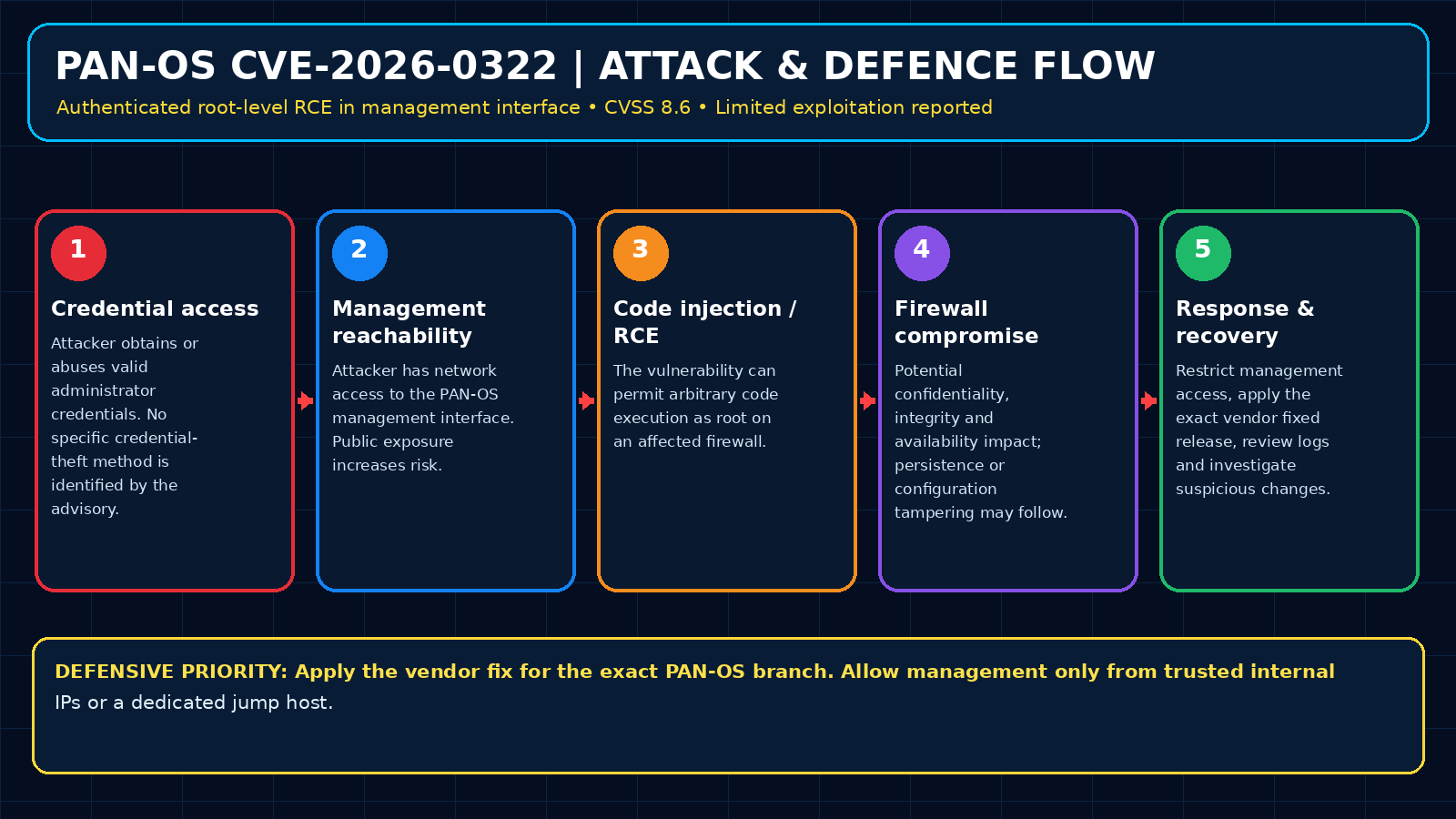
Credential access
An attacker obtains or abuses administrator access. The advisory does not identify a specific credential-theft method.
Reachability
Network access to the management interface is required; broad exposure increases risk.
Code injection
The vulnerability may permit arbitrary code execution as root on an affected firewall.
Potential impact
Confidentiality, integrity, or availability may be affected; specific downstream activity is not established for every case.
Defensive priority: restrict management-plane reachability, apply the exact fixed branch, preserve relevant logs, and investigate unusual authentication or configuration changes.
6. Exploitation Status, Timeline and Attribution
- 14 October 2026: Palo Alto Networks publishes the CVE-2026-0322 advisory.
- 14 October 2026: BleepingComputer reports the vendor's statement that very limited exploitation has been observed.
- 15 October 2026: This CyberRakshakLabs research summary is prepared from the supplied DOCX and public-source verification.
The vendor credits Suraj Siddharudh, an internal reporter, for discovering and reporting the issue. This is researcher credit—not attacker attribution. The sources reviewed do not name a threat actor or substantiate a specific campaign-specific initial-access technique.
Do not attribute exploitation to a ransomware group or claim widespread compromise without additional evidence. A vendor-reported exploitation signal should raise remediation priority while incident conclusions remain tied to telemetry from each environment.
7. Potential Impact if Exploitation Succeeds
| Security objective | Potential consequence | Evidence boundary |
|---|---|---|
| Confidentiality | Access to information available to the compromised firewall or management plane. | Actual data access depends on device role and subsequent activity. |
| Integrity | Unauthorized firewall configuration, account, or security-policy changes. | Look for unapproved changes in configuration history and audit records. |
| Availability | Firewall operation or network protection could be disrupted. | No specific outage is asserted for every exploitation case. |
| Follow-on activity | A compromised network security device could potentially be used to support additional activity. | The reviewed sources do not confirm a universal downstream chain. |
A root-level compromise of a network security appliance warrants serious treatment, but the potential impact should not be confused with proof that a given firewall was compromised or that lateral movement occurred.
8. Detection and SOC Hunting Priorities
Use the following as investigation pivots, not as proof that exploitation occurred:
Unfamiliar source addresses, unusual login times, repeated failures followed by success, or newly created administrators.
Unexpected clients or sources reaching the management interface, especially from untrusted networks.
Unapproved policy changes, altered authentication settings, unexplained commits, or changes to administrator roles.
Compare account inventory and active configuration with an approved, known-good baseline.
Review applicable vendor-provided signatures if the subscription and traffic inspection prerequisites are met.
Export relevant authentication, management, audit, and configuration records before retention windows expire.
Correlate anomalies by time, administrator, source address, and configuration change. Do not rely on a single failed login or an isolated management connection as conclusive evidence; investigate the surrounding sequence and confirm whether the activity was authorized.
9. Immediate Hardening and Incident Response Checklist
- Inventory PA-Series, VM-Series, and Panorama assets; record the exact PAN-OS branch and build.
- Patch using the branch-specific fixed release in the vendor advisory, and verify the running version after maintenance.
- Do not expose management interfaces broadly to the internet; allow access only from trusted internal IP addresses or a dedicated jump host.
- Use named administrator accounts, unique credentials, least privilege, and MFA where supported.
- Preserve relevant logs and configuration snapshots before making changes, where operationally safe.
- If compromise is suspected, restrict management access, engage the vendor or incident-response team, rotate credentials from a trusted device, and restore or rebuild according to vendor guidance.
- After patching, confirm management-plane restrictions and continue monitoring for suspicious account or configuration activity.
- Document the installed release, patch completion time, evidence reviewed, and the owner of any remaining action.
Where threat-prevention controls are available, confirm their required traffic-routing and SSL-decryption prerequisites. Treat them as an additional detection layer—not an alternative to patching.
10. MITRE ATT&CK Mapping — Conditional, Not Confirmed
The vulnerability itself is not a fully observed attacker technique. If an investigation establishes abuse of valid administrator credentials, T1078 — Valid Accounts may be relevant. Map exploitation or post-compromise behaviors only when logs, forensic artifacts, or other defensible evidence supports that mapping.
No named actor, campaign-specific TTP set, or post-compromise behavior is asserted in this article.
11. Evidence Matrix — Confirmed Facts vs. Unknowns
| Finding | Assessment | Confidence / boundary |
|---|---|---|
| Vendor advisory published 14 October 2026 | Confirmed by vendor advisory | High |
| CVSS 4.0 score is 8.6 (High); urgency Highest | Vendor-rated | High |
| Authenticated access plus network access is required | Vendor-described prerequisite | High |
| Very limited exploitation observed | Vendor-reported | High for the statement; scope is not quantified in the supplied sources |
| Named attacker or ransomware group | Not identified in sources reviewed | Unknown |
| Any particular customer firewall is compromised | Not established by this article | Requires customer-specific evidence |
| Specific data theft, lateral movement, or outage | Not confirmed for every exploitation case | Requires forensic validation |
12. Sources, Verification and Research Limitations
- Palo Alto Networks — CVE-2026-0322 security advisory: severity, affected products, exploitation status, and branch-specific fixes.
- Palo Alto Networks — PAN-OS 11.2.16 addressed issues: lists CVE-2026-0322 among addressed CVEs.
- BleepingComputer — Palo Alto Networks warns of PAN-OS RCE flaw exploited in attacks: contemporaneous reporting on the vendor statement and response recommendations.
This analysis uses the user-provided DOCX as the primary content source and cross-checks key vulnerability facts against public vendor material and contemporaneous reporting. Fixed-release guidance can change; verify the live advisory before scheduling upgrades. No customer environment was examined, and this article does not assert that a particular firewall was compromised.
13. CyberRakshakLabs Assessment — Patch Precisely, Restrict Aggressively
CRL Assessment: HIGH. The combination of root-level potential impact, vendor urgency marked Highest, and a limited exploitation report makes prompt remediation appropriate.
The defensible operational response is practical and specific: verify every affected PAN-OS branch, install the corresponding fixed release, restrict management reachability to trusted administrative paths, and look for anomalous authentication or configuration changes. Do not invent an attacker identity or assume a customer's device was breached without direct evidence.
Think Before You Click. Stay Aware. Stay Secure.
CyberRakshakLabs — Threat Intelligence for a Safer Tomorrow.