
CVE-2026-63277 shows how a crafted LibreOffice Calc document can turn an external data-link feature into a code-execution path through a remote Java database driver.
1. Executive Summary
CVE-2026-63277 is a High-severity LibreOffice Calc RCE. The vulnerable path abuses Calc’s external data-link mechanism: a crafted document can define a mapping using the SQL provider and JDBC connector and reference a Java database driver at a remote location. Opening the document can cause Java code from that location to run.
The security lesson is important for ordinary users: a spreadsheet is not always passive data. Application features that process external references can create an execution path before the user ever sees suspicious macros or an executable attachment.
The supplied research notes that the vendor fixed the issue in LibreOffice 26.2.5 and 26.8.0 and that public enrichment reported CVSS 8.5 High with no known exploitation at the time checked. That status should be treated as time-bound rather than a guarantee of future non-exploitation.
2. Technical Root Cause
LibreOffice Calc supports external data mappings. The vulnerable chain involves `calcext:data-mappings`, the SQL provider and JDBC connector. A document could name a Java database driver to be loaded from a remote location. The driver-loading path could therefore become a code-execution boundary.
Vendor fix: in fixed versions, an entry in a Java class path has to be a file URL, blocking the described remote-driver path. The official LibreOffice security advisory lists CVE-2026-63277 as “RCE via calcext:data-mappings, sql provider and jdbc connector” and states that it is fixed in 26.2.5 and 26.8.0.
3. Supplied Evidence
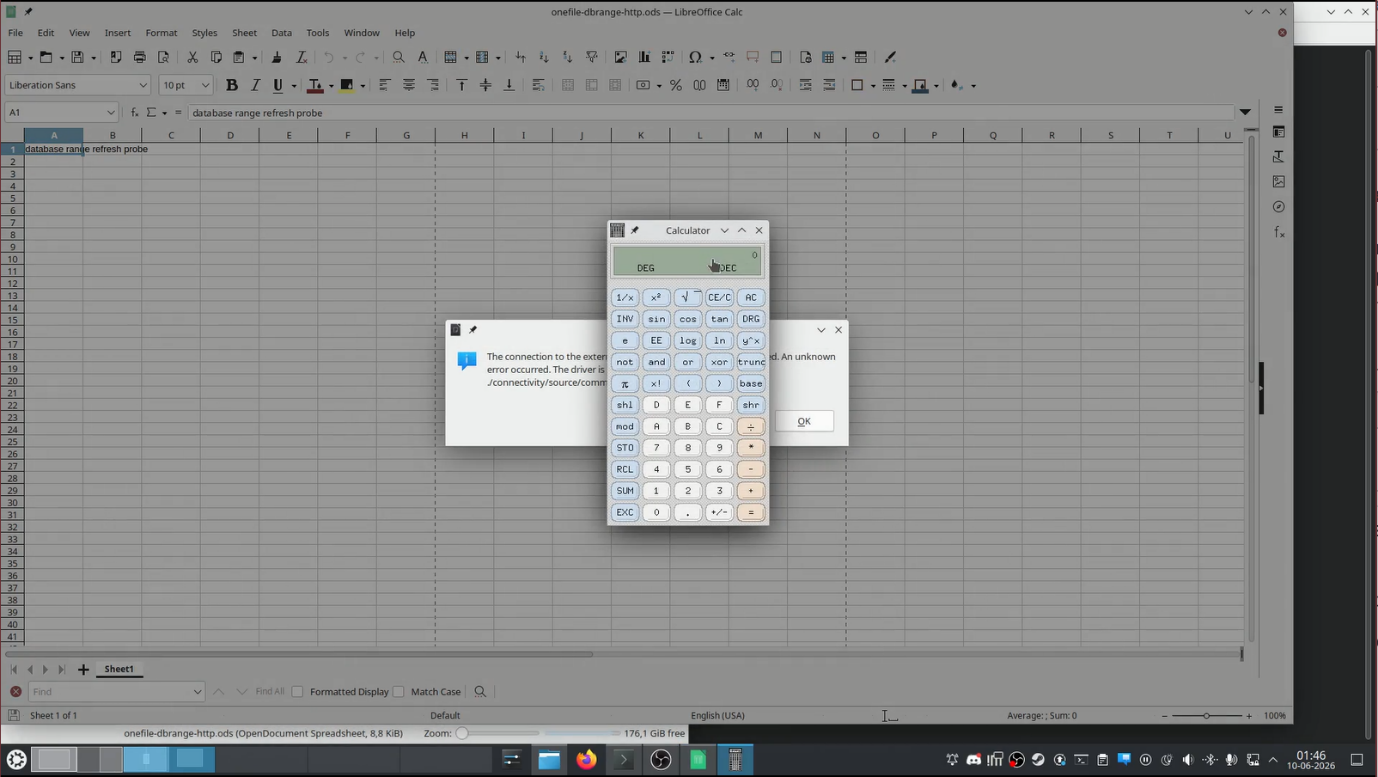
The screenshot is source-provided evidence from the research document. It shows LibreOffice Calc with an external-connection message visible over the spreadsheet. The image supports the presence of the described external-data interaction, but the screenshot alone is not a standalone proof of successful exploitation.
4. Defensive Attack Flow
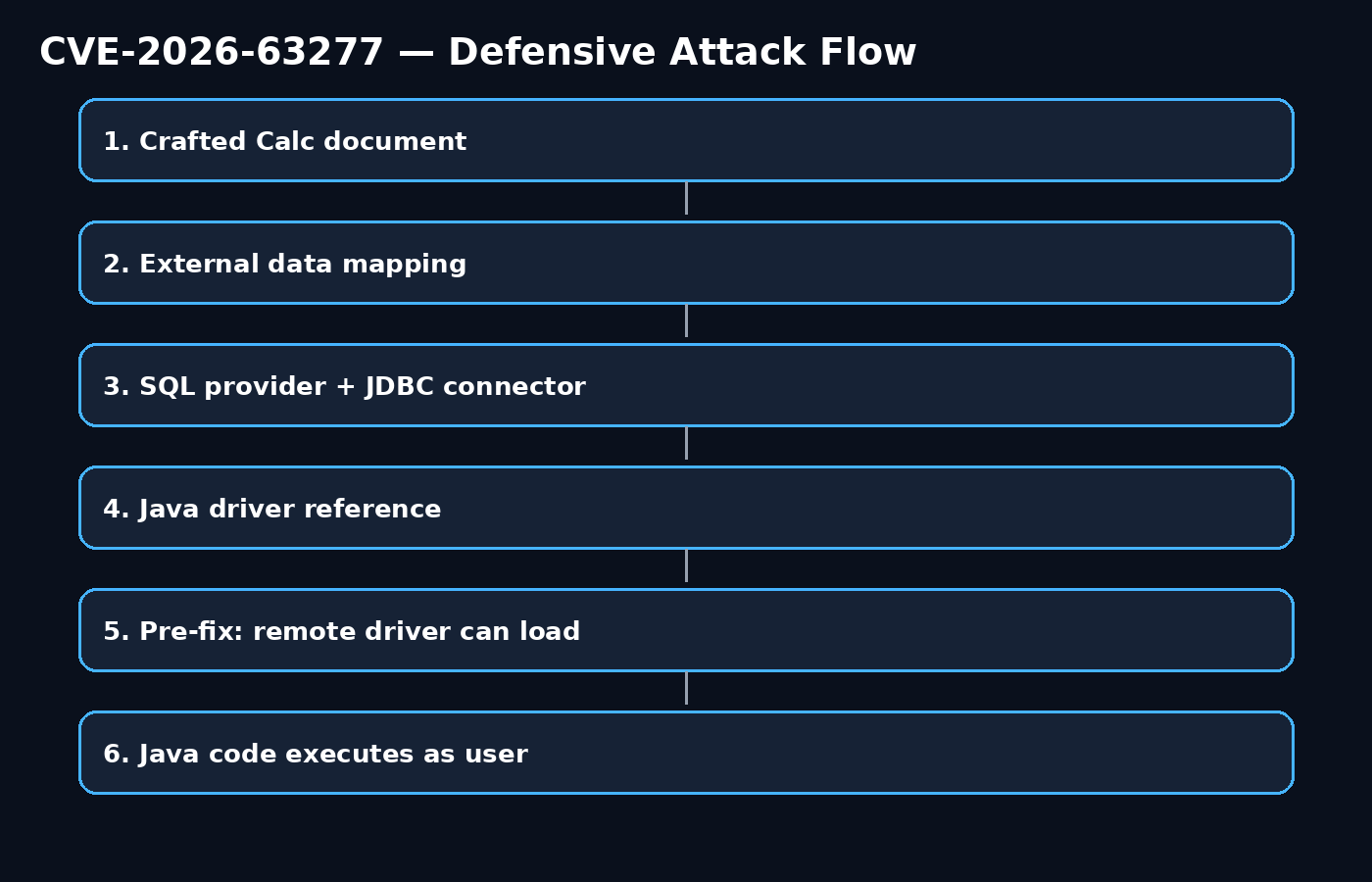
The flow is a defensive reconstruction of the dependency chain rather than a reproduction of a working exploit.
5. Simplified Technical Representation
Calc document
  → external data mapping
     → SQL provider
        → JDBC connector
           → Java driver reference
              → pre-fix remote driver loading
                 → Java code execution
This representation explains the dependency chain without reproducing a working exploit or payload.
6. Impact on Normal Users
7. Detection & Hunting
For a SOC, the key correlation is the sequence: document opened → LibreOffice activity → unexpected Java/child process behavior → outbound network activity. Any such chain should be investigated in context.
8. Remediation
LibreOffice’s official security advisory confirms that CVE-2026-63277 is fixed in 26.2.5 and 26.8.0. The release-notes page also shows the 26.2.6 branch, so organizations on the 26.2 line should use the current supported bugfix release appropriate to their environment.
9. MITRE ATT&CK Relevance
| Technique | Relevance |
|---|---|
| T1204.002 — User Execution: Malicious File | User opens the crafted document. |
| T1203 — Exploitation for Client Execution | Application behavior is exploited for code execution. |
| T1105 — Ingress Tool Transfer | Potential post-exploitation transfer; not inherent to the CVE. |
| T1059 — Command and Scripting Interpreter | Potential follow-on command execution; payload-dependent. |
The mapping is defensive context, not a statement that every technique is observed in a real-world incident involving this CVE.
10. CyberRakshakLabs Assessment
The strongest defense is not only patching. Users and organizations must change the assumption that a spreadsheet is passive. Patch LibreOffice, restrict untrusted documents, monitor application child processes and investigate unexpected network activity.
The most important technical lesson is the execution boundary created by document-driven external-resource handling. A malicious spreadsheet does not need a visible macro or a dropped executable to create risk when the application follows an unsafe external reference path.
11. Sources & Verification Notes
Supplied research document: CyberRakshakLabs LibreOffice CVE-2026-63277 research brief, including the supplied screenshot and defensive attack-flow figure.
LibreOffice Security Advisories: CVE-2026-63277 advisory and fixed-version guidance ↗
LibreOffice Release Notes: Current supported release information ↗
The supplied document’s public-enrichment statements are treated as time-bound research input. This page does not claim that the CVE is being actively exploited unless independently confirmed by a source.
Recommended CyberRakshakLabs Headline
The Spreadsheet That Can Become a Code-Execution Trigger: LibreOffice Calc CVE-2026-63277
Subtitle: A crafted spreadsheet can reach Java code execution through LibreOffice Calc’s external data-link handling — proving that document security is also application security.