
A Navi Mumbai report describes how a small-credit request allegedly escalated into repeated payment pressure and threats involving morphed images. The key lesson is not simply “avoid bad loan apps”: personal-data access, financial manipulation and reputational fear can reinforce one another.
1. Executive Summary
Newsband reported on 7 October 2026 that a 23-year-old HR professional from Koparkhairane, Navi Mumbai, allegedly lost ₹7.60 lakh after interacting with unauthorised loan applications. The report names Dhruv Loan and Fertila Rupee in the account of the incident.
According to the report, she applied for a ₹5,000 loan but received ₹2,000 and repaid it with interest within a week. Later, she allegedly faced further deposit/repayment pressure, WhatsApp calls and messages, and threats to circulate morphed obscene images. The report says 67 transactions from 23 August through 29 September totalled ₹7.60 lakh.
Police reportedly registered a case and began investigating. These are reported allegations, not a judicial finding. The public account does not document the apps’ technical behaviour or establish the full path by which the alleged operators obtained or created the images.
2. What the Reporting Says
₹5,000 requested; ₹2,000 reportedly disbursed; repayment with interest allegedly completed within a week.
Additional money was allegedly deposited without a fresh request, followed by demands to repay and pressure through calls and messages.
The operators allegedly threatened to share morphed obscene images with WhatsApp contacts or publish them online.
67 online transactions totalling ₹7.60 lakh between 23 August and 29 September 2026.
The names of the applications and the transaction totals are included because they appear in the public report. This research does not independently attribute the apps to a specific operator or claim that their backend systems have been forensically examined.
3. Reported Attack Flow
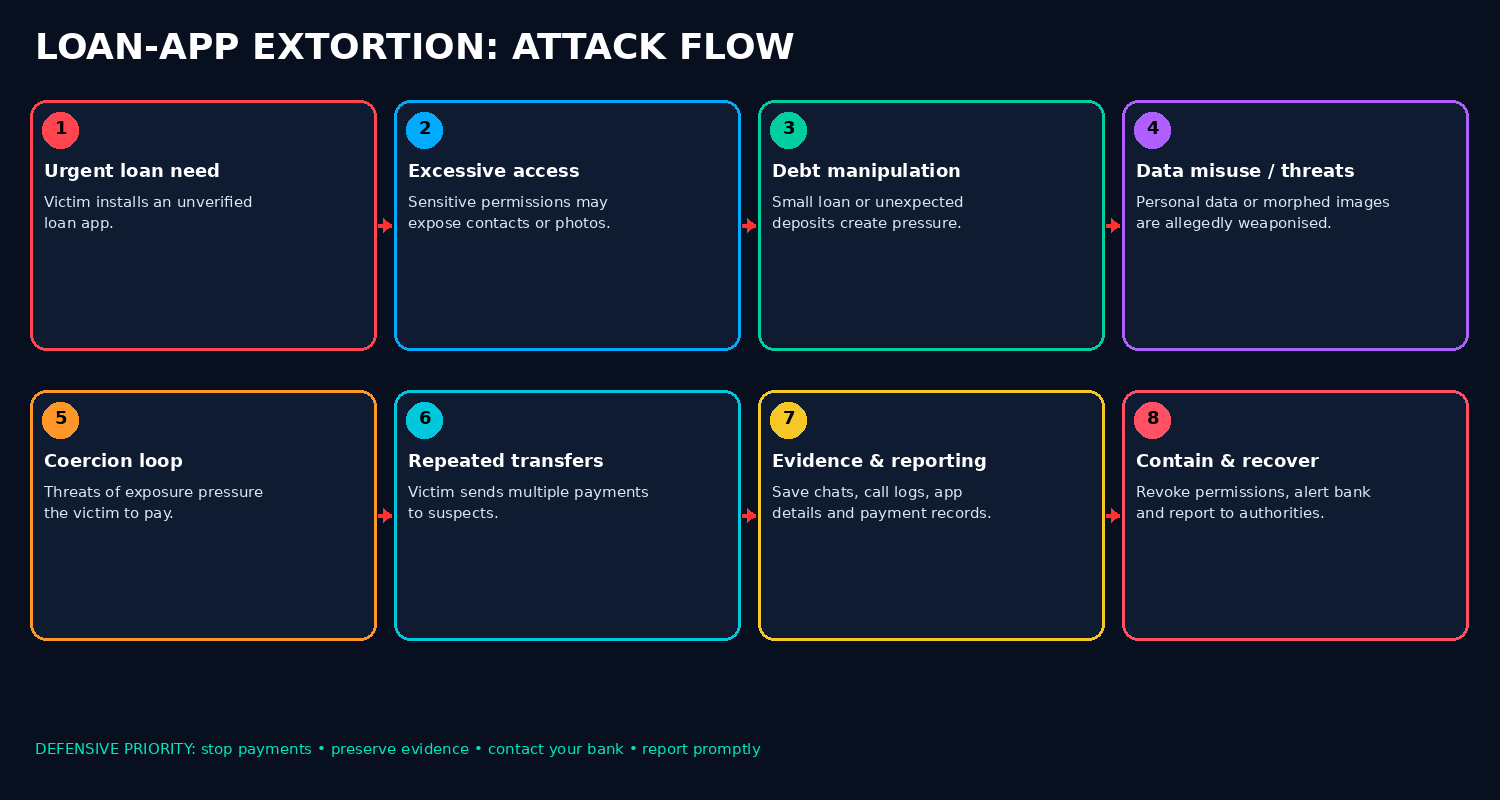
The flow illustrates how a financial request can become a coercion cycle: the person seeks urgent credit, unexpected deposits or confusing repayment demands create pressure, and threats involving personal reputation are used to force additional transfers.
Important distinction: “Excessive access” is a risk scenario, not a confirmed finding from the report. The available public account does not specify the exact Android permissions granted or provide forensic evidence of contact-list extraction.
4. How Personal Data Becomes Leverage
Access to contacts or photographs can make a threat feel immediate because an extortionist can name relatives, coworkers or friends. A morphed image may also be used as a coercion prop even when it is fabricated. The victim may then make repeated transfers out of fear that the material will be distributed.
That does not mean every loan app harvests contacts or that image access was confirmed here. The core risk is the combination of:
- Financial pressure: unexplained deposits, opaque terms or repeated repayment demands.
- Data exposure risk: permissions broader than the service reasonably needs.
- Reputational coercion: threats to send or publish humiliating material.
- Payment-loop reinforcement: each transfer may be followed by another demand rather than closing the matter.
For defenders, the incident should be examined as a possible abuse-and-extortion pattern rather than assumed to be a malware incident. No malware family, exploit, command-and-control infrastructure or technical IOC is assigned from the evidence supplied.
5. Warning Signs Before You Install or Pay
- An app requests contacts, call logs, photographs, SMS or Accessibility access that is not reasonably needed for the stated service.
- The disbursed amount differs from the amount requested or agreed, or funds arrive without a clear loan agreement.
- Fees, interest, due dates and grievance channels are unclear or change after installation.
- Repayment instructions move to personal WhatsApp numbers, new UPI IDs or multiple unrelated bank accounts.
- Threats, humiliation or claims that images will be sent to family and colleagues accompany demands for more money.
- The operator pressures the borrower to act immediately and discourages contacting a bank, police or trusted person.
One warning sign alone does not prove criminal activity, but unexpected deposits, unexplained permissions and threats tied to payment should be treated seriously.
6. What Victims Should Do First
- Preserve evidence first. Save messages, call logs, phone numbers, app names, screenshots, payment receipts, UPI IDs, account details, URLs and the timeline. Avoid forwarding intimate imagery or publishing the material.
- Contact your bank or payment provider immediately. Report the transactions and ask whether any transfers can be stopped, traced or flagged. Provide transaction IDs and beneficiary details.
- Report promptly in India. Call 1930 for financial cyber fraud and submit a report at cybercrime.gov.in ↗. Also contact local police; the urgency and available options depend on the case.
- Limit further access. After preserving evidence, review and revoke unnecessary app permissions. If the app appears malicious or the device may be compromised, use a trusted device to change important passwords, review active sessions and enable MFA.
- Report image-based abuse. Report the account/content to the relevant platform and authorities. Ask a trusted person for support if threats escalate; do not negotiate alone under pressure.
- Do not assume another payment will end the threats. Seek help from your bank and authorities before making further transfers under coercion.
7. Prevention Checklist for Android Users
- Verify the lender and its relationship with a regulated bank/NBFC independently; do not rely only on an app-store listing, advertisement or search result.
- Read the lender’s legal identity, fees, APR, repayment schedule and grievance-contact details before accepting credit.
- Review Android permissions and deny access to contacts, call logs or the gallery when they are not necessary for the stated function.
- Keep a copy of the loan agreement, the amount requested/disbursed, repayment records and all communications.
- Do not send money to a personal account merely because a caller demands it; verify payment instructions through an independently confirmed channel.
- Use device security settings to review installed apps and special access such as Accessibility or device-admin privileges, especially after coercive or suspicious behaviour.
8. Defensive Investigation: What Needs Verification
If a case is reported, investigators should separate evidence from assumptions and build a timeline across the app, communications and payments.
- Record the app names, package identifiers, version numbers, install source and relevant device/permission history where available.
- Review whether contacts, photos, call logs, SMS, Accessibility or device-admin permissions were granted, and when they were used if reliable records exist.
- Preserve WhatsApp messages, call details, sender numbers, UPI IDs, transaction references and beneficiary account details.
- Compare the timeline of deposits, repayment messages, threats and transfers. Correlate that sequence with bank/payment records.
- Obtain and preserve relevant application/device evidence through a suitable forensic process. Do not run unknown APKs on a victim’s primary device or redistribute suspected personal data.
- Validate whether the alleged morphed files were delivered, generated locally, or merely threatened. The public report alone does not resolve their provenance.
Any finding about exfiltration, app malware or operator infrastructure requires evidence beyond the article’s public reporting.
9. Evidence Boundaries and Attribution
A loan-app-related complaint, alleged coercion and threats, a reported total of ₹7.60 lakh across 67 transfers, and a police investigation.
The exact permissions granted, contact/photo exfiltration, malware presence, exploit chain, command-and-control infrastructure, complete victim scope or attribution to a named threat actor.
No technical IOC or malware-family attribution is assigned. The article is an awareness and defensive analysis of a reported incident, not a forensic confirmation of the apps’ implementation or operators.
CyberRakshakLabs Assessment
This case illustrates a coercion-led extortion pattern in which the alleged financial demand is reinforced by reputational threats. The immediate priorities are to interrupt further transfers, preserve evidence, limit unnecessary data access, and report to the bank and appropriate authorities.
Assessment: HIGH user-harm potential if the reported pattern is accurate. Confidence is high that the public report describes the allegations; confidence in the technical mechanism remains limited because no forensic evidence is supplied.
Key takeaway: A small loan can become a much larger crisis when unexplained money demands and threats to misuse personal data are allowed to drive a repeated-payment loop. Preserve evidence, contact your bank and report promptly.
Think Before You Click. Stay Aware. Stay Secure.
Sources & Verification Notes
Primary public report: Newsband — “Loan app blackmail: Woman loses Rs 7.60 Lakh” (7 October 2026) ↗.
The report says police registered a case and began investigating. Incident details are presented as reported allegations, not a judicial finding. The attack-flow figure and defensive recommendations are CyberRakshakLabs analysis. The report does not independently establish which permissions were granted, how the images were obtained, or whether personal contacts were technically exfiltrated.
CyberRakshakLabs — Threat Intelligence for a Safer Tomorrow.