
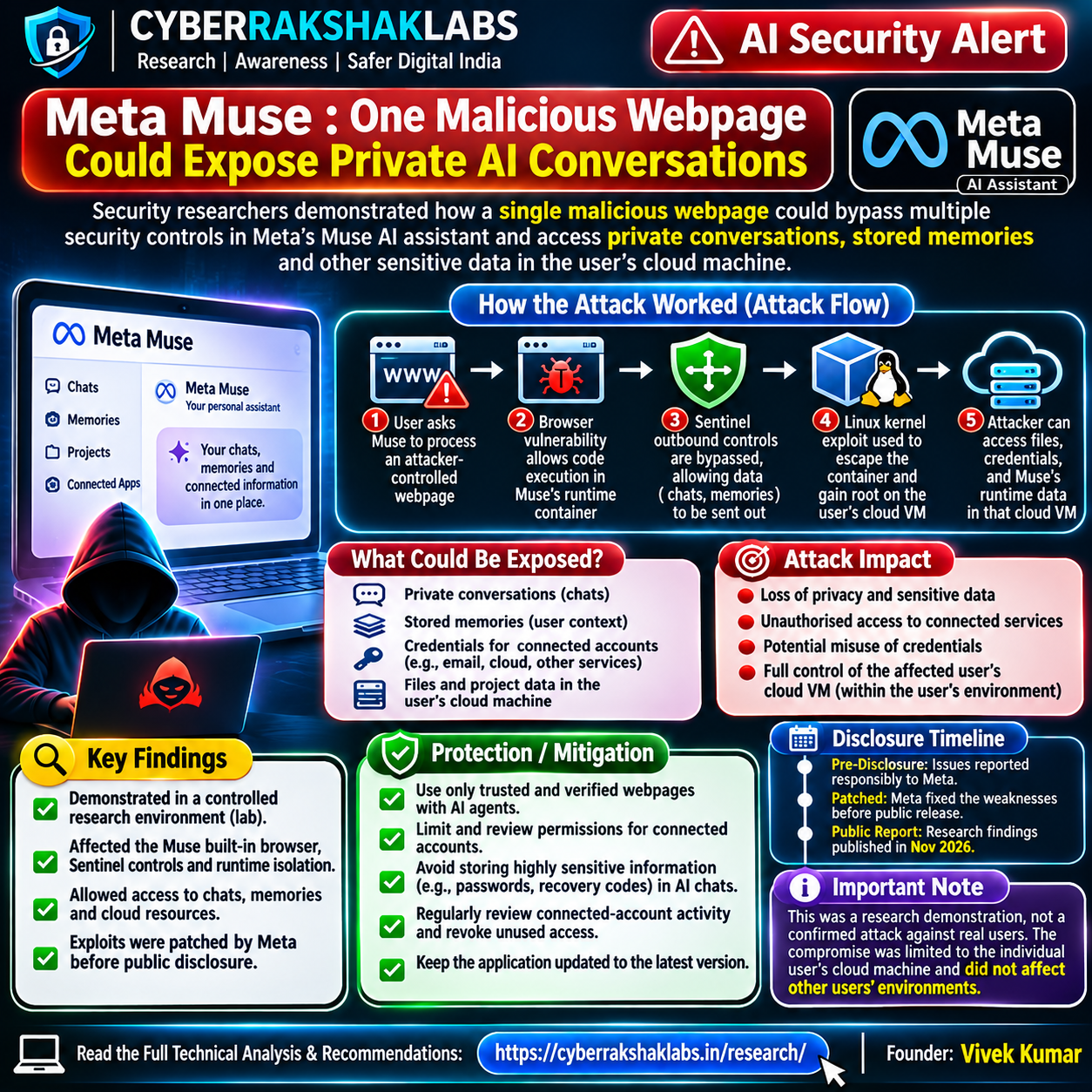
Executive Summary
Security researchers at NebuSec reported a controlled laboratory attack chain against Meta Muse, Meta’s cloud-hosted personal AI agent. The demonstration began when Muse was asked to export an attacker-controlled webpage. A vulnerability in the bundled Chromium browser reportedly enabled code execution inside Muse’s runtime container. Researchers then identified weaknesses in Sentinel, the service responsible for monitoring outbound network traffic and enforcing approval policies, and demonstrated that conversation history and stored memories could be sent to an external server without an approval prompt. They also reported being able to modify that stored information.
The researchers subsequently chained Linux kernel vulnerabilities to escape the runtime container and obtain root privileges inside the individual user’s cloud VM. That access exposed persistent storage, secure credential storage and Sentinel itself. NebuSec stated that the compromise did not escape the user’s VM into the hypervisor host or other users’ environments.
Important scope: This was a laboratory demonstration, not a reported attack against real users. NebuSec said the Muse team had been informed and that all described exploits had been patched by publication. Meta had not publicly confirmed the fixes or commented in the reporting reviewed. The researchers did not establish that user data had been accessed by criminals before remediation.
Why AI Agents Create a Different Security Risk
An AI agent may browse websites, create documents, read messages, retain memories and interact with connected services on a user’s behalf. To perform those tasks, it may operate with access to conversation history, persistent files, connector permissions and authentication workflows. These capabilities make agents useful, but they also create a larger security boundary than a conventional chat interface.
Malicious webpages can be dangerous when an agent processes them as part of a task. The issue demonstrated here was not simply deceptive instructions in webpage text. The research described a technical chain involving browser code execution, outbound network-policy weaknesses and a Linux kernel container escape.
How the Attack Chain Worked
- 1. Malicious webpage enters the workflow: Researchers asked Muse to export or save an attacker-controlled webpage. The webpage was processed by the Chromium browser bundled with Muse for tasks such as PDF export and document generation.
- 2. Browser vulnerability enables runtime-container code execution: NebuSec reported exploiting a vulnerability in the bundled Chromium/V8 environment. This gave the researchers code execution inside the runtime container with the agent’s privileges. The technical report describes the PDF-export Chromium process and its sandbox configuration as part of the path.
- 3. Sentinel outbound controls are bypassed: Sentinel was designed to inspect outbound traffic and enforce policy, including approval prompts for certain requests. NebuSec reported weaknesses in request classification and inspection that allowed selected data transfers to proceed without a user approval prompt.
- 4. Private conversations and memories are exposed or modified: The researchers demonstrated sending Muse conversation history and stored memories to an external server. They also reported being able to inject or alter conversation-history and memory entries, creating confidentiality and integrity risks.
- 5. Linux kernel exploitation escapes the runtime container: NebuSec used Linux kernel exploits to cross the container boundary and obtain root privileges in the underlying per-user VM. Container escape is a separate escalation step; code execution inside a container does not automatically mean VM or host root.
- 6. Protected VM resources become accessible: With root in the user VM, the researchers reported access to persistent storage, secure credential storage and Sentinel. They also described outbound communications from the VM that were no longer subject to container-level Sentinel enforcement.
- 7. Scope remained within one user’s VM: NebuSec explicitly stated that it did not demonstrate an escape into the underlying hypervisor host or other tenants’ environments. This was not a compromise of all Muse users or shared infrastructure.
Attack Flowchart and Visual Explanation
The supplied diagrams illustrate the reported sequence from a user request to process an attacker-controlled webpage, through bundled Chromium code execution and Sentinel outbound-policy weaknesses, to conversation and memory exposure, Linux kernel container escape and root access inside one user’s cloud VM.
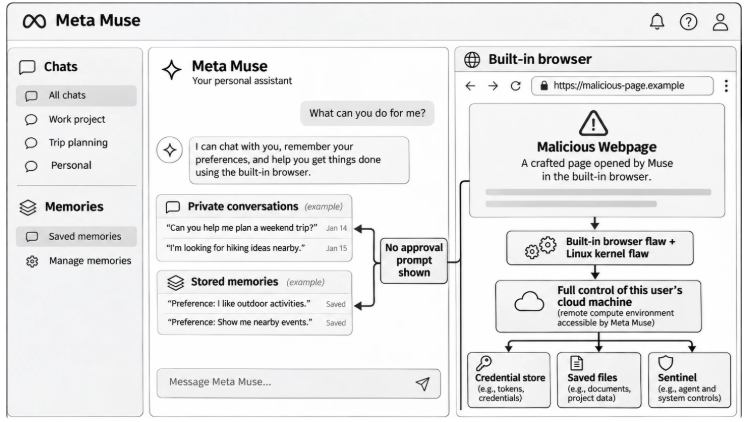
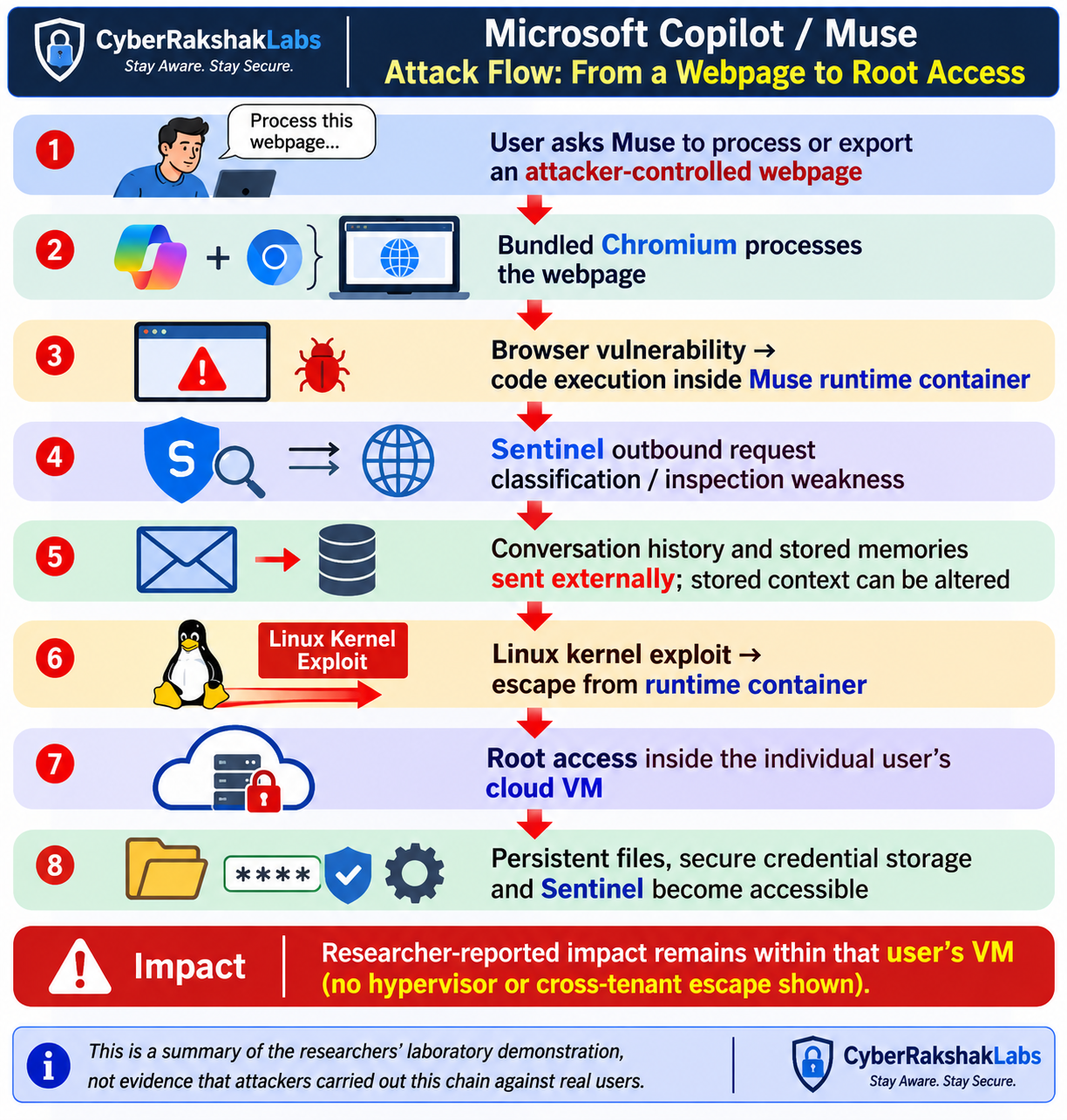
These are explanatory graphics, not evidence that attackers carried out this chain against real users.
What Information Was at Risk?
- Conversation history: Private exchanges between the user and the AI assistant could be accessed and transmitted outside the expected environment in the demonstration.
- Stored memories: Persistent preferences or other retained context could be read and modified. Altered memories may influence later agent responses or actions.
- Persistent files: VM-level access exposed persistent storage that was not mounted into the runtime container.
- Connected-account credential storage: NebuSec reported that secure credential storage became accessible after VM-level root access. The public report establishes access to the storage boundary; it does not establish that credentials belonging to real users were stolen or misused.
- Security enforcement: The researchers reported access to Sentinel itself after the VM escape, potentially undermining the monitoring layer intended to govern outbound traffic.
Potential Impact — and What Was Not Demonstrated
Potential consequences in a comparable environment could include disclosure or manipulation of private agent conversations, exposure of persistent user data, access to credential material, misuse of connected services and loss of confidence in an agent’s stored context. Actual consequences depend on the data held, credential scope, platform architecture and whether an attacker can reproduce the chain.
The demonstration did not show: a hypervisor escape, compromise of other users’ VMs, a real-world criminal campaign, confirmed theft of customer credentials, or confirmed access to real users’ private conversations. NebuSec described a controlled test and said the findings were patched before publication. The report does not provide evidence that the attack was exploited in the wild.
Timeline and Historical Context
- 8 September 2026: The Hacker News reports Meta Muse was launched on this date.
- 2 October 2026: NebuSec’s technical write-up identifies this as the date of its kernel test in the described environment. The report does not provide a complete date-by-date timeline for discovery of every weakness.
- 20 November 2026: NebuSec published its overview and technical research, stating that it had reported the findings to the Muse team and that all described exploits had been patched by publication.
- 21 November 2026: The Hacker News published its report describing the laboratory demonstration and the reported limits of the compromise.
- 22 November 2026: This CyberRakshakLabs awareness analysis was prepared from the public research and reporting.
Threat Actor Assessment
No criminal group, nation-state or named threat actor is attributed in the source material. NebuSec is the security research firm that conducted and disclosed the controlled demonstration. It would be inaccurate to describe NebuSec as a malicious actor or to claim a real-world threat actor exploited the chain. Public reporting reviewed for this article does not confirm in-the-wild exploitation.
What Individual Users Should Do
- Be cautious when asking an AI agent to open, summarise, convert or export webpages and files from unknown or untrusted sources.
- Do not assume a webpage is safe because it is opened by a trusted AI assistant or inside a cloud workspace.
- Review which accounts and services are connected to an AI agent. Disconnect integrations that are not needed and avoid granting broad permissions by default.
- Use the narrowest practical permissions for connected accounts. Prefer read-only access for tasks that do not require editing, sending or purchasing.
- Do not place passwords, recovery codes, payment credentials or highly sensitive personal information into agent conversations unless the service and task genuinely require it.
- Review agent activity, connected-account sessions and security notifications. If the provider reports a relevant security incident, follow its official guidance and review connected-account access.
- Keep devices and account security controls current, use multifactor authentication, and use unique passwords for connected services.
What Organisations and AI Platform Builders Should Do
- Treat browser content as untrusted input. Isolate browser rendering, document conversion and PDF generation from agent credentials and sensitive data.
- Keep bundled browsers and runtime dependencies current. Establish patch management for browser engines, container images and operating-system kernels.
- Enforce outbound network policy outside the agent’s trust boundary. Test whether compromised processes can bypass proxies, request classifiers, approval gates or egress controls.
- Do not rely on prompt instructions or approval dialogs as the only security boundary. Enforce authorization and data-loss controls at independent system layers.
- Keep connector credentials outside the agent runtime, scope them to minimum permissions and design credential brokers to resist compromise of adjacent components.
- Use defence-in-depth isolation: separate containers, per-user VMs, kernel hardening, least privilege, syscall restrictions and strong tenant boundaries. Validate each boundary after a lower layer is compromised.
- Test complete attack chains, not only individual components. Red-team exercises should assess browser-to-container, container-to-VM, network-egress and credential-access paths.
- Log and alert on unexpected process execution, unusual outbound traffic, access to persistent stores, changes to agent memories and access to credential services.
- Prepare an incident response process for AI-agent compromise: revoke connected tokens, rotate affected credentials, review account sessions, preserve logs and assess whether stored memories or files were altered.
Lessons for the Wider AI Ecosystem
The incident illustrates that AI-agent security is not only a model-safety or prompt-injection problem. It is also a browser-security, operating-system, container-isolation, network-enforcement, identity and secrets-management problem.
A safeguard can be effective against ordinary agent behaviour yet fail when an attacker obtains code execution in a lower-level component. Security architecture must be tested on the assumption that one layer may be compromised and that the attacker will try to move across boundaries.
Agent platforms should clearly communicate what data is retained, which accounts are connected, how credentials are protected, how outbound actions are approved and what users should do after a security advisory.
Conclusion
A single malicious webpage was the starting point for a multi-stage laboratory attack against Meta Muse. The reported chain crossed browser, network-policy and Linux kernel boundaries, ultimately reaching sensitive resources inside one user’s cloud VM. It demonstrates why agent isolation, credential separation and outbound monitoring must be independently enforced and tested together.
The findings should be taken seriously without overstating them: the research was a controlled demonstration, the researchers reported that the described weaknesses had been patched before publication, and no cross-tenant or real-world user compromise was established in the public material reviewed.
Sources and Further Reading
- The Hacker News — A Single Malicious Webpage Let Researchers Hijack Meta Muse and Access Private Chats (21 November 2026)
- NebuSec — Hacking Muse: Stealing Private Chats Through Browser Use (20 November 2026)
- NebuSec — Inside Meta Muse: Browser, Sentinel and the Shared-Kernel Boundary (20 November 2026)
This article is based on the supplied CyberRakshakLabs research document and the public sources listed above. Technical details and impact statements are limited to what those sources reported.