
🚨 Microsoft Agent Framework PyPI Supply-Chain Compromise
CyberRakshakLabs | Research • Awareness • Safer Digital India
Source & social links:
LinkedIn Post ↗WhatsApp ↗YouTube ↗
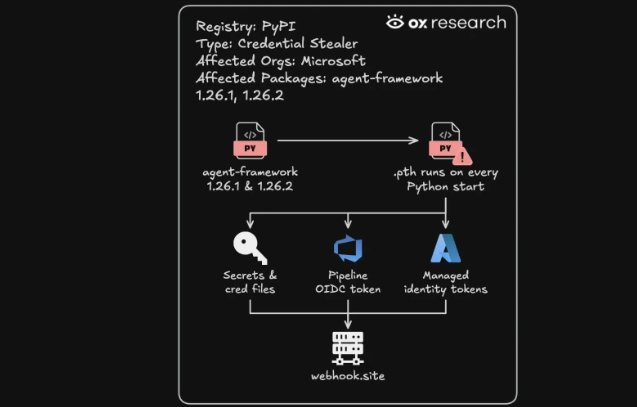
On 17 November 2026, two malicious releases of Microsoft’s Python package agent-framework—versions 1.26.1 and 1.26.2—were published to PyPI approximately 33 minutes apart. They added Python startup hooks that executed credential-stealing code whenever Python started in an affected environment; importing Agent Framework was not required.
The payload targeted cloud and development credentials, including Azure managed-identity tokens, Azure DevOps credentials and, in version 1.26.2, GitHub Actions OIDC material. Researchers reported exfiltration to a webhook[.]site endpoint. Both malicious releases were subsequently removed/quarantined; 1.26.0 is identified as the last clean release.
Scope and Package Context
The affected artifact was the agent-framework PyPI meta-package, not evidence that every Microsoft Agent Framework package or Microsoft service was compromised. Endor Labs reported that the 22 sibling agent-framework-* packages it checked had not received new releases since 12 November. The malicious versions pinned the legitimate core package at 1.26.0, potentially allowing applications to continue functioning.
Researchers cited approximately 190,000 monthly downloads. This is package-popularity context, not a verified count of affected installations or victims. Public sources reviewed do not establish how many organizations installed either malicious version.
Technical Attack Mechanism
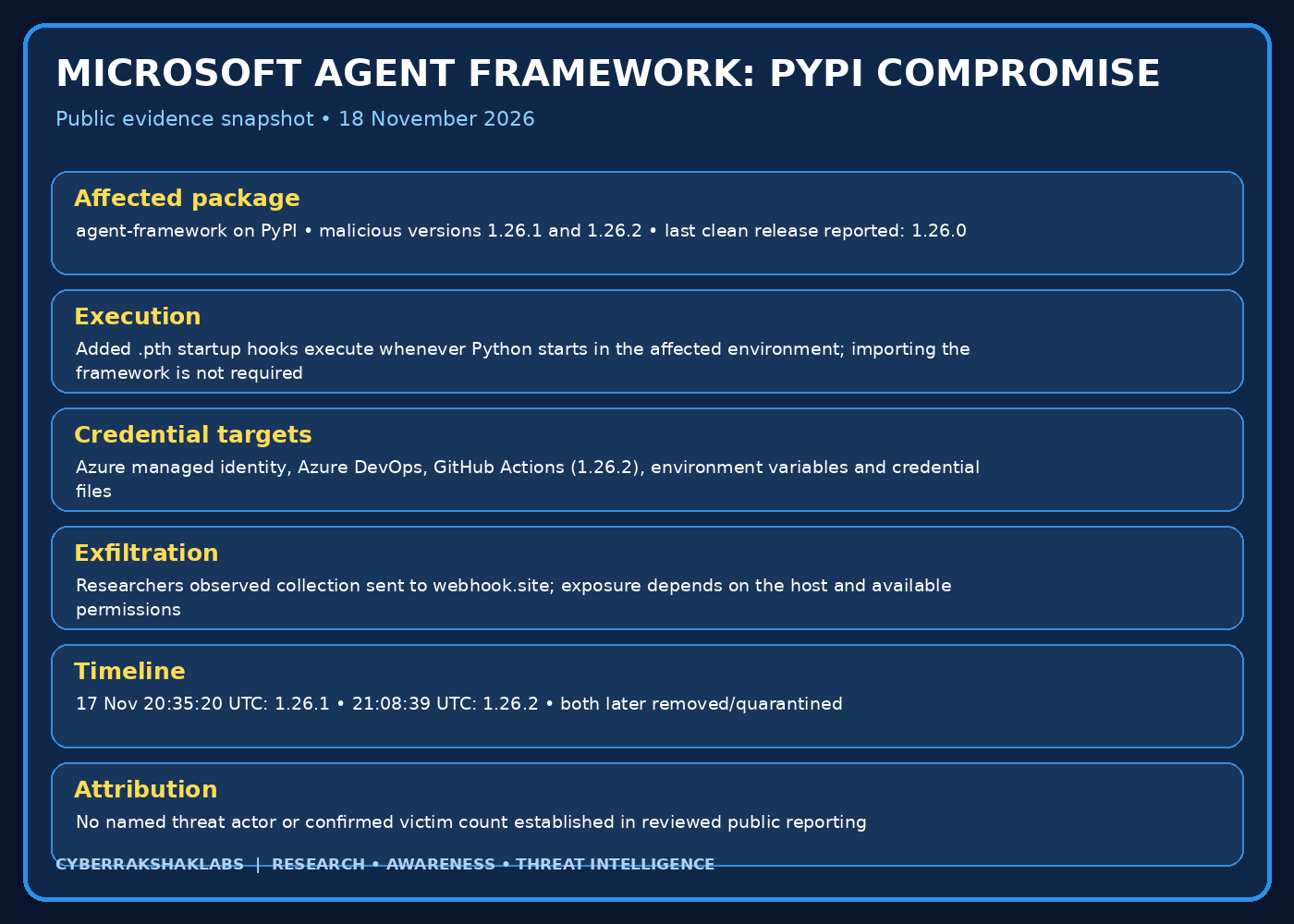
The malicious releases added executable .pth startup hooks to Python’s site-packages. Python processes import lines in .pth files during interpreter startup.
- Version 1.26.1: used
agent_framework_meta.pthto loadagent_framework_meta/_telemetry.py. - Version 1.26.2: moved the loader to
af_runtime_diag.pthand payload toaf_runtime_diag.py, complicating simple detection based on the first release’s file changes.
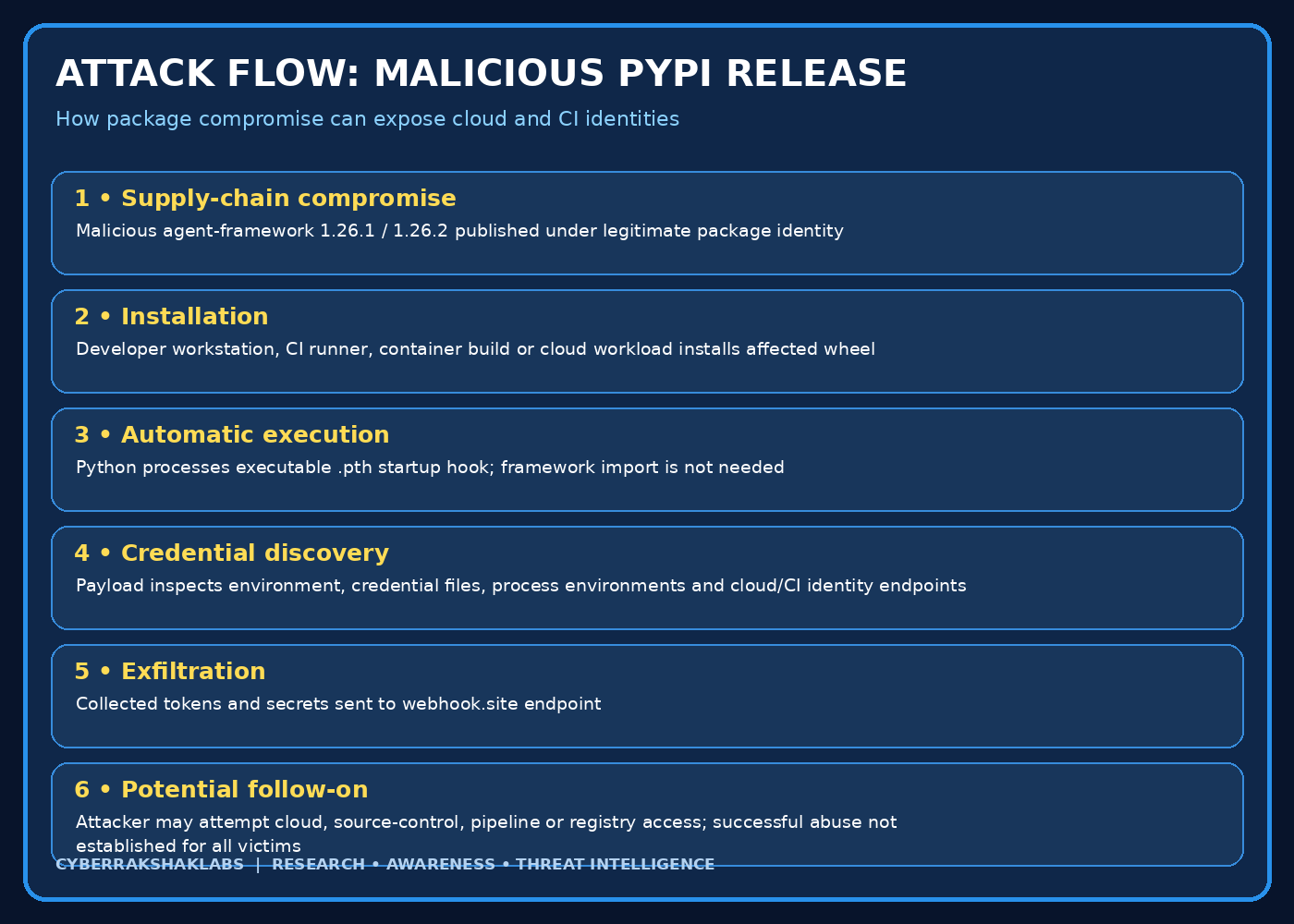
The hook executes when Python starts in the affected environment, including Python-based package-management commands. It does not require the application to import Agent Framework. Researchers observed a detached process on Unix-like systems, allowing collection to continue after the initiating interpreter exited.
Reported collection included selected environment variables, credential/configuration files and other process environments visible through /proc. The payload sought Azure managed-identity tokens for multiple resources, Azure DevOps tokens and, in 1.26.2, GitHub Actions OIDC tokens. Collected material was transmitted to webhook[.]site. Exposure depends on host permissions, available files, environment variables and workload identity configuration.
Attack Timeline (UTC)
- 12 Nov 2026, 18:24–18:26: legitimate
agent-framework1.26.0 and related framework packages published. - 17 Nov 2026, 20:35:20: malicious 1.26.1 published as a wheel-only release.
- 17 Nov 2026, 21:08:39: malicious 1.26.2 published, with the startup hook and payload relocated.
- 17 Nov 2026, around 21:13: researchers reported 1.26.2 live while 1.26.1 had been removed from the index.
- 17 Nov 2026, around 21:20: Aikido reported both versions removed and 1.26.0 restored as latest. Microsoft project maintainers acknowledged the versions had been pulled and said investigation was underway.
Threat Actor and Attribution
Public reporting establishes malicious package publication and credential-theft behavior, but not the operator’s real-world identity, organization, nationality or motive. Researchers discussed potentially compromised publishing access and a newly created maintainer account; these are investigative indicators, not proof of a named actor. Attribution remains unknown.
Likely operational objectives include gaining access to cloud environments and software delivery pipelines through stolen credentials and identity tokens. Subsequent cloud, repository, pipeline, package-registry or artifact abuse is a plausible risk, not confirmed downstream activity in every victim environment.
Indicators of Compromise
- Malicious versions:
agent-framework==1.26.1andagent-framework==1.26.2. - Startup hooks:
agent_framework_meta.pthandaf_runtime_diag.pth. - Payload files:
agent_framework_meta/_telemetry.pyandaf_runtime_diag.py. - Observed exfiltration service:
webhook[.]site. Researchers published specific endpoint paths, hashes and User-Agent strings; validate exact indicators against current threat-intelligence sources before operational blocking. - Behavioral clues: Python processes reading many
/proc/*/environfiles, Python outbound traffic to webhook.site, unexpected cloud identity token requests, and CI jobs installing unpinned package versions.
Impact and Risk
Any host or runner that installed either malicious version during the exposure window should be treated as potentially compromised. This includes developer workstations, CI runners, build containers, Azure workloads and hosts with accessible credentials.
Stolen credentials may enable unauthorized access if still valid and sufficiently privileged. Short-lived tokens may expire, but long-lived secrets, service connections, repository tokens, refresh credentials and cached artifacts may remain relevant. Removing the package stops future execution but does not reverse data already exfiltrated.
Defensive Actions and Incident Response
- Identify affected versions across endpoints, virtual environments, CI runners, container images, caches and internal package mirrors. Review lockfiles, build logs, SBOMs and package records.
- Do not launch Python or pip in an affected environment before removing the malicious startup hooks; Python-based tools may trigger them. Follow a vetted cleanup procedure from a clean administrative shell, then reinstall known-good 1.26.0 with hash verification. Rebuild images and purge caches/mirrors.
- Isolate affected runners/hosts where feasible and preserve logs and forensic artifacts.
- Rotate potentially exposed secrets from a clean environment: Azure service principals, managed-identity dependent access, Azure DevOps tokens/service connections, GitHub tokens/OIDC trust, package-registry credentials, cloud keys and
.envsecrets. - Review Entra sign-in/audit logs, Azure activity, Azure DevOps pipeline activity, GitHub Actions runs, repository changes, artifact/cache writes and egress/DNS/proxy logs from 17 Nov 20:35 UTC onward.
- Inspect workflows that expose runtime/cache tokens or grant
id-token: write; clear suspect caches after evidence collection. - Enforce exact dependency pins and hash-locked builds, verify provenance, scope publishing credentials tightly, and monitor unexpected
.pthfiles.
Confirmed vs. Not Established
Confirmed by multiple researchers: two malicious PyPI releases, automatic startup execution through .pth files, credential collection targeting cloud/CI identities, and subsequent removal/quarantine.
Not established in the public sources reviewed: total installations, affected organizations, amount exfiltrated, successful use of stolen credentials, complete compromised-identity list, or a named threat actor. Organizations must determine exposure from their own telemetry.
References and Source Notes
The analysis follows the supplied source hierarchy and confidence statements. The sources describe malicious package publication, startup-hook execution and credential collection; they do not establish a total victim count or named actor attribution.
- Endor Labs (17 Nov 2026): Agent Framework compromised software supply-chain attack.
- Aikido Security (updated 18 Nov 2026): Two malicious Agent Framework releases hit PyPI in 33 minutes.
- Microsoft Agent Framework GitHub issue #10411: Project maintainer issue and updates.
- StepSecurity (18 Nov 2026): Microsoft Agent Framework PyPI package compromised.
- Socket Research: Agent Framework PyPI package compromised with credential stealer.
Analyst caveat: This report separates observed technical behavior from potential impact. It does not establish a total victim count, successful downstream abuse in every case, or named threat-actor attribution.