
🚨 NGINX2Root: Five Critical Vulnerabilities Put Internet-Facing NGINX Services at Risk
CyberRakshakLabs | Research • Awareness • Safer Digital India
Source & social links:
LinkedIn Post ↗ WhatsApp ↗ YouTube ↗
NGINX2Root is the collective name used for five memory-corruption vulnerabilities disclosed on 18 November 2026 in NGINX Open Source and NGINX Plus. Depending on the enabled module and configuration, a remote unauthenticated attacker may trigger memory corruption in an NGINX worker and potentially execute code with that worker’s privileges.
A separate Linux kernel SCTP vulnerability may provide an additional privilege-escalation path in specific environments. This is not one of the five NGINX CVEs, and worker-level code execution does not automatically grant root access.
Censys reported 8,823,450 services potentially exposed to CVE-2026-123007 on 19 November 2026. The figure is an external service measurement, not a count of confirmed vulnerable organisations or successful compromises.
Executive Summary
On 18 November 2026, F5/NGINX and security researchers disclosed five memory-corruption vulnerabilities affecting NGINX Open Source and NGINX Plus. Collectively referred to as NGINX2Root, the flaws may allow an unauthenticated remote attacker to trigger memory corruption in an NGINX worker and potentially execute code with that worker’s privileges, but only when the relevant module and configuration prerequisites are present.
Xint also described chaining an NGINX foothold with a separate Linux kernel SCTP vulnerability to reach host-level root under additional system conditions. That kernel issue is distinct from the five NGINX CVEs. An NGINX worker-level foothold does not automatically mean root access.
Censys reported 8,823,450 services potentially exposed to CVE-2026-123007 on 19 November 2026. This is a point-in-time service-level measurement—not a count of confirmed vulnerable organisations, unique compromised hosts or successful attacks.
Why NGINX Matters and Where Exposure Can Exist
NGINX commonly provides web serving, TLS termination, reverse proxying, caching, load balancing and Kubernetes ingress. It often handles traffic at an organisation’s internet edge, so a remotely reachable memory-safety flaw can affect a security- and availability-critical component.
The five issues do not affect every deployment in the same way. Exposure depends on enabled protocols, configured modules, proxy and resolver behaviour, mail-proxy settings, worker resource conditions, privileges, accessible secrets and the host or container boundary. An external version check alone cannot establish whether every prerequisite is present.
The Five NGINX Vulnerabilities
The supplied research document lists the following five vulnerabilities and their configuration prerequisites:
| CVE | Vulnerability class | Required configuration / condition |
|---|---|---|
| CVE-2026-123007 | Integer overflow / heap memory corruption | HTTP/2 enabled on a reachable listener. |
| CVE-2026-123633 | Use-after-free | HTTP/2, proxying to an upstream and worker connection-exhaustion conditions. |
| CVE-2026-121810 | Use-after-free | HTTP/3 (QUIC) enabled with proxy_pass to a backend. |
| CVE-2026-123634 | Resolver-related use-after-free | Resolver + variable-based proxy_pass + a subrequest such as mirror or SSI resolving the same hostname. |
| CVE-2026-113425 | Mail-proxy use-after-free | Mail proxy configured with proxy on and auth_http. |
F5 assigned each vulnerability CVSS 3.1 8.1 (High) and CVSS 4.0 9.2 (Critical). These scores are the vendor-reported ratings in the source material. Not every NGINX deployment is exposed to all five flaws.
How the Attack Could Work
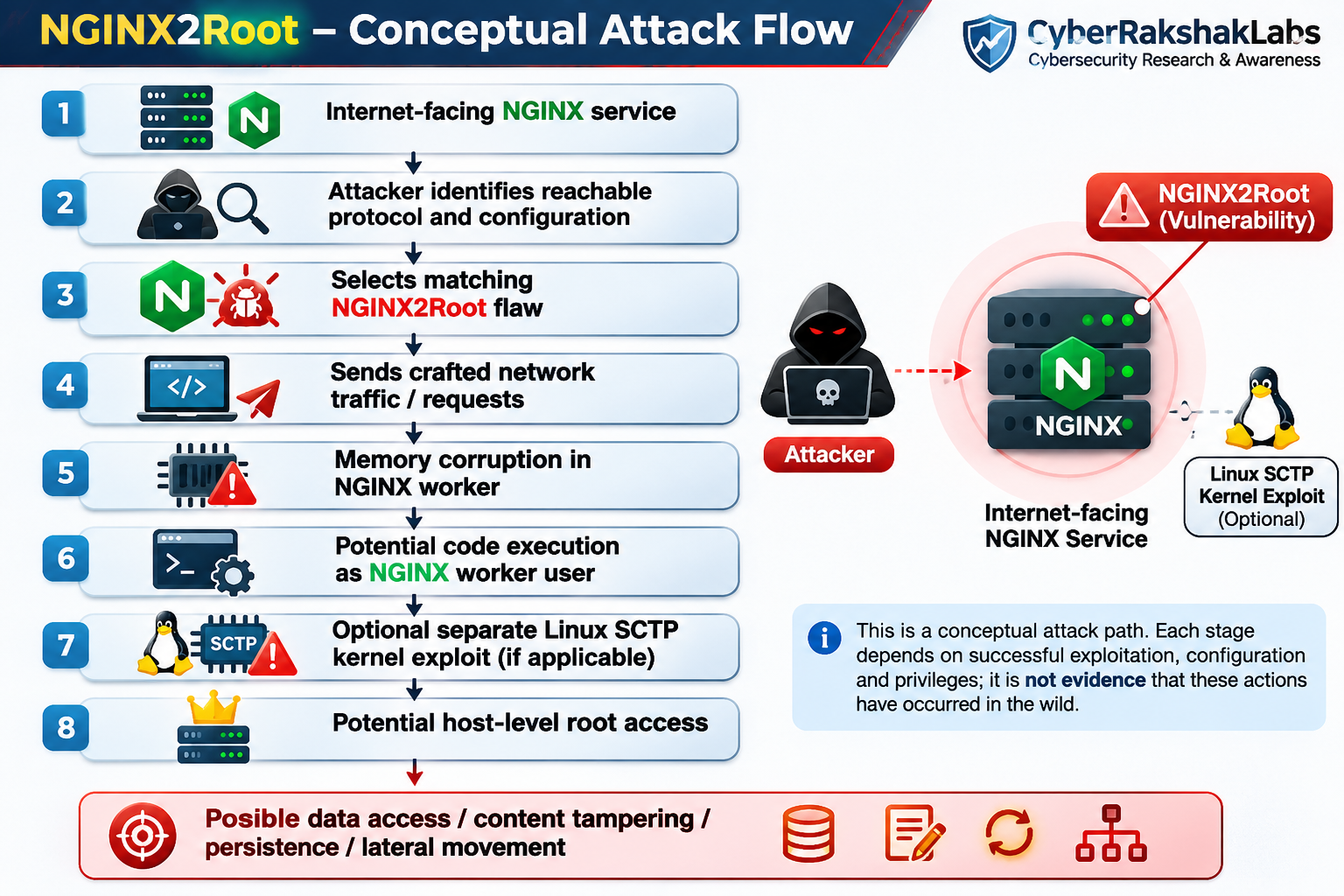
- Reconnaissance: An attacker identifies internet-facing NGINX services and attempts to infer versions, protocol support and exposed listeners. Remote version identification is incomplete.
- Configuration targeting: The attacker selects a flaw whose prerequisites match the target—HTTP/2, HTTP/3/QUIC, a resolver/proxy/subrequest combination, or the mail proxy.
- Malicious input: Crafted protocol frames, connection sequences or requests exercise the vulnerable memory-management path.
- Memory corruption: An integer overflow, out-of-bounds access or use-after-free may corrupt memory in an NGINX worker. Outcomes can include a crash or potentially controlled code execution.
- Worker-level execution: If exploitation succeeds, code runs with the privileges and access available to the NGINX worker. This does not automatically mean root access.
- Possible privilege escalation: Xint described a separate Linux kernel SCTP vulnerability being chained with an NGINX foothold to obtain host-level root where the required kernel and system conditions exist.
- Possible post-compromise activity: Depending on access, an intruder could inspect accessible data, alter served content, establish persistence, access secrets or move toward connected systems. These are possible actions, not confirmed outcomes of this disclosure.
What the 8.8 Million Exposure Figure Means
Censys reported 8,823,450 services potentially exposed to CVE-2026-123007, based on visible affected-version information and HTTP/2 support. It also reported 441,489 services previously observed as exposed but later seen patched or with HTTP/2 disabled.
These are service-level internet measurements, not counts of unique physical servers or confirmed compromises. Some services hide their version; Linux distributions may backport fixes without changing the upstream version string; and external scans cannot inspect all configuration conditions required for the other four flaws. Treat the figure as an exposure signal, not a definitive global inventory.
Disclosure Timeline and Exploitation Status
- 11 October 2026: Xint researchers identified the vulnerabilities.
- 16 October 2026: Xint submitted reports to F5 through HackerOne.
- 21 October 2026: Wiz Research reported confirmed RCE with an ASLR bypass for CVE-2026-123633.
- 27 October 2026: Xint reports reached the NGINX development team.
- 10 November 2026: Xint completed validation of the fixes.
- 18 November 2026: F5 published the vulnerability information; fixed NGINX Open Source releases 1.30.7 and 1.31.9 became available, alongside NGINX Plus fixes.
- 19 November 2026: Censys exposure tracking and further security advisories highlighted the scale of potential exposure.
The public reporting reviewed for this article does not attribute NGINX2Root to a named threat actor, criminal group or nation-state. Advisories available on 18–19 November 2026 reported no confirmed exploitation in the wild. Working research exploits and publicly available proof-of-concept material increase urgency, but do not prove that a particular actor has compromised systems.
Potential Impact — What Could Happen After Exploitation
- Service disruption caused by NGINX worker crashes or instability.
- Unauthorised access to information readable by the NGINX process or exposed through connected applications.
- Website or API content modification where the process has sufficient write access.
- Exposure of secrets stored in accessible files, environment variables or mounted configuration.
- Further movement into connected systems if network access and credentials permit it.
- Host-level compromise only where an additional privilege-escalation path is available and successfully exploited.
The actual impact depends on the worker’s privileges, filesystem permissions, available secrets, network reachability, container boundaries and host configuration. Do not equate a vulnerable NGINX worker with automatic host-root compromise.
What Organisations Should Do Now
- Inventory every NGINX deployment, including Open Source, Plus, containers, Kubernetes ingress controllers, appliances and embedded vendor products.
- Prioritise internet-facing systems and listeners accepting HTTP/2 or HTTP/3; also review mail-proxy, resolver and variable-based proxy configurations.
- Upgrade NGINX Open Source to 1.30.7 or 1.31.9, or install the vendor-supported fixed NGINX Plus release. Follow distribution and appliance advisories.
- Check package-level security status, not only
nginx -v. Distribution vendors may backport fixes without changing the upstream version string. - Restart or perform the supported binary upgrade so worker processes use the patched binary; a configuration reload alone may not replace an old executable.
- If patching is temporarily impossible, consider disabling unused HTTP/2 and HTTP/3 features and applying configuration-specific mitigations. These are temporary and do not cover all five flaws.
- Restrict direct access to origin servers and use trusted network paths, allowlists or authenticated origin controls where appropriate.
- Monitor worker crashes, abnormal long-lived HTTP/2 connections, resolver alerts, unexpected child processes and process execution by the NGINX worker account.
- Use host monitoring or EDR to alert on unexpected process creation by NGINX workers; correlate logs, process telemetry, file changes and outbound connections.
- If compromise is suspected, isolate the host, preserve evidence, rotate secrets accessible to the process, assess connected systems and rebuild from trusted images when integrity cannot be established.
Guidance for Individual Users
- Keep operating systems, browsers, routers and hosted applications updated. Most users cannot patch the NGINX server behind a website themselves.
- Use multifactor authentication for important accounts, especially email, banking and work services.
- Use unique passwords and a password manager to reduce the impact of a separate service compromise.
- Be cautious of unexpected password-reset prompts, outage notices or requests to install software following a service incident.
- Follow verified security notices from service providers and use official channels for incident updates.
Detection, Incident Response and Conclusion
Potential signals discussed by researchers include unexpected NGINX worker crashes, unusual HTTP/2 connection behaviour, resolver cancellation alerts, mail-proxy worker failures and unexpected programs launched by an NGINX worker. No single log message proves exploitation. Correlate protocol events, process telemetry, authentication activity, file changes and outbound connections.
Do not treat patching alone as cleanup if compromise is suspected. Preserve evidence, check for persistence and credential exposure, establish the worker-to-host privilege boundary and rebuild affected systems from known-good sources when integrity cannot be established.
NGINX2Root demonstrates how memory-safety flaws in widely deployed internet-facing infrastructure can create serious risk. The 8.8 million figure signals broad potential exposure, but does not mean 8.8 million organisations are confirmed vulnerable or compromised. Organisations should inventory deployments, validate configuration and vendor patch status, upgrade promptly and monitor for suspicious worker behaviour.
Sources and Further Reading
- Cloudflare — nginx2root: five new nginx vulnerabilities (20 Nov 2026)
- Xint — NGINX2Root: New Remote Code Execution Vulnerabilities (18 Nov 2026)
- BleepingComputer — Critical NGINX NGINX2Root bugs let attackers hijack servers
- CERT-EU Security Advisory 2026-022
- CIS — Multiple Vulnerabilities in NGINX Could Allow for Remote Code Execution
- Sophos — NGINX2Root advisory
This article follows the supplied CyberRakshakLabs research document. Exposure figures, timelines, scores and technical conditions are attributed to the sources named above.