CYBERRAKSHAK LABS Ā· RESEARCH #080

🚨 Pune Senior Citizen Loses ₹2.1 Crore: Anatomy of an Investment and Digital-Arrest Scam

Cybersecurity threat research | Public-figure impersonation, fake investment returns and coercive authority impersonation

By Vivek Kumar Ā· Published 2 November 2026
RESEARCH#080
CATEGORYCyber Fraud / Investment Scam / Digital Arrest / Social Engineering
CRL ASSESSMENTINCIDENT ANALYSIS
RESEARCH LEVELThreat Research
PUBLISHED2026-11-02
Source & social links:
LinkedIn Post ↗ WhatsApp ↗ YouTube ↗
How CyberRakshakLabs researches threats →
A reported ₹2.10 crore Pune cyber-fraud case shows how fake investment returns can be followed by a coercive digital-arrest scam.
Attribution and evidence note:

Public reporting does not identify a confirmed criminal group, named suspects or complete technical infrastructure. Do not infer a malware infection, data breach or specific platform from the reported facts.

Executive Summary

A 70-year-old resident of Pune’s Mundhwa area reportedly lost approximately ₹2.10 crore in two successive cyber frauds: ₹1.07 crore in a fictitious investment scheme and ₹1.02 crore in a later ā€œdigital arrestā€ impersonation scam. The Indian Express reported on 1 November 2026 that a complaint was registered at Pune City Cyber Police Station on 30 October 2026. The victim was first lured by an online venture-capital advertisement that falsely used prominent public figures’ names, then intimidated by callers impersonating telecom and police authorities.

The two phases demonstrate how criminals can combine financial deception and psychological coercion: fabricated profits build trust and encourage larger transfers, while a later false law-enforcement story uses fear, secrecy and fabricated verification requirements. Public reporting does not identify a confirmed criminal group, named suspects or complete technical infrastructure.
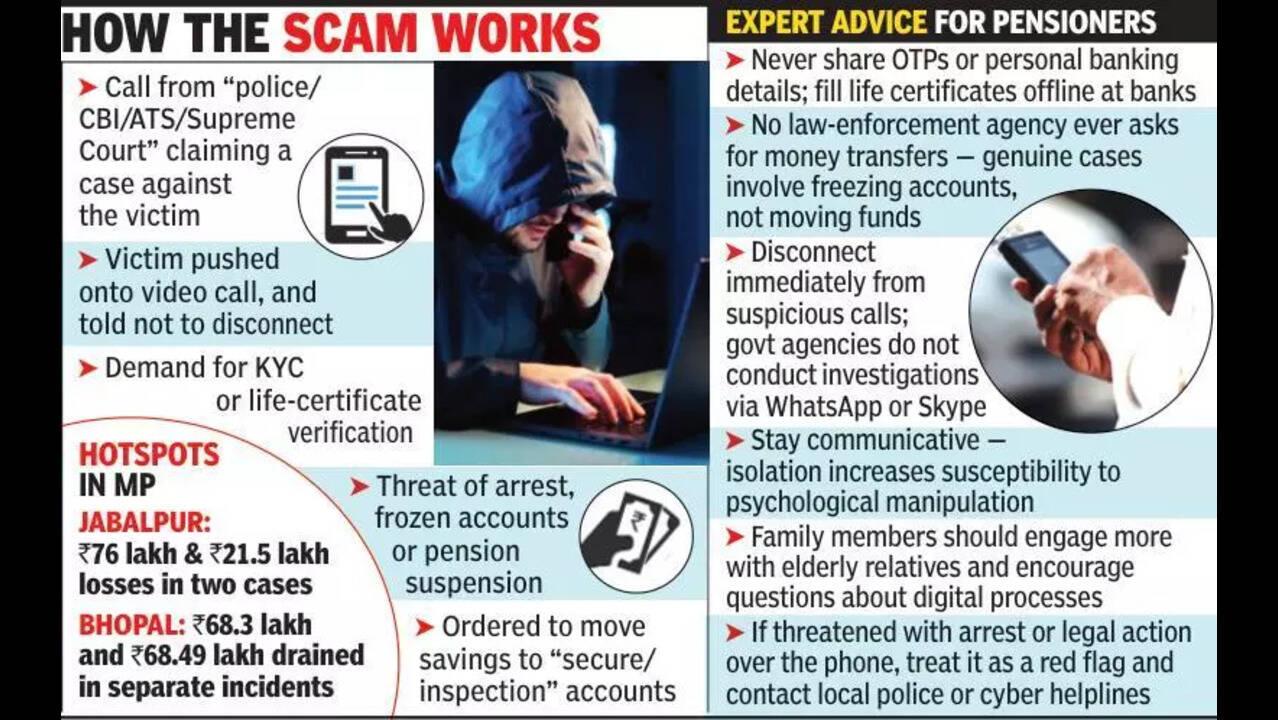
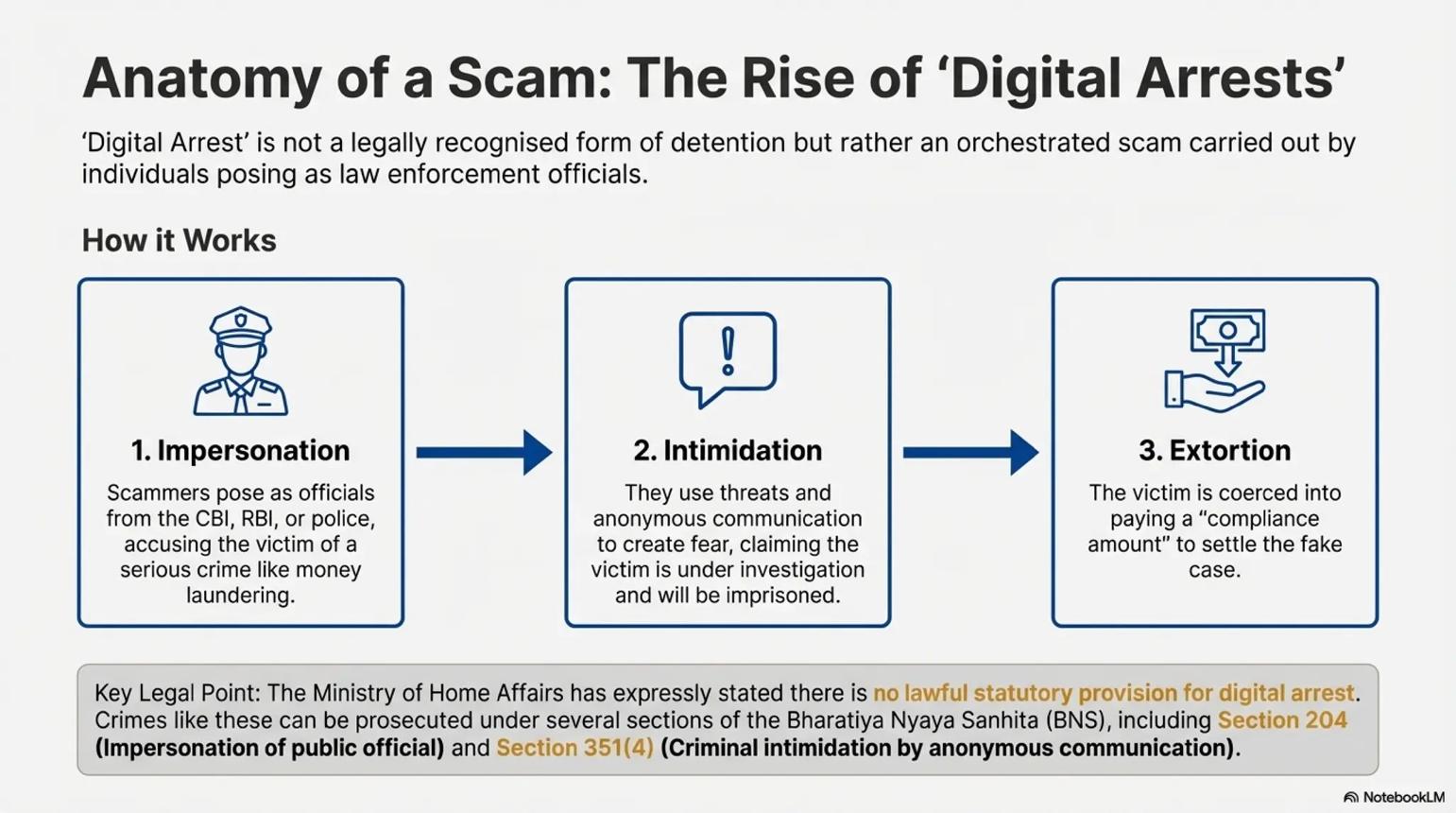
Infographic explaining common digital-arrest scam tactics and expert advice for pensioners
Incident Snapshot
  • Victim: 70-year-old Pune resident living alone, according to the report.
  • Reported loss: approximately ₹2.10 crore in total.
  • Investment fraud: ₹1.07 crore transferred to multiple mule accounts over approximately four months.
  • Digital-arrest fraud: ₹1.02 crore transferred to six mule accounts over a few weeks.
  • Police: FIR registered at Pune City Cyber Police Station on 30 October 2026 under relevant provisions of the IT Act and Bharatiya Nyaya Sanhita.
  • Threat actor: not publicly identified.
Digital-arrest scam flow: impersonation, intimidation and extortion
1. Phase One — Fake Investment Advertisement

The victim reportedly encountered an online advertisement for a purported ā€œVenture Capitalā€ company. The advertisement falsely presented Mukesh Ambani, Sachin Tendulkar and P. Chidambaram as promoters. It promised that an initial ₹20,000 investment would yield ₹80,000 within a week. Such extraordinary, time-bound returns are a major warning sign.

After the victim contacted the number in the advertisement, a person claiming to be the company manager said the company had an office in the United Kingdom and directed him to transfer ₹20,000 through an online payment application. A week later, the fraudster sent a fabricated statement showing the amount had grown to ₹80,000 and urged him not to withdraw it.

The victim was then encouraged to invest ₹5 lakh, with a promised monthly bonus of USD 500. Further transfers were solicited under changing descriptions, including cryptocurrency, gold and bronze trading. Fabricated profit statements made the supposed account balance look attractive and encouraged additional investment.

2. Phase One — Escalation and Withdrawal Trap

Over approximately four months, the victim reportedly transferred another ₹1.07 crore from his bank account to multiple mule accounts provided by the fraudsters. When he attempted to withdraw the displayed profits, he was asked to pay an additional ₹13.5 lakh. The withdrawal demand exposed the likely fraud: displayed gains were not proof of real investment assets, and the additional payment was another extraction attempt.

The public report does not identify the exact app, website, domain, payment application, account numbers, exchange or technical platform. It would be inaccurate to claim a specific fake trading app or malware was involved without further evidence.

3. Phase Two — TRAI and Police Impersonation

In July 2026, the victim reportedly received a call from someone claiming to represent the Telecom Regulatory Authority of India (TRAI). The caller alleged that a SIM card registered in the victim’s name was being used for criminal activity. He then received calls from individuals posing as Mumbai Police Crime Branch officers.

The callers claimed an ATM card in the victim’s name had been seized among 247 cards during a fictitious money-laundering investigation involving former Jet Airways chairman Naresh Goyal. They said the victim needed a ā€œpolice clearanceā€ and instructed him to transfer his deposits for verification while being under ā€œdigital arrest.ā€

The victim was told not to disclose the matter to anyone and was assured the funds would be returned after the investigation. Under this coercion, he transferred ₹1.02 crore to six mule accounts over a few weeks. The callers later pressured him to arrange more money and suggested selling his flat, while threatening arrest by the Enforcement Directorate if he spoke to others.

4. How the Fraudsters Used Information and Money

Public-figure names and an apparently credible investment identity were used as social proof. The initial small transfer and fabricated profit statement created a feedback loop: the victim was shown apparent gains and encouraged to increase the amount.

During the second phase, knowledge of the victim’s identity and financial accounts was used to personalize a fabricated law-enforcement story. The callers used authority impersonation, fear of arrest, secrecy instructions and a false asset-verification rationale to induce transfers.

The report confirms transfers to multiple mule accounts. It does not establish whether perpetrators obtained personal or financial information through a data breach, phishing, malware, insider access or public sources. It also does not establish that the victim’s phone was compromised.

5. High-Level Attack Flow
  • Victim encounters an online investment advertisement using public figures’ names.
  • Victim contacts the advertised number; fraudster poses as an investment manager.
  • Small initial payment is followed by a fabricated profit statement to establish trust.
  • Victim is encouraged to make larger investments under cryptocurrency, gold and other trading pretexts.
  • Money is routed to multiple mule accounts; withdrawal is blocked and an extra fee is demanded.
  • Later, a caller impersonates TRAI and alleges SIM misuse; others impersonate Mumbai Police.
  • Fraudsters fabricate a money-laundering case and ā€œdigital arrest,ā€ demand secrecy and request funds for verification.
  • Victim transfers ₹1.02 crore to six mule accounts; more money is demanded; victim approaches police.
6. Timeline — Publicly Reported Events
  • Investment phase: online venture-capital advertisement encountered a few months before the first transfers; exact date not stated.
  • Investment phase: initial ₹20,000 payment, followed by fabricated ₹80,000 balance and further investment requests.
  • Over approximately four months: victim reportedly transfers another ₹1.07 crore to multiple mule accounts.
  • July 2026: alleged TRAI impersonation call begins the second phase, followed by callers posing as Mumbai Police Crime Branch.
  • Over the following few weeks: victim transfers ₹1.02 crore to six mule accounts under the false digital-arrest/verification pretext.
  • 30 October 2026: FIR registered at Pune City Cyber Police Station.
  • 1 November 2026: Indian Express publishes its report.
7. Historical Context and Related Scam Patterns

The investment phase resembles established fake trading and investment-platform fraud patterns: social-media or search advertisements, fabricated expertise, initial apparent gains, pressure to increase deposits, blocked withdrawals and additional fee demands. SEBI’s investor-awareness material describes this sequence in fake trading-app scams.

The second phase matches the digital-arrest pattern described by India’s National Cyber Crime Threat Analytics Unit: callers falsely claim a person is under investigation, threaten legal consequences and demand transfers under the pretext of clearing the person’s name or placing funds in a refundable security/escrow account. A real police or regulatory authority does not place a citizen under phone/video ā€œdigital arrestā€ or ask them to transfer savings to a private account for verification.

8. Threat Actor Assessment

No named threat actor, criminal syndicate, country or technical infrastructure is identified in the public report. The use of multiple mule accounts suggests a money-movement network, but does not identify the masterminds; mule-account holders may be complicit, recruited or themselves deceived. The defensible attribution is unknown perpetrators under police investigation.

9. Prevention — Before Investing
  • Verify that the entity and person offering investment advice are registered with the relevant regulator. For securities-market intermediaries, use SEBI’s official investor resources and recognised exchange websites.
  • Do not trust endorsements or promoter names shown in online advertisements; public figures’ names and images can be misused without their knowledge.
  • Treat guaranteed or extraordinary returns—such as turning ₹20,000 into ₹80,000 in one week—as a major fraud indicator.
  • Never transfer investment money to personal or unrelated third-party accounts. Verify the official beneficiary independently.
  • Do not install apps or APKs sent through WhatsApp, Telegram or unknown websites. Check the publisher and official distribution channel.
  • Do not pay extra tax, unlock, verification, clearance or withdrawal fees to release purported profits without independent verification.
10. Prevention — Digital Arrest and Impersonation
  • Do not transfer money because a caller claims to be TRAI, police, CBI, ED, a court or a bank investigator.
  • End the call and independently contact the organisation through its official website or published phone number.
  • Never move savings to an account described as a police, RBI, court or government verification account.
  • Do not obey instructions to remain secret, isolate yourself, stay on a video call or avoid contacting family, a lawyer or local police.
  • Discuss suspicious financial requests with a trusted family member or adviser before acting, especially when a caller creates urgency or threatens arrest.
  • Preserve call logs, phone numbers, messages, URLs, advertisements, screenshots, transaction IDs, bank statements and beneficiary details.
11. What to Do Immediately After a Transfer
  • Call India’s cyber financial fraud helpline 1930 immediately and report the incident at https://cybercrime.gov.in/ . The official portal describes 1930 as the immediate reporting route for financial cyber fraud.
  • Contact the sending bank, UPI/payment provider and beneficiary bank through official channels. Request urgent transaction tracing and action on beneficiary accounts where legally possible; obtain a written complaint reference.
  • File a police complaint with the relevant cybercrime police station and provide transaction IDs, timestamps, amounts, beneficiary details and communications.
  • Preserve messages, call records, browser history and apps as evidence. Do not pay anyone who promises guaranteed recovery of the lost funds.
  • Recovery is not guaranteed; fast reporting can improve the chance of timely intervention but does not ensure that funds will be returned.
12. Source Accuracy and Limitations

The supplied input brief states that the victim was targeted between August and October 2024. This conflicts with the contemporaneous Indian Express report: the second impersonation phase is placed in July 2026 and the FIR is dated 30 October 2026. This article follows the contemporaneous report’s 2026 chronology and does not repeat the 2024 dates as fact.

Public reporting does not provide the advertisement URL, fake company name, domain, phone numbers, mule-account details, exact app or platform, technical indicators, named suspects, arrests or confirmed source of the victim’s personal information. These details are not invented.

Conclusion

This Pune case shows how criminals can combine financial deception with psychological coercion. The investment scam used public-figure impersonation, unrealistic returns and fabricated profits; the later digital-arrest scam used authority impersonation, threats and secrecy to obtain additional transfers. The strongest defence is independent verification: never invest based on an advertisement alone, never transfer money to a caller claiming to be an investigator, and report financial cyber fraud immediately through 1930.

Sources