
🚨 Uber Third-Party Data Breach: Driver Identity Information Exposed
CyberRakshakLabs | Research • Awareness • Safer Digital India
Executive summary
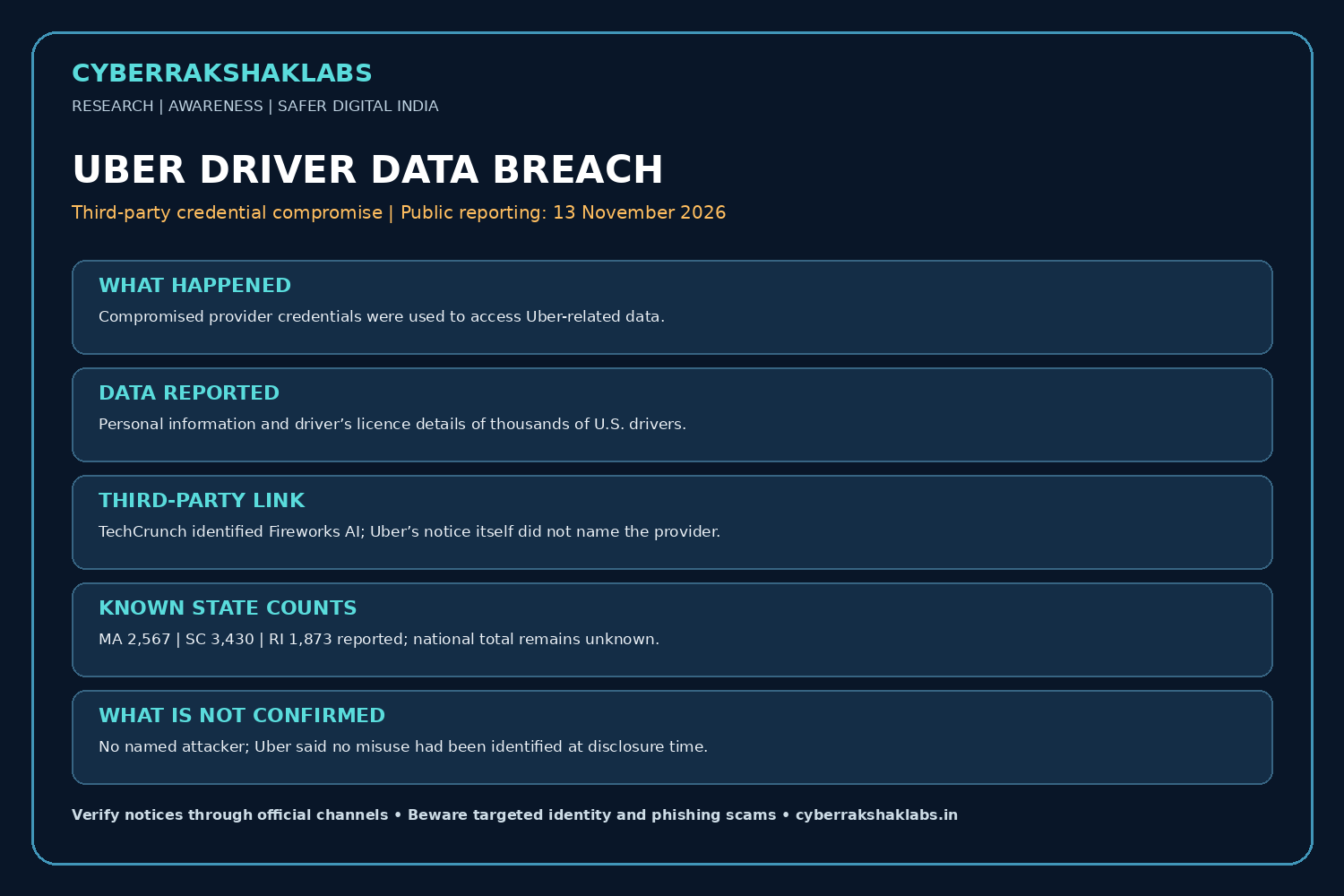
Uber confirmed that credentials compromised at a third-party service provider were used to access Uber-related data. TechCrunch identified the provider as Fireworks AI and reported that the accessed information included personal information and driver’s licence details belonging to thousands of U.S. drivers. The publicly described access path is through a provider relationship; it is not evidence that Uber’s core production environment was directly breached.
The final number of affected drivers is unknown. TechCrunch reported state notification counts of 2,567 in Massachusetts, 3,430 in South Carolina and 1,873 in Rhode Island; an Illinois filing had a pending count. These are reported state counts, not a confirmed national total.
1. Confirmed facts and unknowns
- Fireworks notified Uber on 9 October 2026 that credentials had been compromised and used to access Uber’s account with the provider.
- Uber disconnected data connections with the provider and investigated. By 13 October, the investigation determined that the credentials had accessed Uber data, including personal information.
- TechCrunch identified Fireworks AI as the provider and reported driver’s licence information among the stolen data. Reuters noted that Uber’s public notice did not name the provider or enumerate the data fields.
- Uber said it had not identified misuse of the information at the time of reporting. This does not establish that future misuse will not occur.
- The precise total population, complete data-field inventory, initial credential-theft technique, dwell time and downstream distribution remain unknown in the reviewed public sources.
2. Incident timeline
| Date | Event |
|---|---|
| October 2026 (exact date not public) | Fireworks AI experienced unauthorized access involving compromised credentials. |
| 9 October 2026 | Fireworks notified Uber that compromised credentials had been used to access Uber’s account with the provider. |
| 13 October 2026 | Uber’s investigation determined that the credentials were used to access Uber data and that personal information was included. |
| 10 November 2026 | Uber’s breach notice was dated, according to Reuters. |
| 13 November 2026 | TechCrunch and Reuters published reports; Uber was notifying affected drivers and offering credit monitoring and fraud assistance. |
3. Evidence-led attack path
- Third-party compromise: an attacker obtained or accessed credentials associated with Fireworks AI. The precise technique is not public.
- Credential abuse: compromised credentials were used to access Uber data through the provider relationship.
- Data access and theft: personal information was accessed; TechCrunch reported driver’s licence details among the stolen information.
- Potential downstream abuse: identity fraud, targeted phishing, impersonation and attempts to exploit account-recovery or identity-verification processes are plausible risks, not confirmed follow-on activity.
- Response: Uber disconnected data connections, investigated and notified affected individuals.
This is an evidence-led third-party access path. The source material does not establish the initial credential-theft method or a direct compromise of Uber’s core production environment.
4. Impact and how attackers may use the data
Driver’s licence details are valuable identity data. Combined with other personal information, they can make phishing and impersonation more convincing and may support fraudulent applications or attempts to defeat identity checks. The reviewed public reporting does not establish that these activities have occurred in this case.
The incident demonstrates that vendor access is part of an organisation’s security boundary. Least privilege, scoped credentials, short-lived tokens, monitoring and rapid revocation are essential.
5. Threat actor assessment
No named group has publicly claimed responsibility for the Uber data theft in the sources reviewed. TechCrunch reported that Fireworks attributed its provider-side incident to a financially motivated cybercriminal group interested in selling stolen tokens for access to large language models.
That is Fireworks’ reported characterization of its own incident; it does not identify the actor or prove that the same group directly exfiltrated Uber driver records. No actor, nationality or campaign attribution is asserted.
6. Detection, response and protection
- Inventory all integrations, service accounts, API keys and credentials with access to the provider; revoke and rotate affected secrets.
- Review provider and Uber audit logs for unusual API calls, bulk reads, unfamiliar IPs, abnormal access times, privilege changes and unexpected exports.
- Determine exactly which records and fields were accessed, over what period, and whether other customer or employee data was involved.
- Preserve logs and forensic evidence; coordinate legal, privacy, procurement and incident-response teams.
- Require the provider’s incident timeline, root-cause analysis, credential inventory, containment evidence and independent remediation validation.
- Affected drivers should verify notices through official Uber channels, monitor accounts and credit, and treat unsolicited requests for identity documents or one-time codes as suspicious.
- Organisations should enforce least privilege, short-lived scoped credentials, secrets vaulting, rotation, phishing-resistant MFA where supported, vendor access monitoring and tested third-party incident procedures.
7. Scope and confidence
This report separates facts in Uber’s public notice as relayed by Reuters, provider identification and data-field detail reported by TechCrunch, and analytical downstream-risk scenarios. The reviewed sources do not provide a complete forensic report.
No precise national total, confirmed misuse, named attacker or definitive provider-side root cause is asserted.
8. Conclusion
The publicly described Uber incident involved compromised credentials associated with a third-party provider being used to access Uber-related data. TechCrunch identified the provider as Fireworks AI and reported exposure of personal information and driver’s licence details belonging to thousands of U.S. drivers.
The complete affected population, full data-field inventory, initial credential compromise technique and downstream misuse remain unknown in the reviewed sources. Organisations should treat vendor credentials and integrations as part of their security boundary, constrain access, monitor provider activity and maintain tested third-party incident response procedures.
References and source notes
- TechCrunch, 13 Nov 2026: Uber confirms hackers stole thousands of drivers’ licence information in data breach.
- Reuters, 13 Nov 2026: Uber says U.S. drivers’ licence data stolen in data breach.
- User-supplied Input_Post(3).docx, 14 Nov 2026.
Source limitation: the public-source research supplied for this article does not include a complete forensic report. Provider identification and driver’s licence data details are attributed to TechCrunch; Reuters is cited for Uber’s public notice context and reported notice date.