
🔐 Yatra.com Listed by LockBit5: Claim, Evidence and Customer Risk
LockBit5 leak-site claim | Evidence assessment, customer risk and defensive guidance
Executive summary
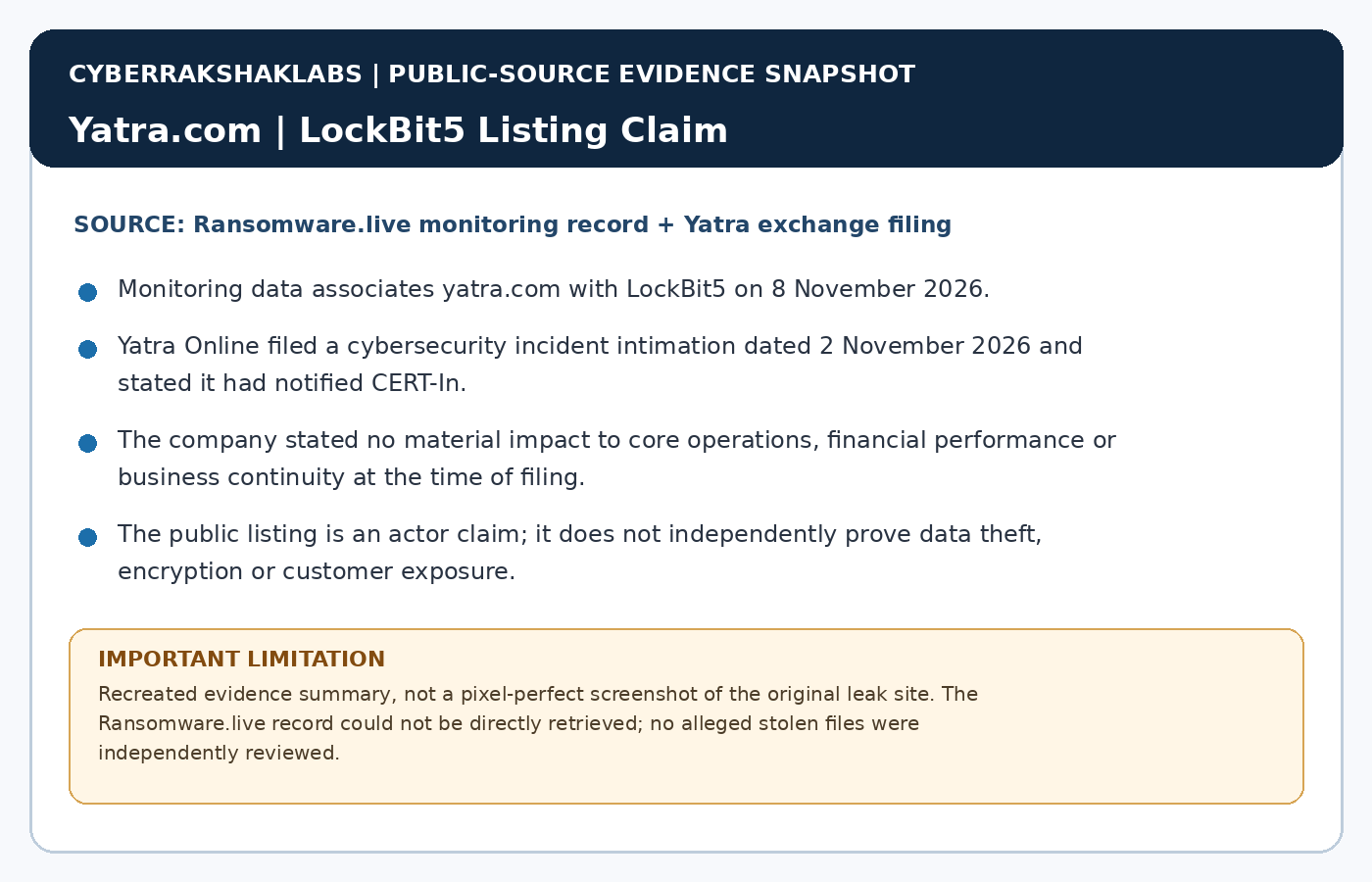
On 8 November 2026, Ransomware.live monitoring data associated yatra.com with the LockBit5 ransomware group. This is a leak-site listing / actor claim—not independent proof that Yatra’s environment was compromised, that data was exfiltrated, that systems were encrypted, or that customer information was exposed.
Separately, Yatra Online Limited filed an exchange intimation dated 2 November 2026 confirming a cybersecurity incident, CERT-In notification and an ongoing assessment. The filing stated there was no material impact to core business operations, financial performance or business continuity at the time. The reviewed sources do not establish that the two events are linked.
1. Evidence assessment
| Question | Finding |
|---|---|
| Was a LockBit5 listing reported? | Yes. Monitoring data records yatra.com associated with LockBit5 on 8 Nov 2026. |
| Did Yatra disclose a cyber incident? | Yes. Company filing dated 2 Nov 2026 confirms an incident and CERT-In notification. |
| Are these events linked? | Not established by the reviewed evidence. |
| Was customer data stolen? | Not independently verified; no data sample was authenticated. |
| Was encryption confirmed? | No Yatra-specific encryption evidence was found in the reviewed sources. |
| Named affiliate / operator? | No individual or affiliate attribution established. |
2. Timeline
| Date | Event | Interpretation |
|---|---|---|
| 2 Nov 2026 | Yatra Online exchange intimation dated 2 Nov. | Company confirms incident, CERT-In notification and assessment; no material impact stated at that time. |
| 5 Nov 2026 | Investor-relations page displays the filing in its 5 Nov list. | The PDF itself carries the date 2 Nov; distinguish filing date from page listing date. |
| 8 Nov 2026 | Ransomware.live monitoring associates yatra.com with LockBit5. | Threat actor / monitoring claim; not independently verified compromise. |
| 10 Nov 2026 | Research verification snapshot. | No authenticated stolen data or Yatra-specific technical intrusion details identified in the reviewed sources. |
3. Threat actor: LockBit5 and historical context
LockBit operates as a ransomware-as-a-service (RaaS) ecosystem. Core operators maintain malware, infrastructure and extortion services; affiliates may conduct intrusions and share proceeds. Earlier generations include LockBit 2.0, LockBit 3.0 and Linux/ESXi variants.
Law-enforcement Operation Cronos disrupted LockBit infrastructure in February 2024, including seizure of public-facing sites and servers. Subsequent reporting described a LockBit 5.0 resurgence/relaunch in 2025. These historical facts explain the brand and operating model but do not prove which affiliate, access broker or infrastructure was involved in the Yatra listing.
4. Likely ransomware / data-extortion lifecycle (generic model)
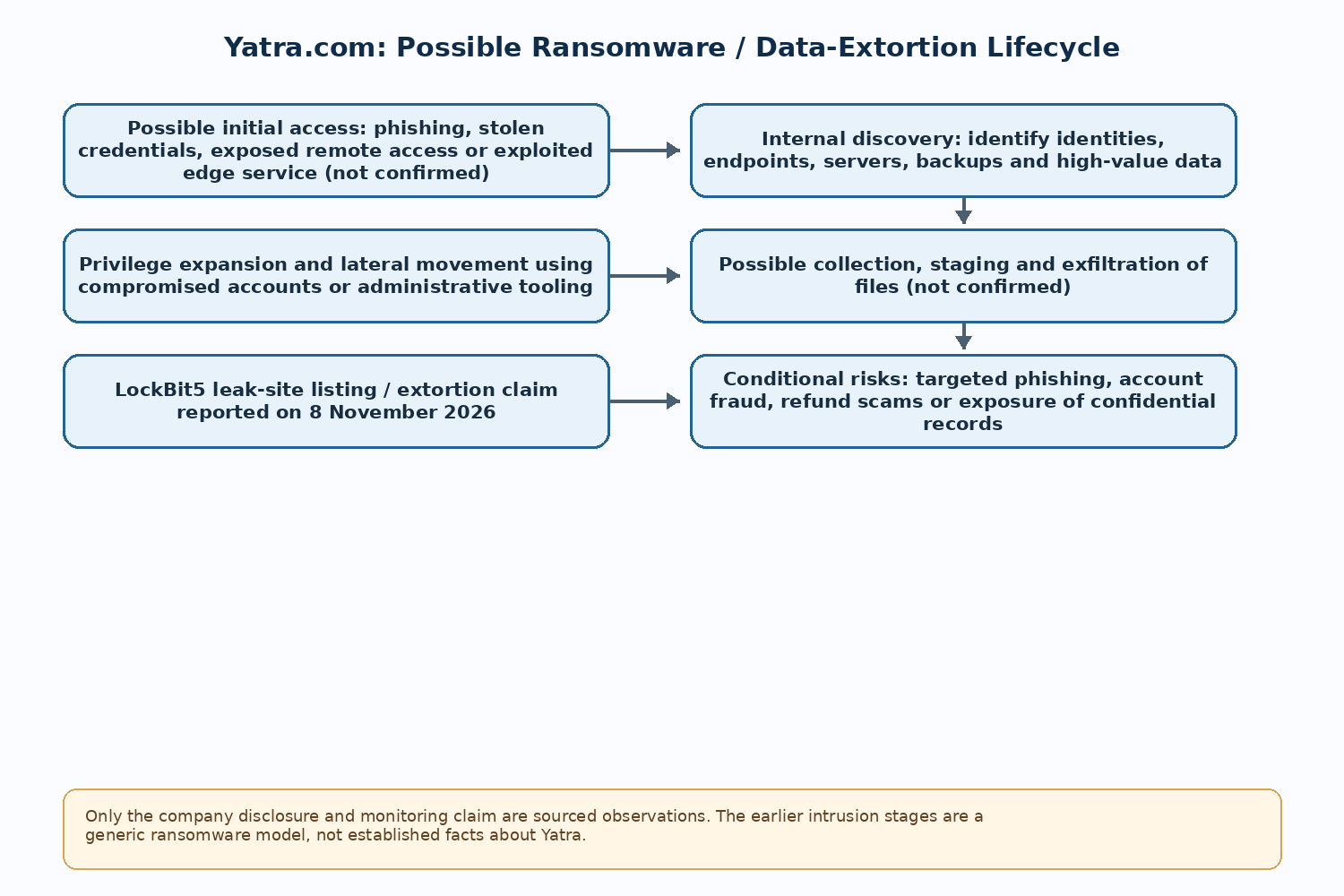
These are generic ransomware lifecycle possibilities, not confirmed Yatra activity.
Initial access
Phishing, stolen VPN/RDP credentials, exposed remote-management services, exploitation of internet-facing appliances or compromised suppliers. No Yatra-specific entry vector is confirmed.
Discovery & privilege expansion
Attackers may enumerate identities, file shares, endpoints, cloud resources, backups and administrative accounts. Not confirmed for Yatra.
Collection & staging
Files may be gathered, compressed or staged before transfer. No Yatra data collection has been verified.
Exfiltration / extortion
Data may be transferred to attacker-controlled infrastructure. No exfiltration volume or destination is known. A leak-site listing can pressure a victim through an allegation and threat of publication.
Encryption
Ransomware may encrypt systems, but a leak-site claim alone does not establish that encryption occurred.
5. How travel-platform data could be misused
The following are conditional scenarios, not findings about Yatra’s records:
Booking / itinerary phishing
Real passenger names, destinations or dates can make fake refund, cancellation and rescheduling messages convincing.
Account takeover
Exposed email addresses, phone numbers or reused credentials can support credential stuffing and targeted takeover attempts.
Identity fraud
Identity-document images or profile details, if present, could support impersonation and fraudulent support requests.
Payment / refund fraud
Booking references and contact details could make fake payment-verification or refund workflows appear genuine.
Corporate / vendor fraud
Employee and supplier details could support business-email compromise, invoice redirection or impersonation of travel coordinators.
Personal safety & privacy
Itinerary and travel-date information can reveal when someone is away from home or where they are expected to be.
6. Indicators and detection opportunities
- Identity: anomalous sign-ins, impossible travel, MFA fatigue, new MFA methods, suspicious OAuth grants, service-account activity and privilege changes.
- Endpoint / server: unexpected remote administration, archive creation, credential-dumping alerts, suspicious scripting, security-tool tampering and unusual privileged processes.
- Network: abnormal outbound volume, rare destinations, new cloud-storage usage, long-lived sessions and unexpected data-transfer protocols.
- Backup / file systems: mass file access, permission changes, backup deletion, snapshot removal and large-scale renaming / encryption.
- Email / support: mailbox forwarding rules, bulk exports, password-reset anomalies and unusual help-desk requests.
7. Defensive actions for organisations
- Preserve endpoint, identity, VPN, firewall, DNS, cloud audit, email and backup logs; maintain evidence chain of custody.
- Scope access, collection, exfiltration and encryption separately; do not assume one from another.
- Revoke suspicious sessions / tokens, rotate exposed credentials and secrets, isolate compromised hosts and restrict remote management.
- Verify offline / immutable backups and test restoration; isolate backup administration from normal domain credentials.
- Determine exact affected data categories before issuing customer guidance or making public claims.
- Coordinate legal, privacy, regulatory and law-enforcement notifications as applicable.
- Prepare customer-support and finance teams for booking / refund impersonation and vendor-payment redirection attempts.
8. Guidance for customers and travellers
- Do not assume your booking data was exposed solely because a ransomware group posted a claim.
- Access the company through its official app / site or a trusted bookmark; do not follow incident-related links from unsolicited messages.
- Treat urgent refund, cancellation, rescheduling or payment-verification messages with suspicion.
- Never share OTPs, card PINs, CVVs, passwords or remote-access codes with callers claiming to be support staff.
- Change reused passwords on other services; use unique passwords and MFA where available.
- Review account and payment activity; contact the company through independently verified support channels if something appears unusual.
9. Conclusion
The Yatra / LockBit5 report should be described as a ransomware-group claim requiring monitoring, not as a confirmed customer-data breach. Yatra’s earlier exchange filing independently confirms a cybersecurity incident and CERT-In notification, but the available evidence does not connect that event to LockBit5.
Further conclusions require an official update, forensic confirmation or independently validated samples.
References
- Ransomware.live record supplied in the input (direct retrieval unavailable during verification; treat as monitoring reference): Ransomware.live listing.
- Yatra Online Limited, Intimation of Cyber Security Incident, 2 Nov 2026: Company filing (PDF).
- Yatra investor-relations compliance disclosures: Investor relations page.
- Check Point Research, The State of Ransomware – Q1 2026: Research report.
- U.S. DOJ, U.S. and U.K. Disrupt LockBit Ransomware Variant, 20 Feb 2024: DOJ release.
- Australian Cyber Security Centre, Understanding Ransomware Threat Actors: LockBit: ACSC advisory.