
Public ransomware trackers listed Amantya Technologies under the name Orova on 12 October 2026. The listing is an actionable warning signal; it is not, by itself, forensic proof of intrusion, file encryption, data theft or a particular initial-access method.
1. Executive Summary — What We Know and What We Do Not
On 12 October 2026, public ransomware-tracking sources listed Amantya Technologies as a victim associated with Orova. The listing was also reflected in third-party monitoring dashboards and aggregator pages. This is a meaningful threat-intelligence lead because a public extortion listing can signal an attempt to apply pressure, but the listing itself does not prove the full claim.
Amantya describes its work across AI, software, data, cloud, telecommunications, GIS and digital engineering. These environments may contain customer information, source code, credentials, cloud configuration, project files and operational documentation. None of these categories should be described as stolen in this case without authenticated evidence.
CyberRakshakLabs rates the listing HIGH priority for validation, not as a confirmed breach verdict. Defenders should investigate promptly, preserve evidence and avoid repeating attacker claims as established facts.
2. What Public Trackers Show
The public Orova group tracker includes Amantya Technologies in its victim listings with a discovery date of 12 October 2026. A separate RansomLook listing feed also showed an Amantya Technologies/Orova entry, and a third-party ransomware tracker displayed the same association.
These sources corroborate that the listing was circulating publicly. They should not automatically be treated as three independent confirmations of the underlying incident: aggregators may reuse the same original post or upstream feed. No independently verified forensic artifact in the supplied material resolves that limitation.
For company context, Amantya's official website describes its work across software, AI, cloud, data, telecom and GIS. That helps frame potential areas to examine, but it is not evidence that any of those systems were compromised.
3. Evidence Matrix — Listing Versus Confirmed Incident
| Finding | Assessment | Confidence |
|---|---|---|
| Public victim listing exists | Visible in multiple public tracker surfaces under the Orova name. | High that the claim is circulating |
| Confirmed intrusion | Not independently established by the evidence reviewed. | Unconfirmed |
| Data exfiltration | No verified Amantya-specific sample or exfiltration evidence established here. | Unconfirmed |
| Encryption or operational outage | No reliable evidence reviewed confirms encryption or service disruption. | Unconfirmed |
| Initial access vector | Unknown. Do not assume phishing, VPN compromise or an exploited vulnerability. | Unknown |
| Orova attribution | Orova is the label attached to the listing; the operators and access path remain unverified. | Claimed association only |
This matrix is intentionally conservative. It separates evidence that a listing exists from the much stronger claim that a specific compromise and data theft have been forensically demonstrated.
4. Timeline — Public Reporting Snapshot
- 12 October 2026: third-party ransomware trackers displayed Amantya Technologies in a victim listing associated with Orova.
- 13 October 2026: public commentary and aggregator pages continued to reference the listing.
- At the time of this research: the reviewed material did not independently confirm incident scope, root cause, the authenticity of any alleged stolen data, or the use of encryption.
The date shown by a tracker is a disclosure or discovery date. It should not be presented as the date the organisation was compromised unless the underlying evidence establishes that distinction.
5. Why a Ransomware Listing Matters — Even Before Confirmation
Leak-site listings can be used to create urgency and reputational pressure. In some incidents, actors threaten to publish selected files; in others, claims can be exaggerated, copied, stale, misleading or unsupported. Ransomware operations may combine data theft with encryption, but that pattern varies by actor and event.
- Credibility pressure: a named victim listing can trigger questions from customers, staff and partners before technical facts are known.
- Data-extortion risk: purported samples may be used to pressure a victim. Their provenance must be validated.
- Follow-on targeting: any genuinely exposed contact or project information could make phishing or business-email-compromise attempts more convincing.
- Operational risk: encryption, deletion and outage are possible ransomware impacts in general, but none is confirmed here.
These are general extortion patterns, not findings that any of these actions occurred at Amantya.
6. The Supplied Screenshot — What It Does Not Prove
The source DOCX includes an image captioned as a leak screenshot, showing a notice about passwords associated with a list of other companies. In the supplied image, that notice does not establish that Amantya is on the list or that Amantya credentials were exposed. The screenshot is not independently authenticated and is not reproduced here as Amantya-specific breach evidence.
Before relying on any alleged sample, responders should confirm its original location, capture timestamp, file hash, provenance and relevance to the claimed victim. Filenames or a dark-web watermark are not enough to demonstrate that data came from the named organisation.
7. Threat Actor and Attribution Boundaries
Orova is the ransomware-group name attached to the public victim listing. A label on a leak site is not sufficient to establish the people behind an operation, their location, an access broker, a specific malware family, or links to other groups.
The reviewed material did not provide a verified Amantya-specific malware sample, infrastructure indicator, ransom note, validated exfiltrated dataset or forensic artefact that would support deeper attribution. Avoid country-level attribution or naming a particular ransomware strain without additional evidence.
8. Likely Exposure Areas to Investigate — Not Confirmed Stolen Data
Given Amantya's public business profile, incident responders may need to review the following areas as part of a broad scoping exercise. This list is an investigation guide, not a claim that these assets were compromised.
- Identity provider, corporate email, VPN, remote-access tools and privileged accounts.
- Cloud consoles, object storage, SaaS platforms, CI/CD systems and secrets repositories.
- Customer and partner documents, engineering artefacts, source repositories and project data.
- Backups, hypervisors, endpoint-management systems and administrative jump hosts.
- External-facing services, management interfaces and recent firewall or identity-policy changes.
9. Attack-Flow Analysis — A Triage Model, Not a Reconstructed Intrusion
The diagram below describes a defensive workflow for validating a ransomware claim. It does not assert that every stage occurred in the Amantya case. Initial access, collection, exfiltration and impact must be established from endpoint, identity, network, cloud and application evidence.
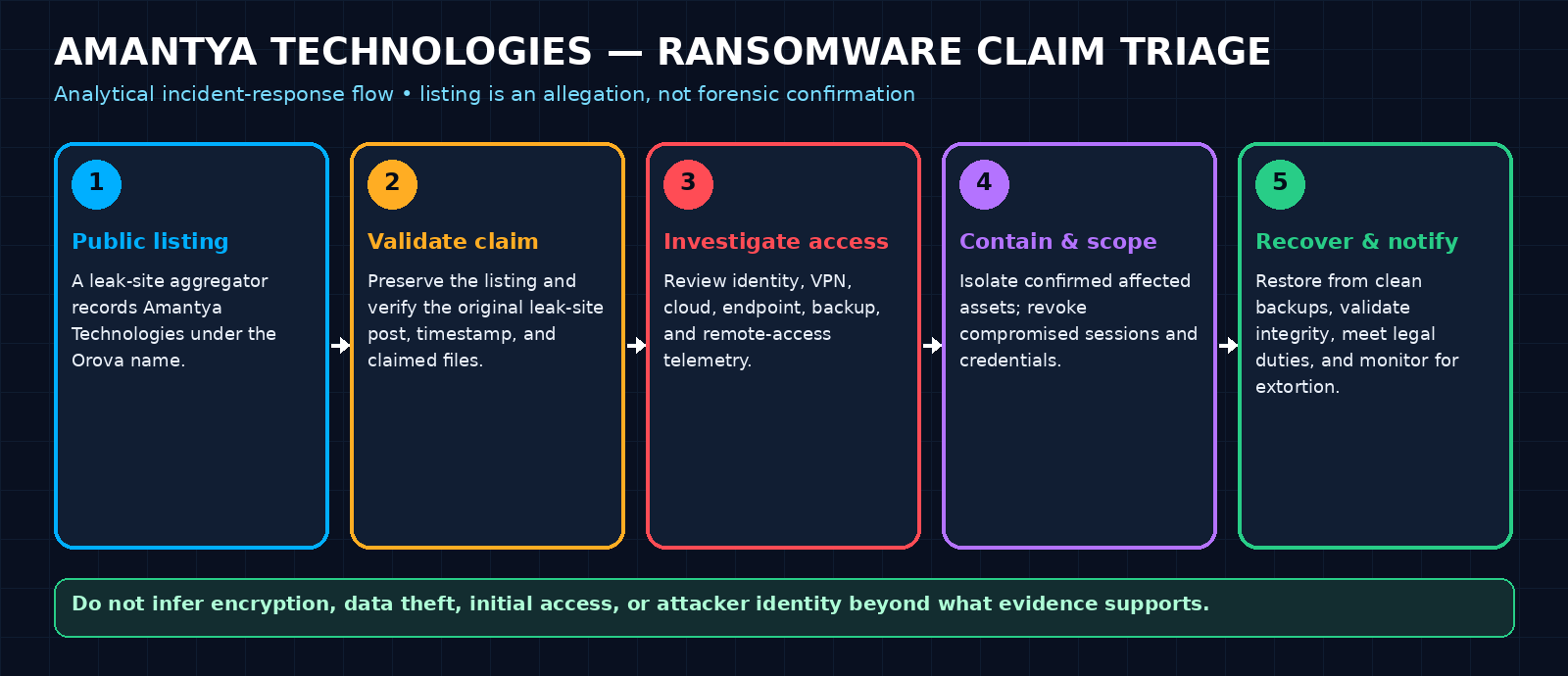
Do not infer successful compromise from the presence of a listing alone. Correlate every proposed stage with timestamps, accounts, hosts, log records and validated artefacts.
10. Initial Access — Questions Investigators Should Test
The initial-access vector is unknown. The response team should test hypotheses against telemetry rather than selecting a likely-sounding explanation in advance.
- Were there anomalous sign-ins, MFA changes, suspicious OAuth grants, new administrator accounts or unusual token activity?
- Did VPN or remote-management access originate from new locations, devices or unusual time windows?
- Were internet-facing applications or management interfaces exposed or recently changed?
- Do endpoint, application or cloud logs show exploitation, unexpected command execution, new persistence or access to unusual repositories?
- Does outbound traffic show a verified transfer pattern linked to any claimed dataset or archive?
Phishing, credential abuse, a vulnerable public-facing service and a compromised remote-access path are possible lines of enquiry only; none is established by the public listing.
11. Potential Impact If the Claim Is Confirmed
If a material compromise and data access are confirmed, potential impact could include exposure of customer or partner information, project documentation, engineering artefacts, source code, credentials or cloud configuration. Depending on the actual scope, secondary risks could include targeted phishing, supplier impersonation, business-email compromise, contractual obligations and reputational harm.
These are conditional risk scenarios. The current evidence does not establish which, if any, data category was accessed or taken, and it does not confirm encryption or an outage.
12. Recommended Response — First Priorities
- Preserve the original listing URL, timestamps, screenshots and any claimed samples. Record collection time and cryptographic hashes.
- Activate incident response, assign an incident lead and verify the listing through safe, authorised channels.
- Review identity, email, VPN, cloud and endpoint telemetry for anomalous sign-ins, privileged changes and session/token misuse.
- Hunt for unexpected remote tools, bulk file reads, archive creation, suspicious shell or PowerShell activity, data staging and abnormal outbound transfers.
- If compromise is confirmed, isolate affected systems according to response policy, rotate exposed credentials/tokens from a clean administrative device and block verified malicious infrastructure.
- Validate immutable backups and recovery paths; do not rebuild before preserving evidence and containing the root cause.
- Assess exposure from authenticated evidence, then follow applicable legal, contractual and privacy-notification obligations.
13. DFIR — Preserve Evidence Before It Disappears
Prioritise logs that have limited retention windows: identity-provider and MFA events, VPN/remote-access logs, EDR telemetry, endpoint process history, web application/WAF logs, cloud audit records, storage access, database queries and network egress. Preserve original files and document chain-of-custody details.
Do not download or execute suspicious files on production systems merely to validate an actor's claim. Analyse samples in a controlled environment and keep the original hash, acquisition method and handling notes with the evidence.
14. Detection and SOC Hunting Priorities
- New privileged users or MFA resets
- Unfamiliar sign-in locations and legacy authentication
- Suspicious sessions, token activity or OAuth grants
- Unusual VPN and remote-access usage
- EDR disablement or security-tool tampering
- Mass file changes, archive tools or shadow-copy deletion
- Unexpected remote-management software
- Abnormal outbound volume or new destinations
- Bulk downloads and unusual API calls
- New access keys or modified retention policies
- Unexpected repository cloning
- Changes to storage or sharing permissions
- Abnormal database reads or export jobs
- New files, web processes or scheduled tasks
- Unusual access to customer/project repositories
- Log gaps or unexpected logging-policy changes
Build detections around the environment's own baseline and verified incident indicators, not around the victim listing alone.
15. Indicators of Compromise — None Verified for This Case
Do not add generic ransomware infrastructure as if it were Amantya-specific. An IoC table should be published only after artefacts are collected, validated, and tied to this incident with a documented source and confidence level.
16. MITRE ATT&CK Perspective — Avoid Premature Mapping
A public victim listing does not establish an ATT&CK technique. If forensic evidence later confirms credential misuse, exploitation, collection or exfiltration, analysts can map those observed behaviours to the relevant techniques and document the evidence supporting each mapping.
Until then, keep all access and impact hypotheses labelled as investigative possibilities, not confirmed tactics, techniques or procedures.
17. CyberRakshakLabs Assessment — Priority Is Not Proof
CRL Assessment: HIGH investigation priority. The public listing is sufficiently relevant to warrant prompt validation by the organisation and its incident-response partners. The reviewed evidence does not support announcing a confirmed breach, confirmed data theft or confirmed encryption.
The operational priority is to compare the claim against identity, endpoint, cloud, application, database and egress telemetry; preserve time-sensitive evidence; verify sample provenance; and update the assessment only when reliable evidence changes the picture.
18. Limitations — What Would Change This Assessment?
Confidence would materially change if there were an authenticated statement from the organisation, verifiable incident-specific samples, reliable forensic findings, confirmed abnormal access, validated exfiltration records or a technical advisory tied to the affected environment. Tracker entries copied from one another do not substitute for that evidence.
This article reflects a 13 October 2026 public-source snapshot. Reassess it if new primary evidence becomes available.
The supplied DOCX provided the research framing, evidence caveats and incident-response priorities. Public tracker references reviewed for this snapshot include:
Orova group tracker ↗
RansomLook public listing feed ↗
Digital Checkmark ransomware tracker ↗
Amantya Technologies official website ↗
Tracker entries show that the claim is circulating; they do not independently confirm intrusion, exfiltration, encryption or attacker attribution. The screenshot supplied in the brief is not treated as proof of Amantya data exposure.
Think Before You Click. Stay Aware. Stay Secure.
CyberRakshakLabs — Threat Intelligence for a Safer Tomorrow.