
Executive Summary
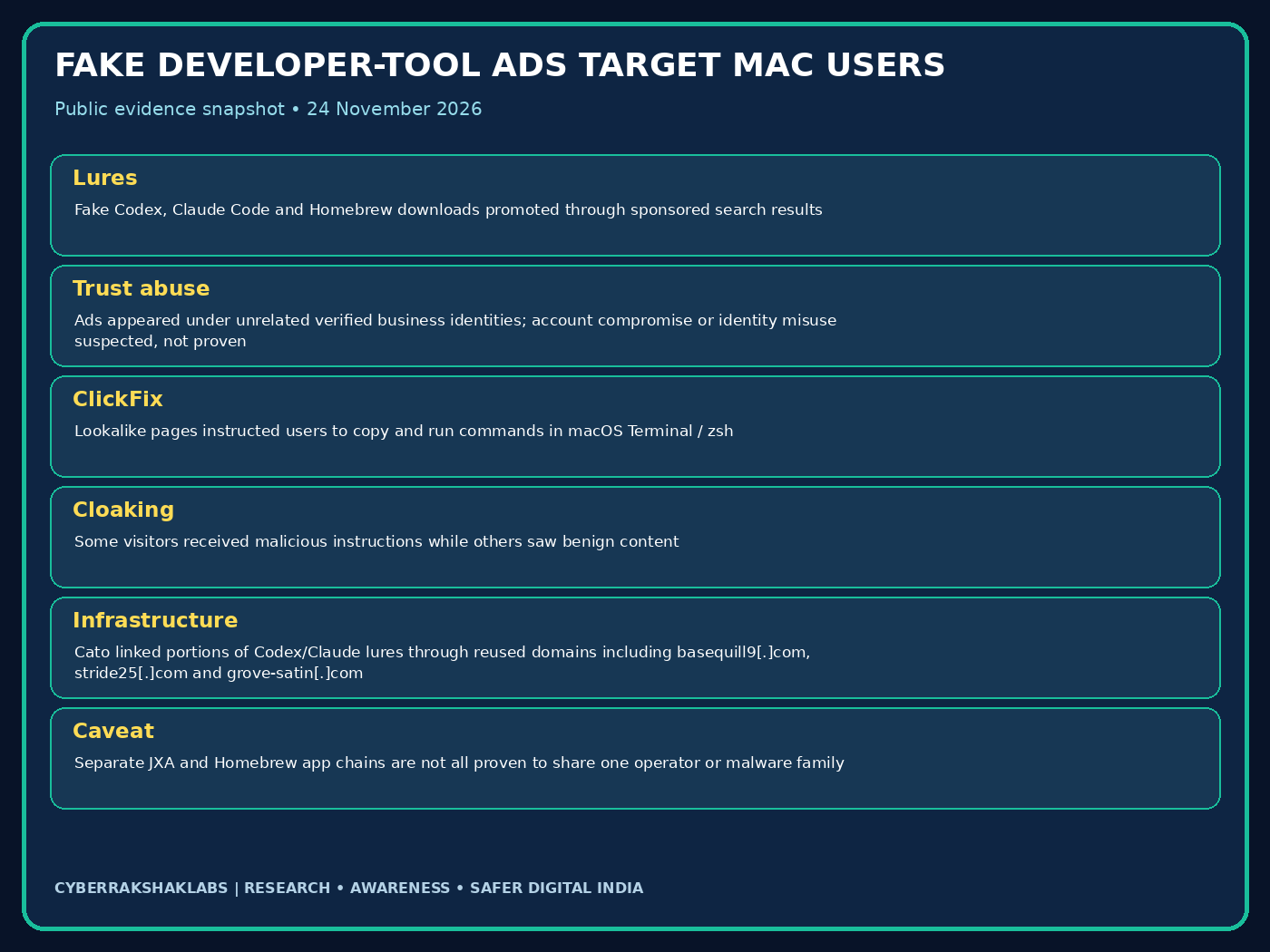
Cato Networks reported malicious Google sponsored results promoting fake Codex, Claude Code and Homebrew downloads. The advertisements appeared under identities associated with legitimate but unrelated businesses. Cato assessed possible advertiser-account compromise or identity misuse; the precise mechanism was not proven.
Search-ad redirects led to lookalike pages and ClickFix instructions that persuaded users to paste commands into macOS Terminal/zsh. Cato linked portions of Claude and Codex activity through reused downstream infrastructure and similar encrypted loaders. Separate JavaScript for Automation (JXA) and Homebrew application chains were not all linked to one operator or malware family.
1. Campaign Overview and Historical Context
The campaign abused trust in widely used developer tools and package-management software. A user searching for Codex, Claude Code or Homebrew could encounter a sponsored result that appeared to be associated with a legitimate but unrelated verified business identity. The ad redirected to a lookalike download or instruction page rather than the genuine project.
Fake Homebrew and macOS developer-tool installers have appeared in earlier campaigns. Cato references Google-ad Homebrew impersonation in January 2025, further AMOS/Odyssey domain activity in October 2025 and separate fake Homebrew/ClickFix reporting in 2026. These examples show recurring abuse of trusted software brands, not one proven continuous actor.
Cato published its consolidated investigation on 19 November 2026; Hackread covered it on 23 November 2026. The supplied research document also includes a page-2 diagram mapping observed Codex/Claude lure domains to downstream infrastructure and a captured Codex ad displayed under an unrelated verified business identity.
2. Attack Chain: From Sponsored Search Result to Terminal Execution
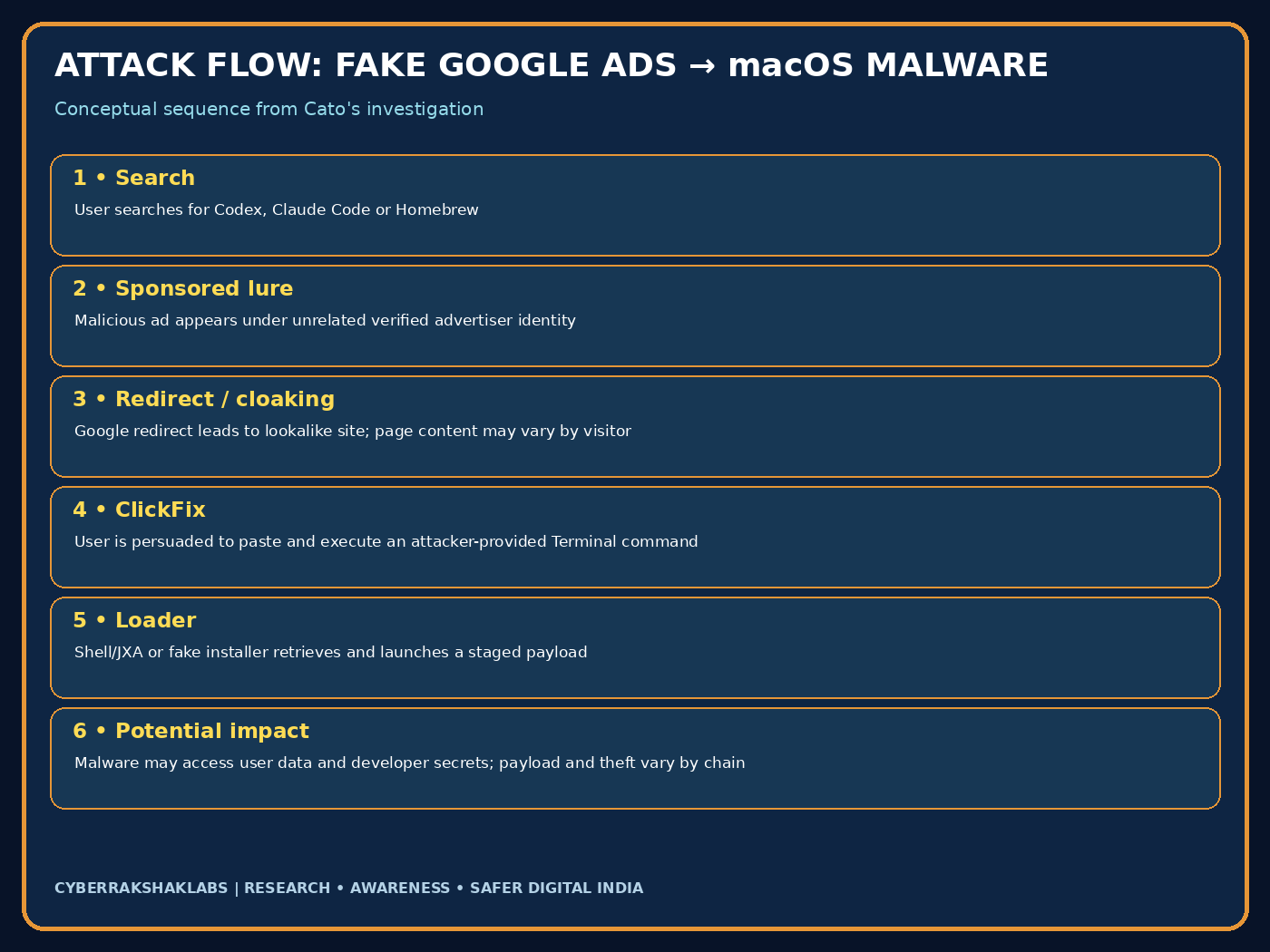
- Search: A user searches for Codex, Claude Code or Homebrew and sees a malicious sponsored result.
- Sponsored lure / trust abuse: The ad appears under a verified identity associated with an unrelated business. Advertiser-account phishing or identity misuse is suspected, not proven.
- Redirect and cloaking: A redirect reaches a lookalike site. Cato observed traffic cloaking: some visitors received malicious instructions while others saw benign content.
- ClickFix instruction: The fake page asks the user to copy and execute a command in macOS Terminal/zsh. This turns the victim into the execution mechanism and can bypass the instinct to avoid downloading a conventional installer.
- Loader activity: In the observed Claude chain, the command decoded a hidden URL, fetched a script from
vine-96[.]com, decrypted/decompressed staged content and attempted to retrieve/tmp/helper. A separate telemetry request went togrove-satin[.]com. - Separate JXA and Homebrew-lookalike chains: Another chain used JXA from
claude-tools[.]comto retrieve a native payload fromkmtxyn[.]com/agent. A Homebrew-lookalike application chain involvednomeibrew[.]com,pirloz[.]com, GitHub/jsDelivr and a sample namedDayNote.
3. Infrastructure and Indicators of Compromise
Observed lure domains
parentpreneurx[.]com, homebrexwin[.]com, storageprofiler[.]com, codex-notes[.]com, cli-desktop[.]com, claud-tips[.]com, cli-codex[.]com, codex-craft[.]com, codex-desk[.]com and claude-tools[.]com.
Downstream / payload-related domains
basequill9[.]com, stride25[.]com, plume-compass[.]com, grove-satin[.]com, vine-96[.]com, kmtxyn[.]com, nomeibrew[.]com and pirloz[.]com.
Roles vary by chain. Cato notes that some C2-related labels do not confirm post-execution command-and-control activity for every domain. Shared Cloudflare IP addresses are hosting context, not reliable attribution evidence. Domains may now be inactive or reassigned.
Behavioral leads
- Browser-to-Terminal execution and encoded zsh commands.
- Base64 decoding followed by AES-128-CTR/gzip loader activity.
- Retrieval or execution of
/tmp/helper. - Counterfeit
Finder.appbundles in user-writable Application Support locations. - Unexpected retrievals from GitHub and jsDelivr.
These indicators and behaviors are historical research observations. Their current availability or malicious status should be validated before operational blocking decisions.
4. Campaign Timeline
| Date | Observed event |
|---|---|
| 14 Aug 2026 | Cato's earlier Codex investigation captured a sponsored result and a fake TALLY decoy. |
| 17 Aug 2026 | Cato infrastructure records referenced Codex telemetry later correlated with grove-satin[.]com. |
| 11 Sep 2026 | A separate Homebrew-lookalike DayNote disk-image chain was documented. |
| 14 Sep 2026 | A separate Claude JXA chain was documented. |
| 6 Nov 2026 | Cato notified Cloudflare; Cloudflare acknowledged and restricted access to reported URLs. Cato reported nomeibrew[.]com to M247. |
| 11 Nov 2026 | Cato recorded the referenced GitHub repository and jsDelivr resource as unavailable. |
| 19 Nov 2026 | Cato published its consolidated research. |
| 23 Nov 2026 | Hackread published coverage of the Google Ads / macOS malware activity. |
5. Malware Delivery, Attribution and Threat Actor Assessment
No named threat actor, country or organisation was attributed. Cato assessed portions of the Claude/Codex activity as linked to an AMOS-associated delivery system based on reused infrastructure and loader similarities. This does not prove every payload was AMOS and does not identify the operator.
The source connects portions of Claude and Codex activity through reused downstream infrastructure and similar encrypted loaders. It separately describes JXA and Homebrew-lookalike application chains and warns against combining them without supporting evidence.
Accordingly, this research uses a campaign-cluster assessment rather than naming a threat actor or claiming a single malware family across all observed delivery paths.
6. Potential Impact on macOS Users and Developers
If executed, the malware may gain code execution in the affected user's macOS context and access data or secrets available to that user. The source does not establish exact stolen data or victim count.
- Developer repository access: Repository tokens and source-code access credentials may be exposed.
- Cloud access: Cloud API keys, service credentials and local configuration secrets may be accessible.
- SSH material: Private keys, agent access or related connection material may be at risk depending on local permissions and storage.
- Package ecosystem credentials: Package registry tokens and publishing credentials may be exposed.
- CI/CD environments: Build and deployment secrets available to the developer's account or workstation may be at risk.
These are potential consequences of code execution in a developer's user context, not confirmation that each type of secret was accessed or exfiltrated in this campaign.
7. Detection and Hunting Guidance
- Review browser-to-shell process relationships, especially browser activity followed by Terminal or zsh launching encoded commands.
- Investigate zsh commands that perform Base64 decoding, retrieve remote scripts or combine decryption/decompression steps such as AES-128-CTR and gzip.
- Search for unexpected creation, execution or network retrieval of
/tmp/helper. - Inspect user-writable Application Support directories for counterfeit or unexpected
Finder.appbundles. - Review unexpected GitHub and jsDelivr requests, including downloads that do not match normal developer workflows.
- Inspect LaunchAgents, login items, shell startup files, browser extensions, outbound connections and account activity for persistence or follow-on activity.
- Correlate domains with endpoint and network telemetry; do not treat shared CDN or Cloudflare IP addresses as attribution indicators.
Use the domains as historical pivots and validate them against current telemetry and threat-intelligence context. The source cautions that domains may be inactive or reassigned.
8. Defensive Recommendations
For macOS users and developers
- Download developer tools only from official project documentation or trusted publisher channels; navigate directly rather than clicking sponsored search results.
- Never paste commands from advertisements or unfamiliar websites into Terminal without independently understanding every command and its purpose.
- Verify publisher identity, official download links, checksums or signatures where provided, and expected installation procedures.
- If a command has already been executed, isolate the Mac where practical, preserve shell history and downloaded files, and investigate endpoint activity.
- Rotate developer, cloud and package-registry credentials accessible to the device from a clean device; revoke active sessions and tokens where appropriate.
- Review LaunchAgents, login items, shell startup files, browser extensions, outbound connections and account activity. Rebuild from trusted media if system integrity is uncertain.
For organisations and advertisers
- Audit Google Ads users, administrator access, OAuth grants, MFA configuration, payment methods and unexpected campaign changes.
- Use strong MFA and least privilege for advertising accounts; remove stale users and third-party authorisations.
- Monitor for unauthorised campaign creation, changes to destination URLs and suspicious account recovery activity.
- Provide developer-focused awareness training on malvertising, lookalike domains and ClickFix-style instructions.
- Ensure endpoint monitoring can identify suspicious browser-to-shell execution and credential-access activity.
9. Evidence Boundaries and What Is Not Established
Supported by the source investigation
- Malicious sponsored ads promoting fake Codex, Claude Code and Homebrew downloads.
- Lookalike download chains and ClickFix-style Terminal instructions.
- Selective content delivery / traffic cloaking.
- Observed domains and infrastructure reuse connecting portions of Claude/Codex activity.
Not established
- The named operator, country or organisation behind the activity.
- Compromise of every advertiser account whose identity appeared in the ads.
- One common actor across every observed Claude, Codex, JXA and Homebrew chain.
- Universal AMOS attribution for every payload.
- Total number of victims or exact data stolen from every affected Mac.
10. Conclusion
This activity demonstrates how malicious sponsored search results can exploit trust in familiar developer tools. The observed chain combines advertiser-identity abuse, lookalike download pages, selective content delivery and ClickFix instructions that persuade users to run attacker-provided commands in macOS Terminal.
For developers, the risk extends beyond the workstation itself: credentials and secrets available to the logged-in user may provide paths into source repositories, cloud environments, package registries and CI/CD systems. Organisations should therefore combine endpoint detection with credential hygiene and advertising-account security.
The available evidence supports links between portions of Claude and Codex activity, but not a single proven actor or malware family across every chain. Treat the indicators as historical research leads, validate them before blocking, and preserve the distinctions between the separate delivery paths.
11. Sources and Further Reading
- Cato Networks — Threat Actors Abuse Suspected Compromised Google Ads Accounts to Target Developers with Fake Tools (19 November 2026)
- Hackread — Google Ads Used to Spread Mac Malware Through Fake Codex and Claude Code Downloads (23 November 2026)
- User-provided Input_Post.docx, page 2 — Cato infrastructure-reuse and advertiser-identity screenshots.
Historical indicators may be inactive or reassigned. Shared hosting/CDN IPs are not attribution evidence. Potential impact is not proof of successful exploitation or theft.