
Executive Summary
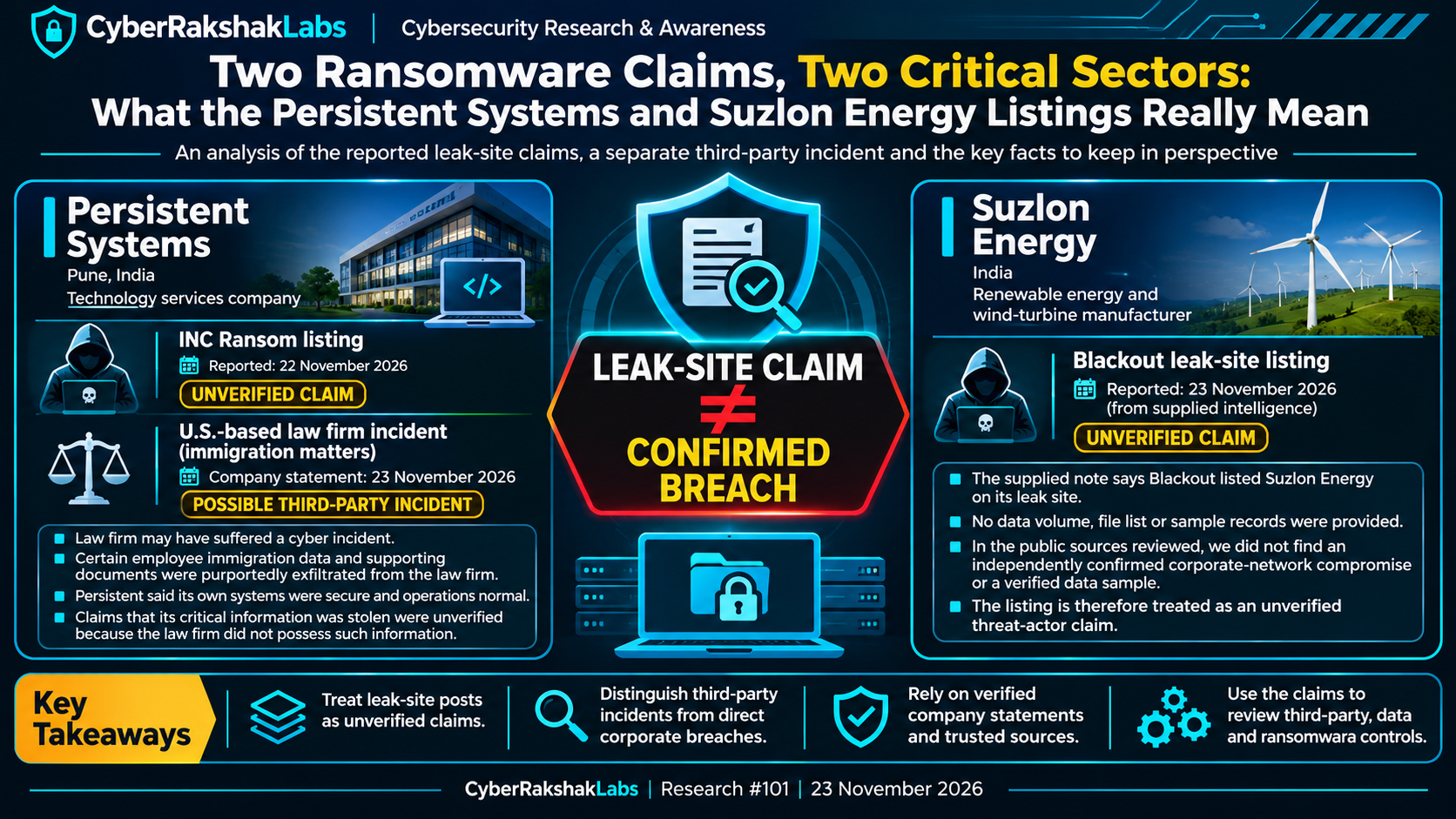
Two ransomware leak-site claims involving Indian organisations have drawn attention. INC Ransom listed Persistent Systems, a Pune-based technology services company, while supplied threat-intelligence notes report that Blackout listed Suzlon Energy, a renewable-energy and wind-turbine manufacturer.
Neither leak-site entry should be treated as proof of a confirmed ransomware intrusion. A post on an extortion group’s leak site is an assertion; it does not independently establish that the named organisation’s corporate network was compromised, that the group possesses the claimed data, or that encryption occurred.
Important update — Persistent Systems, 23 November 2026: Persistent filed a statement with the stock exchanges saying that a U.S.-based law firm it had engaged for immigration matters may have suffered a cybersecurity incident. Certain employee immigration data and supporting documents were purportedly exfiltrated from that law firm. Persistent said its own systems were secure, operations were normal, and claims that its critical information was stolen were unverified because the law firm did not possess such information.
The possible law-firm incident must be considered alongside—but not conflated with—the INC Ransom leak-site listing. For Suzlon Energy, the supplied note reports a Blackout listing but provides no data volume, file list or sample records; no independent confirmation was identified in the sources reviewed for this article.
1. What Has Been Reported?
Persistent Systems — INC Ransom listing
The supplied intelligence note says INC Ransom listed Persistent Systems on its leak site on 22 November 2026 and claimed to hold “tens of thousands” of confidential and mission-critical data items. The note did not include a data volume, file inventory or sample records. A third-party ransomware tracker also indexed a listing attributed to INC Ransom; this corroborates that a claim was recorded, not that the attacker’s assertions are true.
On 23 November 2026, Persistent Systems issued a statement to the NSE and BSE. It said a U.S.-based law firm engaged for immigration matters may have experienced a cyber incident, with certain employee immigration data and supporting documents purportedly exfiltrated from that firm. Persistent stated that its own systems were secure and operations continued normally. It also said claims that its critical information was stolen were unverified because the law firm did not possess such information.
Suzlon Energy — Blackout listing
The supplied intelligence note dated 23 November 2026 reports that Blackout listed Suzlon Energy (suzlon.com) on its leak site. The note describes the company but provides no data volume, file list or sample records.
No independent technical evidence, company confirmation, regulator notice or verified sample dataset was provided with the supplied note. The public sources reviewed for this article did not independently establish that Suzlon’s corporate systems were compromised. The entry is therefore treated as an unverified Blackout claim—not a confirmed breach.
Engineering, project, supplier, maintenance or service information may be sensitive in the wind-energy sector. However, the supplied listing does not establish that any of these data categories were accessed or stolen.
2. Understanding the Attack Type: Ransomware and Double Extortion
Modern ransomware operations often combine data theft with encryption. In a double-extortion model, attackers seek sensitive information before or alongside disrupting systems, then threaten to publish or sell it if the victim does not meet their demands. Some campaigns focus primarily on data theft and extortion even when encryption is not publicly established.
A typical intrusion may progress through the following phases. The exact entry method and actions in either of the two reported claims are not publicly confirmed.
- Initial access: Possible routes in ransomware incidents include phishing, stolen credentials, exposed remote-access services, vulnerable internet-facing systems or a compromised third party. These are common pathways, not confirmed entry methods for either claim.
- Discovery and privilege expansion: Intruders may identify users, servers, directory services, security tools, file shares and business applications, then attempt privilege escalation or lateral movement.
- Collection and staging: Accessible information may be located, copied and compressed. Depending on the environment, this can include contracts, employee records, customer information, technical documents and operational records.
- Exfiltration: Information may be transferred to attacker-controlled infrastructure. Bulk transfer can be difficult to distinguish from legitimate activity without context.
- Encryption or operational disruption: Some operations encrypt servers, endpoints, virtual machines or backups; others may focus on data theft and extortion. Neither encryption nor disruption has been confirmed in the two claims covered here.
- Extortion and leak-site pressure: A group names an organisation and threatens publication. A listing alone does not prove that claimed data is genuine, current or obtained from the named organisation.
3. Threat Actor Profiles
INC Ransom
INC Ransom is a financially motivated ransomware and data-extortion operation active since at least 2023. Public threat-intelligence and government reporting describe it as a ransomware-as-a-service (RaaS) operation with affiliates. It is also associated in public reporting with the names GOLD IONIC and Tarnished Scorpion.
The Australian Cyber Security Centre describes possible affiliate initial-access routes including spear-phishing, exploitation of known vulnerabilities in unpatched internet-facing devices and purchased valid credentials. Reported post-compromise behaviours include account discovery, remote access, archiving data with utilities such as 7-Zip or WinRAR, and exfiltration using tools such as rclone. These are group-level behaviours reported across incidents; they are not evidence that these tools or techniques were used against Persistent Systems.
MITRE ATT&CK documents techniques associated with the group, including domain-account discovery, use of valid accounts over RDP, archiving via utilities and Windows command-shell activity.
Blackout
Threat-intelligence trackers describe Blackout as a ransomware and data-extortion group first observed in early 2024. Public tracking describes leak-site activity involving organisations in healthcare, telecommunications, mining, manufacturing, technology and other sectors, with a double-extortion model.
Public reporting on Blackout’s technical tradecraft is less detailed than reporting available for some larger ransomware operations. The reviewed sources do not provide a sufficiently reliable, specific set of malware hashes, command-and-control indicators or confirmed intrusion techniques attributable to the Suzlon claim. No Blackout-specific technical indicator is asserted in this article.
4. Timeline and Status Assessment
| Date | Event | Assessment |
|---|---|---|
| Since at least July 2023 | INC Ransom activity documented by MITRE and government advisories. | Established actor background. |
| Early 2024 | Public threat-intelligence tracking records Blackout leak-site activity beginning in early 2024. | Group history; not related to the Suzlon claim date. |
| 22 Nov 2026 | INC Ransom listing for Persistent Systems reported by supplied intelligence and indexed by a third-party tracker. | Leak-site claim; not proof of corporate-network compromise. |
| 23 Nov 2026 | Persistent Systems files a statement with NSE/BSE concerning a possible incident at a U.S.-based law firm handling immigration matters. | Company-confirmed awareness of a possible third-party incident; company says its systems are secure and critical-data theft claims are unverified. |
| 23 Nov 2026 | Supplied intelligence note reports a Blackout listing for Suzlon Energy. | Unverified claim; no sample data or independently confirmed incident details provided. |
5. Potential Impact: Why These Sectors Matter
Technology services and IT providers
- Client and supplier exposure: Service providers may process customer data, support tickets, project records, system documentation and business communications. If a provider or its third party is compromised, impact can extend beyond one organisation—but no such exposure is confirmed in the Persistent listing.
- Targeted follow-on phishing: Attackers may use project names, invoice references, support-ticket details or employee information to craft credible messages. This is a plausible risk scenario, not evidence that such data was taken.
- Contractual and regulatory consequences: Confirmed exposure of personal data, customer information or confidential business records may trigger contractual, privacy, regulatory and notification obligations.
- Trust and operational disruption: Customers may temporarily restrict data exchange or access while an incident is assessed.
Renewable energy and wind-turbine operations
- Engineering and intellectual property: Designs, technical drawings, bills of materials and engineering documents could be commercially sensitive if accessed.
- Project and supplier information: Project schedules, procurement records, vendor details and contract documents could support fraud or targeted impersonation if exposed.
- Operations and maintenance: Service procedures, asset information and maintenance records may be sensitive to operators and service partners. The Suzlon claim does not establish that such data was stolen.
- Operational technology: A corporate IT ransomware incident does not automatically mean turbine control systems or OT were compromised. Any OT impact requires separate evidence.
6. Awareness Guidance for Employees and Individuals
- Be alert for emails or messages referencing real project names, invoices, HR matters, immigration documents, supplier payments or support tickets. Verify unexpected requests through a known contact channel.
- Do not open unexpected attachments or links, even when the sender appears to be a colleague, supplier or customer. Confirm unusual requests independently.
- Never share passwords, one-time passcodes, MFA approval codes or recovery codes with anyone claiming to be IT support.
- Report unusual MFA prompts, unexpected password-reset notices, suspicious remote-support requests and unexplained device behaviour to the organisation’s security team.
- Use unique passwords and MFA. Where available, prefer phishing-resistant MFA such as passkeys or hardware security keys.
- Do not download or circulate alleged leaked files. They may contain personal information, malware or legally sensitive material. Report the discovery through official security channels.
- If an employee receives a suspicious message referring to a named incident, preserve the message and report it rather than replying or forwarding it widely.
7. Defensive Recommendations for Organisations
- Validate the claim before making public conclusions. Establish a crisis team spanning security, legal, privacy, communications, HR, business leadership and third-party risk.
- Review identity security. Enforce MFA, disable legacy authentication where possible, monitor unusual sign-ins, restrict privileged accounts and rotate credentials where compromise is suspected.
- Secure remote access. Remove exposed services that are not required, restrict administrative access, use VPN or zero-trust access controls, and monitor RDP and remote-management activity.
- Patch internet-facing systems promptly. Prioritise known exploited vulnerabilities and maintain an accurate external-asset inventory.
- Strengthen endpoint and server detection. Alert on suspicious command shells, unusual archive creation, bulk file access, remote execution, credential dumping and unexpected security-tool tampering.
- Monitor data movement. Establish baselines for outbound transfers and investigate unusual use of cloud storage, file-transfer utilities, synchronisation tools or large outbound archives.
- Protect backups. Maintain offline or immutable backups, separate backup administration from production identity, and regularly test restoration.
- Segment IT, OT and critical production environments. Ensure corporate IT incidents cannot automatically provide access to industrial control or engineering networks.
- Review third-party access and data sharing. Identify what external law firms, payroll providers, engineering partners, managed service providers and suppliers can access; limit permissions and retain audit logs.
- Prepare a data-extortion response playbook. Preserve evidence, validate samples safely, identify affected data subjects and customers, meet applicable reporting duties and coordinate communications.
- Conduct threat hunting using group behaviours as hypotheses—not proof. Search for relevant activity across identity, endpoint, network, email and cloud telemetry.
8. IOCs and Detection Opportunities
Organisations can still use behaviour-based hunting based on publicly documented INC Ransom tradecraft. MITRE ATT&CK and government advisories describe behaviours such as domain-account discovery, remote access using valid accounts, use of command shells, archiving with common utilities and data exfiltration using tools such as rclone. These are detection leads for the actor generally, not incident-specific IOCs and not proof of use in either case.
Potential detection opportunities
- Unusual RDP or remote-management access, particularly from new source locations or accounts that do not normally administer servers.
- Unexpected creation of large archives using 7-Zip, WinRAR or similar utilities, especially when followed by outbound transfers.
- Unusual rclone execution or synchronisation to unfamiliar external storage destinations.
- High-volume access to file shares, engineering repositories, HR stores or document-management systems outside normal business patterns.
- Unexpected disabling of endpoint protection, backup agents, logging or security services.
- New privileged accounts, suspicious group-membership changes, credential-access activity or abnormal service creation.
9. What Is Confirmed, Claimed and Unknown?
| Category | Persistent Systems | Suzlon Energy |
|---|---|---|
| Company communication | Persistent’s 23 Nov statement says a U.S.-based law firm engaged for immigration matters may have experienced an incident; certain employee immigration data and supporting documents were purportedly exfiltrated from that firm. Persistent says its own systems are secure and operations normal. | No company confirmation identified in the sources reviewed for this article. |
| Threat-actor claim | INC Ransom listing reported on 22 Nov; supplied note says “tens of thousands” of data items. Persistent says claims of critical-information theft are unverified. | Supplied note reports a Blackout listing; no volume, file list or sample records provided. |
| Not established | A breach of Persistent’s own corporate network; theft of mission-critical company or client data; ransomware encryption; use of specific malware or infrastructure. | A Suzlon corporate-network compromise; stolen engineering, project or operational data; encryption; OT impact; attacker access method. |
| Incident-specific IOCs | None verified in the material reviewed. | None verified in the material reviewed. |
10. Conclusion
The Persistent Systems and Suzlon Energy listings highlight how ransomware leak sites can create immediate uncertainty for organisations, customers, suppliers and employees. The key analytical discipline is to separate the existence of a listing from proof of an intrusion and to distinguish third-party incidents from compromise of the named company’s own environment.
Persistent Systems’ 23 November statement materially updates the initial reporting: it acknowledges a possible incident at a U.S.-based law firm handling immigration matters, while stating that Persistent’s own systems are secure and that claims of critical-information theft are unverified. The Blackout claim involving Suzlon remains unverified in the material reviewed.
For organisations, the priority is to validate exposure, secure identity and remote access, monitor data movement, protect backups, review third-party access and prepare for data-extortion and phishing attempts. For employees and individuals, independent verification and rapid reporting remain essential.
11. Sources and Further Reading
- Persistent Systems — Company statement to NSE/BSE, 23 November 2026
- Australian Cyber Security Centre — INC Ransom affiliate model and targeting of critical networks
- MITRE ATT&CK — INC Ransom (G1032)
- RansomwareRadar — Persistent Systems listing attributed to INC Ransom (listing record; not independent proof of compromise)
- Brandefense ATLAS — Blackout group profile and leak-site history (tracker data; claims are not confirmed breaches)
- Dark Radar — Blackout threat-actor profile and leak-site activity
Source links are provided for further review. Leak-site trackers record claims and should not be treated as independent confirmation of a breach.