
CVE-2026-96951 is reported as an actively exploited Windows Shell security-feature bypass affecting Mark of the Web (MOTW). The priority is to patch and investigate suspicious file activity—not to assume every affected file automatically executes.
1. Executive Summary — What Is Known?
Microsoft’s October 2026 security updates address CVE-2026-96951, a Windows Shell security-feature-bypass vulnerability. The CVE record lists a CVSS 3.1 score of 8.8 High; October Patch Tuesday reporting identifies the issue as exploited in the wild and says successful exploitation can evade Mark of the Web protections.
MOTW helps Windows and compatible applications recognize that a file originated from an untrusted location. Weakening that signal can affect downstream warnings or restrictions, but a bypass alone does not prove that a malicious payload executed, credentials were stolen, or a system was fully compromised.
CRL assessment: HIGH priority for patching and exposure review. Keep actor attribution and intrusion-impact statements evidence-based. Confirm exact affected products and installed builds against the Microsoft Security Update Guide.
2. What Mark of the Web Does
Mark of the Web is commonly associated with the Windows Zone.Identifier alternate data stream, which can record that a file came from an internet or other untrusted zone. Depending on file type and application behavior, this provenance marker can trigger additional handling—such as warnings, Protected View or security checks in applications that honor it.
A MOTW bypass can reduce the effectiveness of a security layer that relies on the origin marker. It does not mean every downloaded file automatically executes, and it does not establish that all downstream controls fail. Behavior depends on the affected component, the file, the application and other endpoint defenses.
3. CVE-2026-96951 — Technical Interpretation
The CVE record describes improper neutralization of special elements used in a command (“command injection”) in Windows Shell that allows an unauthorized attacker to bypass a security feature over a network. The published CVSS vector includes user interaction, meaning an attacker must persuade the target to take an action rather than force the vulnerable content to be viewed under the stated scenario.
Public reporting connects the bypass with MOTW-related protections and malicious files delivered through email, messaging or a web download. The exact exploit chain, file format, payload and build-specific conditions should be confirmed against Microsoft’s product guidance before detection engineering or product-scope claims are made.
Do not infer an unrestricted remote-code-execution vulnerability from the words “command injection” alone. The CVE title and description, user-interaction requirement and product/build scope must be read together.
4. Illustrative Attack Flow — What Could Happen?
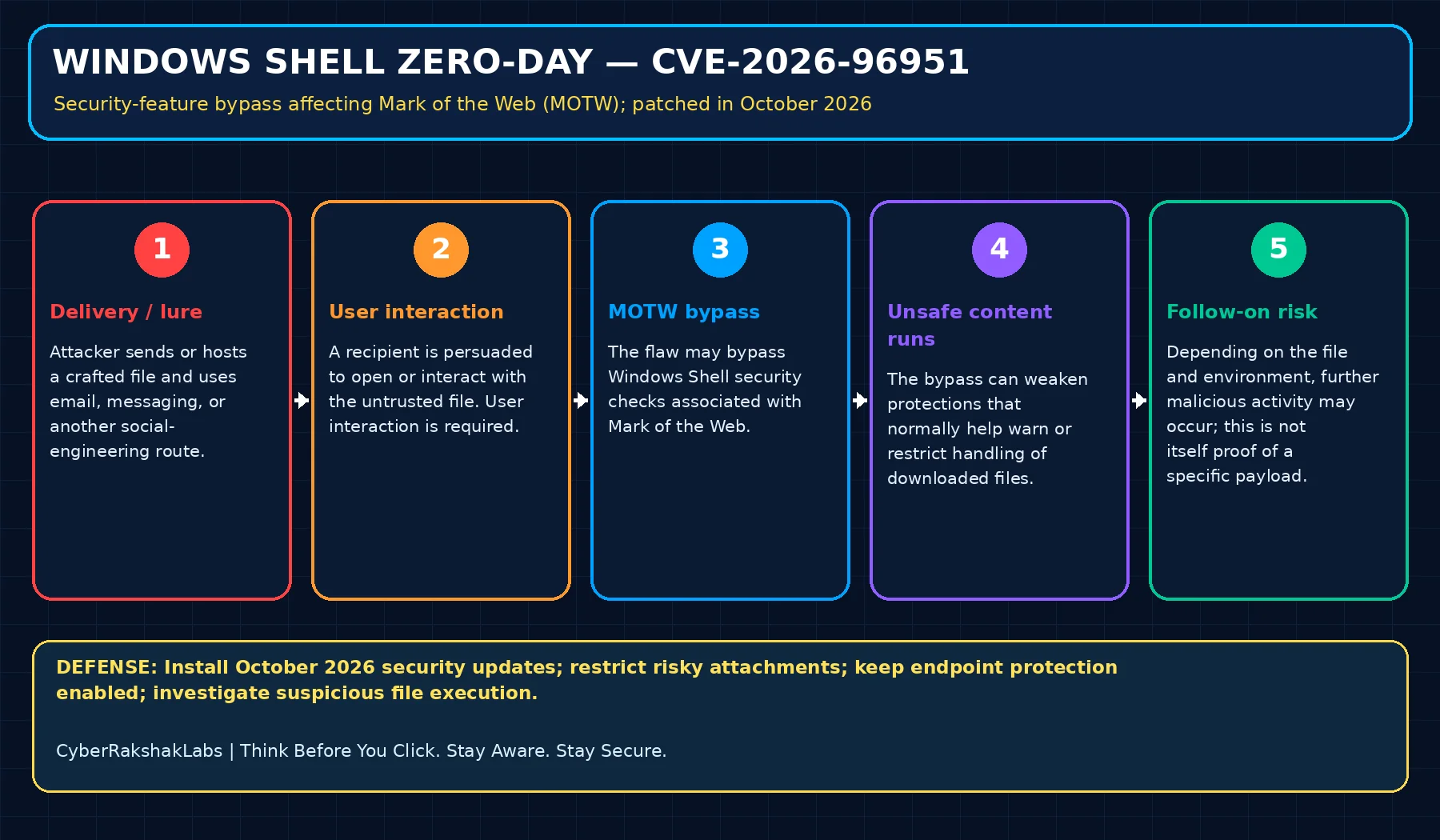
- An attacker delivers or hosts a crafted file using email, instant messaging, a download page or another social-engineering route.
- The target is persuaded to open or interact with the file.
- The exploit attempts to bypass security-feature handling associated with Mark of the Web.
- If successful, the file may receive less scrutiny from controls that rely on the origin marker.
- Any later code execution, credential theft, persistence or data theft depends on the payload and wider environment; none of these outcomes is proved by the CVE alone.
This sequence is a conceptual investigation model, not a confirmed end-to-end chain for every reported exploitation.
5. Evidence Matrix — Confirmed Signal vs. Unknowns
| Finding | Assessment | Confidence / boundary |
|---|---|---|
| CVE record exists | Published by Microsoft as CVE-2026-96951; Windows Shell security-feature bypass. | High — CVE record |
| CVSS score | 8.8, CVSS 3.1, High. | High — CVE record |
| Exploitation in the wild | Reported by Microsoft and secondary Patch Tuesday coverage. | High for published status; operational details are limited |
| MOTW bypass | Public reporting identifies Mark of the Web protections as the security feature at risk. | High for reported vulnerability behaviour |
| Named threat actor or victim set | No actor or victim set was established in the reviewed sources. | Unconfirmed / not attributed |
| Specific payload, malware family or incident IoCs | No verified hashes, URLs, IP addresses or malware indicators were supplied or confirmed for this CVE. | Not established here |
The presence of an actively exploited vulnerability is a reason to prioritize remediation. It is not, on its own, proof of a particular payload or compromise in a specific organisation.
6. Threat Actor and Attribution — No Named Group Confirmed
The reviewed sources do not establish a specific threat actor, campaign, victim organization, malware family or confirmed intrusion set for CVE-2026-96951. “Actively exploited in the wild” describes an exploitation status; it does not assign responsibility.
Do not automatically connect this issue to another Windows security-feature-bypass vulnerability simply because the weaknesses share a broad category. Similar security outcomes do not establish shared operators, infrastructure or exploit code.
7. Potential Impact if Exploitation Succeeds
- Reduced effectiveness of MOTW-based warnings or restrictions for a targeted file.
- Higher likelihood that a user handles a crafted file under a mistaken assumption that normal protections are intact.
- Possible follow-on malicious activity if the file and endpoint configuration allow it.
- Potential endpoint compromise, credential exposure or later movement only if additional stages occur.
These are potential risks tied to the vulnerability class—not confirmed outcomes for a named victim or every exploitation attempt.
8. Patch Priority — What Administrators Should Do
- Apply the relevant October 2026 security updates after normal validation, prioritizing supported systems in active use.
- Use the Microsoft Security Update Guide entry to verify product coverage, fixed builds and deployment details; do not rely on the CVE title alone to infer every affected SKU.
- Confirm deployment success from endpoint/asset-management telemetry and identify stale, unmanaged or intermittently connected endpoints.
- Keep Defender or the organisation’s endpoint detection and response platform enabled and current.
- Maintain layered safeguards such as least privilege, application control where feasible, attack-surface reduction and user awareness.
9. Detection and SOC Hunting Priorities
- Preserve the original downloaded file and its hash.
- Review file origin, download URL, message/email context and timestamps.
- Where appropriate, inspect
Zone.Identifiermetadata as one source of provenance—not as a standalone verdict.
- Review unusual launches of files from download, temporary or user-writable folders.
- Correlate a suspicious file open with child-process creation, script interpreters and unexpected network connections.
- Review EDR alerts for security-control tampering or suspicious follow-on behavior.
- Preserve email/message headers, download URLs and endpoint timelines.
- Correlate the event with user reports and application behavior.
- Keep the exact file and chain-of-custody notes for controlled analysis.
- Use vendor-confirmed affected-build scope to define priority assets.
- Do not treat absence of a visible MOTW marker as proof that this CVE was exploited.
- Use indicators only when they are tied to verified activity.
Detection logic should be tuned against the organisation’s own endpoint telemetry and known-good behavior. The sources reviewed do not provide incident-specific IoCs for this vulnerability.
10. IoC and MITRE ATT&CK Notes
A high-level mapping to malicious-file delivery or user execution may be relevant during investigation, but technique mapping should be assigned only where observed telemetry supports it. This article does not claim a specific MITRE ATT&CK technique was confirmed in a real intrusion.
Do not copy general-purpose or unrelated threat infrastructure into an IoC table as if it belonged to CVE-2026-96951.
11. Timeline and Historical Context
- February 2026: CVE-2026-21510 was reported as an earlier Windows security-feature-bypass zero-day patched by Microsoft.
- April 2026: reporting described CVE-2026-32202 as another exploited security-feature-bypass issue in the Windows ecosystem.
- 13 October 2026: October Patch Tuesday reporting identified CVE-2026-96951 as actively exploited and addressed by security updates.
- 14 October 2026: CyberRakshakLabs prepared this research brief using the supplied content and cited public reporting.
These historical references show recurrence of security-feature-bypass risk. They do not prove that the same actor or exploit chain was used across the CVEs.
12. Response Checklist for Organisations
- Confirm whether your products/builds are in scope using Microsoft’s official guidance.
- Deploy the applicable fix, verify successful installation and document exceptions.
- Prioritize workstations and environments that frequently receive files through email, browsers, chat and collaboration tools.
- Preserve suspicious files, hashes, timestamps, message headers, download URLs, EDR telemetry and relevant logs.
- If compromise is suspected, isolate the endpoint according to incident-response policy, investigate credentials and adjacent systems, and remediate based on evidence.
- Reassess for newly published technical details or indicators rather than assuming the current public record is complete.
13. CyberRakshakLabs Assessment — Urgent Patch, Evidence-Based Claims
CRL Assessment: HIGH. Active-exploitation reporting makes CVE-2026-96951 a priority for patching and asset review. The practical concern is that a security layer intended to preserve internet-file provenance may be bypassed in the described scenario.
The defensible response is to apply the relevant updates, validate affected builds, keep endpoint protection active and investigate suspicious file activity. The available sources do not justify attributing the exploitation to a named group, asserting a specific payload, or declaring a particular organisation compromised.
14. Research Limitations — What to Verify Next
Product-level scope, fixed build numbers and any updated exploitation details should be checked against Microsoft’s latest Security Update Guide entry. Public reporting gives the broad vulnerability description and exploitation status, but a specific exploit chain or campaign requires additional primary technical evidence.
This assessment reflects the sources listed below and the information reviewed on 14 October 2026. Update the conclusion if the vendor, affected organisation or reliable forensic reporting provides new primary evidence.
This article is based on the supplied DOCX, with the key CVE details cross-checked against public reporting. The Microsoft Security Update Guide should be used for exact product and build applicability.
CVE record — CVE-2026-96951 ↗
Microsoft Security Update Guide ↗
BleepingComputer — October 2026 Patch Tuesday ↗
Tenable — CVE-2026-96951 analysis ↗
The Hacker News — reported exploitation and user interaction ↗
Supplied topic source — CybersecurityNews ↗
Public descriptions of exploitation do not establish the attacker, affected victim set or payload. The supplied title/attack-flow graphics are illustrative reference material, not official Microsoft advisory screenshots.
Think Before You Click. Stay Aware. Stay Secure.
CyberRakshakLabs — Threat Intelligence for a Safer Tomorrow.