
1. Executive Summary — What Is AdFection?
A Citizen Lab investigation published on 15 October 2026 describes a technique researchers call AdFection: targeted advertisements were used as a delivery path for Candiru mercenary spyware. Devices used at Al Jazeera Media Network were targeted during 2024–2025. The investigation links Discover-Tech's advertising infrastructure to targeting and the hand-off to spyware infrastructure.
The key distinction is between an ad impression, a targeting decision, and a successful infection. A broad advertising impression did not automatically mean a device was infected. The chain selected devices that matched targeting criteria; those selected devices could then be redirected through validation and exploit infrastructure.
2. How the Zero-Click Delivery Chain Works
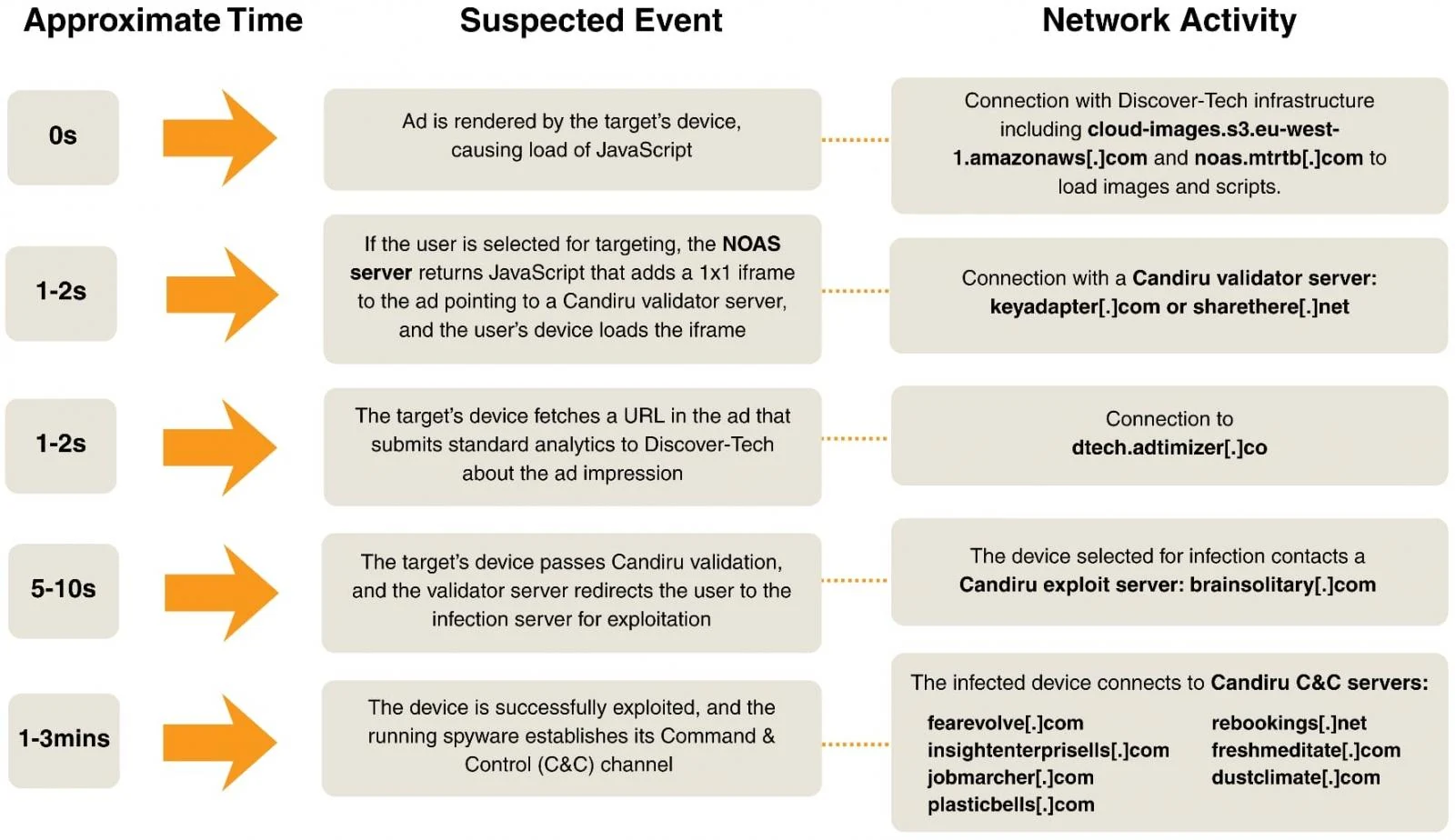
The source investigation describes a multi-stage sequence. The exact exploit implementation is not fully public, so the stages below summarize the reported chain rather than reconstructing exploit code.
| Stage | Reported action | Defensive relevance |
|---|---|---|
| 1. Ad impression | An advertisement renders in a website or mobile app and executes its associated script. | Exposure can occur through normal browsing or app use; the user may not click. |
| 2. Profiling and telemetry | Advertising infrastructure receives targeting and impression-related information, potentially including IP and advertising/browser identifiers. | Ad-tech endpoints and identifier leakage become relevant telemetry sources. |
| 3. Selection | A server-side decision determines whether the device matches a target profile; non-targets may receive no exploit stage. | Most impressions must not be equated with successful exploitation. |
| 4. Validation and redirect | Selected devices are passed to validation and then exploit infrastructure attributed to Candiru. | Correlate DNS, proxy, browser/app and endpoint events in sequence. |
| 5. Implant and command-and-control | For successfully compromised devices, spyware may establish control channels and collect sensitive device information. | Preserve network and device artifacts for specialist forensic review. |
3. Why the Advertising Supply Chain Matters
Programmatic advertising connects advertisers, demand-side platforms (DSPs), ad exchanges, supply-side platforms (SSPs), publishers and the browser or app showing the ad. The ecosystem relies on rapid decisions and data exchange. The investigation describes how this legitimate infrastructure was allegedly repurposed to profile and select devices for surveillance.
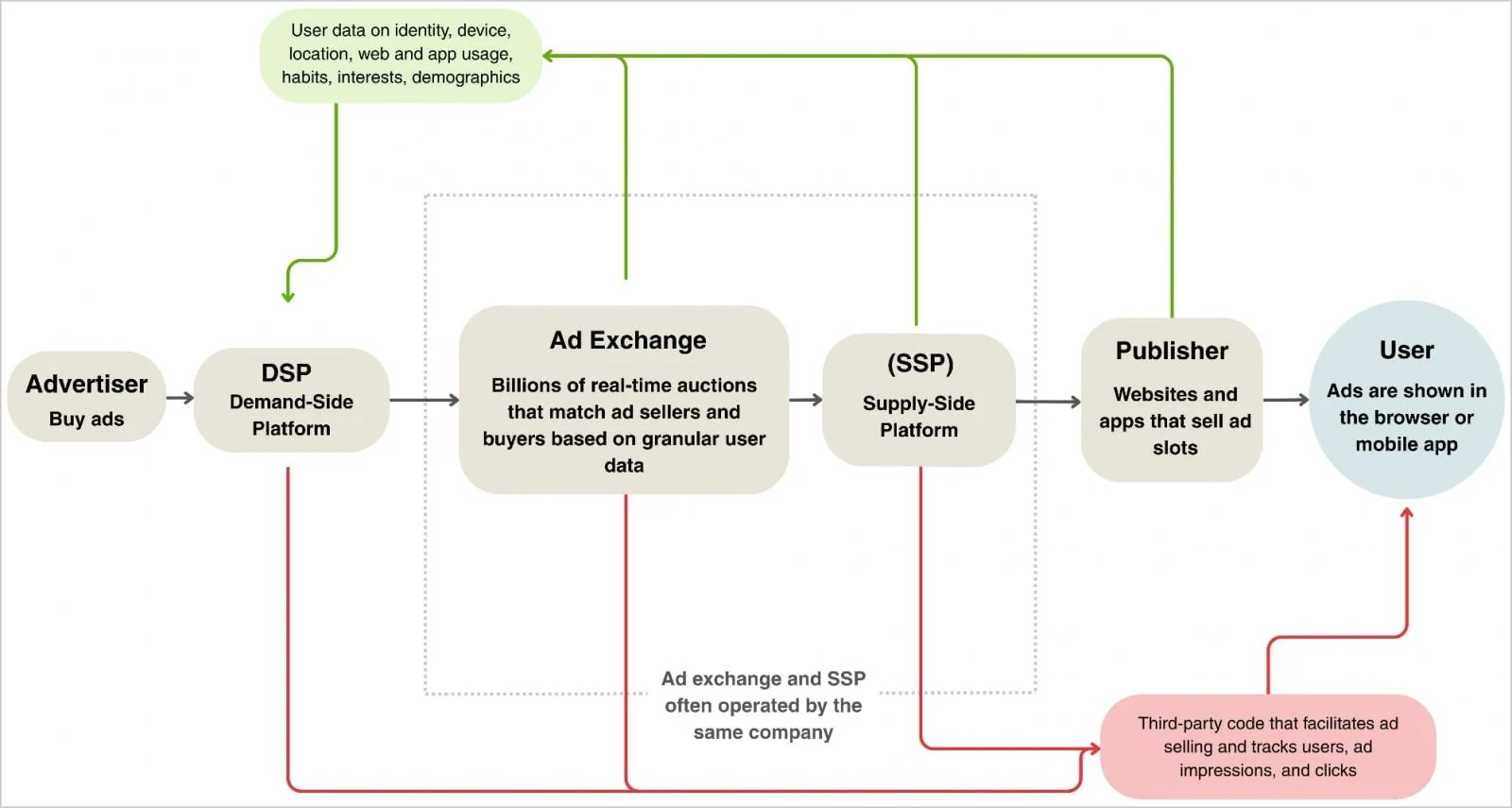
Scale does not equal infection
Advertising reach and profiling telemetry can be broad while an exploit hand-off remains highly selective.
Trust can be inherited
Content arriving through ordinary publisher/ad channels may bypass the user's suspicion of a direct malicious link.
For defenders, this expands the third-party risk model: ad networks, embedded scripts, real-time bidding flows, analytics endpoints and content delivery paths can be relevant to an incident even where the user never visited a suspicious URL intentionally.
4. What the Evidence Supports — and What It Does Not
| Finding | Assessment | Boundary |
|---|---|---|
| Citizen Lab published an AdFection investigation | Publicly documented | Primary report dated 15 October 2026. |
| Devices used at Al Jazeera were targeted during 2024–2025 | Reported by investigators | Public reporting describes at least 45 devices targeted; do not interpret this as 45 universally confirmed infections. |
| Discover-Tech provided the ad-delivery bridge | Attributed in the investigation | Vendor/infrastructure attribution from Citizen Lab and Confiant. |
| Candiru spyware was linked to the infection chain | High-confidence attribution in the report | This does not reveal the identity of the ultimate customer. |
| Every device that displayed an ad was infected | Not supported | The chain included target selection and subsequent exploit stages. |
| Exact exploit code, full infection count and government customer | Not established in sources reviewed | Do not fill these gaps with speculation. |
The distinction between targeted devices, devices that passed validation, and devices for which investigators confirmed compromise matters for accurate reporting and response prioritisation.
5. Timeline and Campaign Context
- 2021: The United States added Candiru to its Entity List, citing malicious cyber activities.
- 2024–2025: Citizen Lab reports targeting of devices used at Al Jazeera; the organisation's technology team observed unusual patterns across this period.
- 15 October 2026: Citizen Lab published the AdFection investigation describing the Discover-Tech/Candiru connection.
- 16 October 2026: BleepingComputer published a technical summary of the findings.
The campaign is notable because it puts ad-tech targeting and spyware delivery in one operational chain. It should not be treated as proof that every advertising platform is involved or that all users face the same level of targeting.
6. Threat Actor and Attribution Assessment
Discover-Tech
Described by investigators as the advertising technology intermediary used to profile/target devices and bridge ad delivery with surveillance infrastructure.
Candiru
A commercial mercenary-spyware vendor whose spyware is linked to the reported infection chain with high confidence in the public investigation.
The specific government customer or ultimate operator was not publicly identified in the sources reviewed. Attribution should stay with the vendor and infrastructure relationships actually documented; this article does not assign a country, agency or named customer.
7. Potential Data Exposure — Capabilities vs. Proven Collection
Public reporting describes spyware capabilities that may include access to files and documents, browser data such as cookies/bookmarks/saved credentials, communications, keystrokes, screenshots, and microphone or webcam input.
If credential or session theft is suspected, rotate credentials and revoke active sessions from a known-clean device after coordinating containment and evidence preservation with incident responders.
8. SOC Hunting — What to Look For
Hunting should focus on the ordered event pattern rather than a single generic indicator. Use current, validated indicators from Citizen Lab and Confiant's technical appendices; infrastructure may change, and an individual domain match requires context.
Prioritise correlation across DNS, proxy, firewall, mobile telemetry, EDR, browser/app records and identity activity. A single domain, crash or battery symptom alone is not proof of infection.
9. Incident Response and DFIR Priorities
- Preserve browser/app telemetry, device logs, DNS records, network flows, endpoint artifacts and relevant identity logs before rebuilding or resetting a suspected device.
- Escalate high-risk suspected compromise to a specialist mobile/endpoint forensics team; targeted mercenary spyware may evade ordinary antivirus checks.
- Correlate the exposure window across related staff devices, shared accounts, identity sessions and sensitive data access.
- Validate network indicators against the primary report and your own context before deploying blocks, avoiding broad blocks based only on unverified lists.
- If credential theft is suspected, rotate credentials and revoke sessions from a known-clean device; preserve the evidence needed to confirm scope.
- Coordinate legal, privacy, executive and notification decisions against verified findings and applicable obligations.
10. Practical Protection for Organisations and High-Risk Users
These measures reduce exposure or improve detection, but none alone guarantees protection from a targeted zero-click spyware operation.
11. Indicators and Verification Notes
The figures supplied with this research include example infrastructure labels and a staged network sequence. This article does not recreate a complete IOC appendix. Before creating block rules or detections, retrieve the current indicator set directly from the primary Citizen Lab and Confiant publications, confirm defanging and context, and evaluate false-positive risk.
For published intelligence, separate each item into source-reported indicator, observed local event and analyst-assessed linkage. Do not treat an infrastructure match as standalone proof that a device is compromised.
12. ATT&CK Mapping — Why Attribution Should Wait for Evidence
The public summary alone is insufficient to assign a complete, victim-specific ATT&CK technique chain with confidence. A defender may investigate drive-by compromise, exploit delivery, collection and command-and-control hypotheses, but final mapping should be based on the primary technical report and local forensic evidence.
Document what was directly observed separately from what is inferred from the reported sequence. Avoid representing every possible capability as an observed technique in this incident.
13. Sources, Verification and Research Limitations
- Citizen Lab — Exposing AdFection: How Discover-Tech Turned Targeted Ads Into a Pipeline for Zero-Click Mercenary Spyware — primary technical investigation.
- Citizen Lab — AdFection Executive Summary — primary summary.
- Confiant — ADINT: Weaponized Ad Tech for Zero-Click Spyware and Mass Identity Vacuuming — companion ad-tech analysis.
- BleepingComputer — Targeted ads installed Candiru spyware in zero-click attacks — technical news summary, 16 October 2026.
- Al Jazeera — Israeli ad-tech firm helped place spyware on Al Jazeera devices — reporting on the investigation and organisation's response.
Scope note: this article summarises public reporting available as of 17 October 2026. It does not independently examine affected devices, assert a complete infection count, identify the ultimate customer, or prove that every targeted device was infected.
14. CyberRakshakLabs Assessment — Advertising Is an Attack Surface
CRL Assessment: HIGH. The reported chain challenges the assumption that a user must open a suspicious attachment or click a malicious link before a device can be exposed. For high-risk individuals and organisations, ad-tech infrastructure should be considered within third-party risk, endpoint visibility and incident-response planning.
The best operational response is measured: update devices, reduce unnecessary ad tracking where feasible, centralise telemetry, validate source-reported indicators, and route suspected cases to specialists. Do not turn the campaign into a claim that every ad is malicious or every targeted device was infected.
Think Before You Click. Stay Aware. Stay Secure.
CyberRakshakLabs — Threat Intelligence for a Safer Tomorrow.