
wcscspn() and wcspbrk()CP3A.260905.009. The report supports a string-parsing correctness/compatibility bug. It does not establish a CVE, memory corruption, privilege escalation, an attacker campaign, or exploitation in the wild.1. Executive Summary — What Is Reported?
A public Android NDK issue, #2260, reports that Android 17's Bionic C library can mishandle wcscspn() and wcspbrk() when a wide string contains a character at or above U+0100 and the reject/delimiter set contains two or more characters, all below U+0100.
The reporter states that the failure was reproduced on a Pixel 7 and Pixel 8a running Android 17 build CP3A.260905.009. The issue page labels NDK r29 affected. The current public report describes a correctness defect with possible downstream application impact; it does not show an exploit or an intrusion.
2. The Bug in Plain Language
These functions scan wide-character strings to find characters from a caller-supplied reject or delimiter set. The reported edge case appears when that set contains at least two low-valued characters (for example, ASCII newline and carriage return) and the text includes a non-ASCII character such as Ā, a CJK character, Cyrillic, Greek, or an emoji.
In a representative case, the scan should continue past Ā because it is not in the delimiter set, and then stop when it reaches the newline. The reported regression can instead treat the first character at or above U+0100 as a match.
wcscspn(L"aĀb
", L"x
")
/* Expected stop: the newline, at index 3.
   Reported regression: the scan can stop earlier at Ā. */
This is a simplified illustrative test, not an exploit payload. Reproduce only against builds and applications you are authorized to test.
The issue reports that wcspbrk() is affected because it uses wcscspn(). The reporter states that wcsspn(), wcschr(), wcsrchr(), wmemchr(), and wcsstr() behaved correctly in the tested cases.
3. Technical Explanation — The Reported Lookup-Table Path
The issue's author describes an optimized path that builds a 256-entry lookup table when the reject set contains multiple characters below U+0100. During the haystack scan, the affected implementation appears to stop when it sees a character at or above 0x100, instead of continuing because that character cannot be present in a table populated only by lower-valued set members.
This explanation reflects the reporter's analysis of the shipped library, including disassembly described in the issue. CyberRakshakLabs has not independently reproduced the reverse-engineering work or tested the affected devices.
The core correctness expectation is straightforward: when a scanned character is not in the reject set, the function should continue. A character outside the lookup table's range cannot be a match for a set made exclusively of low-valued characters.
4. Reported Scope — Builds and Limitations
| Platform / condition | Report status | Boundary |
|---|---|---|
Pixel 7, Android 17 build CP3A.260905.009 | Reported affected | Specific build fingerprint cited by the reporter |
Pixel 8a, Android 17 build CP3A.260905.009 | Reported affected | Issue reports the September 2026 security patch level |
| NDK r29 | Labelled affected in issue | Do not infer that every application or toolchain usage fails |
| Nothing Phone 2, Android 16 | Reported unaffected in one test | Not a complete device or OS compatibility matrix |
| Other Android 17 builds and devices | Not established | Exact affected population and fixed rollout status require upstream confirmation |
The public Android 17 source snapshot cited in the report reportedly used an implementation that behaved correctly in June 2026. The code described on September builds differs, which suggests the regression was introduced between those points; it does not establish the complete release history or every affected device.
5. Potential Application Impact — What Could Break?
The issue cites downstream examples rather than showing that all Android applications are vulnerable. One example involves Visual Pinball's libwinevbs parsing: a comment containing an emoji could cause line scanning to stop at the emoji and report an invalid character. The issue also describes FileSystem.MoveFolder path handling as a case where a Unicode character could be misinterpreted during wildcard detection.
Possible correctness failures
Invalid-input errors, early termination, broken tokenization, source/comment parsing failures, or incorrect path interpretation.
Security significance
Context-dependent. The supplied evidence does not demonstrate memory corruption, code execution, privilege escalation, or remote exploitability.
Security teams should prioritize applications whose parsing errors affect authorization, path validation, file movement, command interpretation, or other security-sensitive workflows. These are review priorities, not confirmed exploit paths in the reported incident.
6. Evidence Matrix — Confirmed Report vs. Unknowns
| Finding | Assessment | Confidence / boundary |
|---|---|---|
| Android NDK issue #2260 exists and was opened 12 October 2026 | Confirmed in public issue tracker | High |
wcscspn() and wcspbrk() stop incorrectly under the described condition | Reported and acknowledged in issue discussion | High for the specific reported test case |
Pixel 7 and Pixel 8a build CP3A.260905.009 | Reporter identifies both as affected | High for reported builds; not a complete matrix |
| All Android 17 devices or apps are affected | Not established | Unknown |
| Memory corruption, RCE, or privilege escalation | Not demonstrated in reviewed source | No supporting evidence |
| Threat actor, malware family, campaign, or exploitation in the wild | Not identified by the primary report | No supporting evidence |
| Final fixed release and production rollout | Not confirmed by the supplied issue text | Check current upstream/vendor release notes |
7. Bug Flow Diagram — From Input to Incorrect Parsing
The original analytical diagram below summarizes the reported function-level behavior. It is an explanatory graphic created for this research, not a screenshot from Android, Google, or the issue tracker.
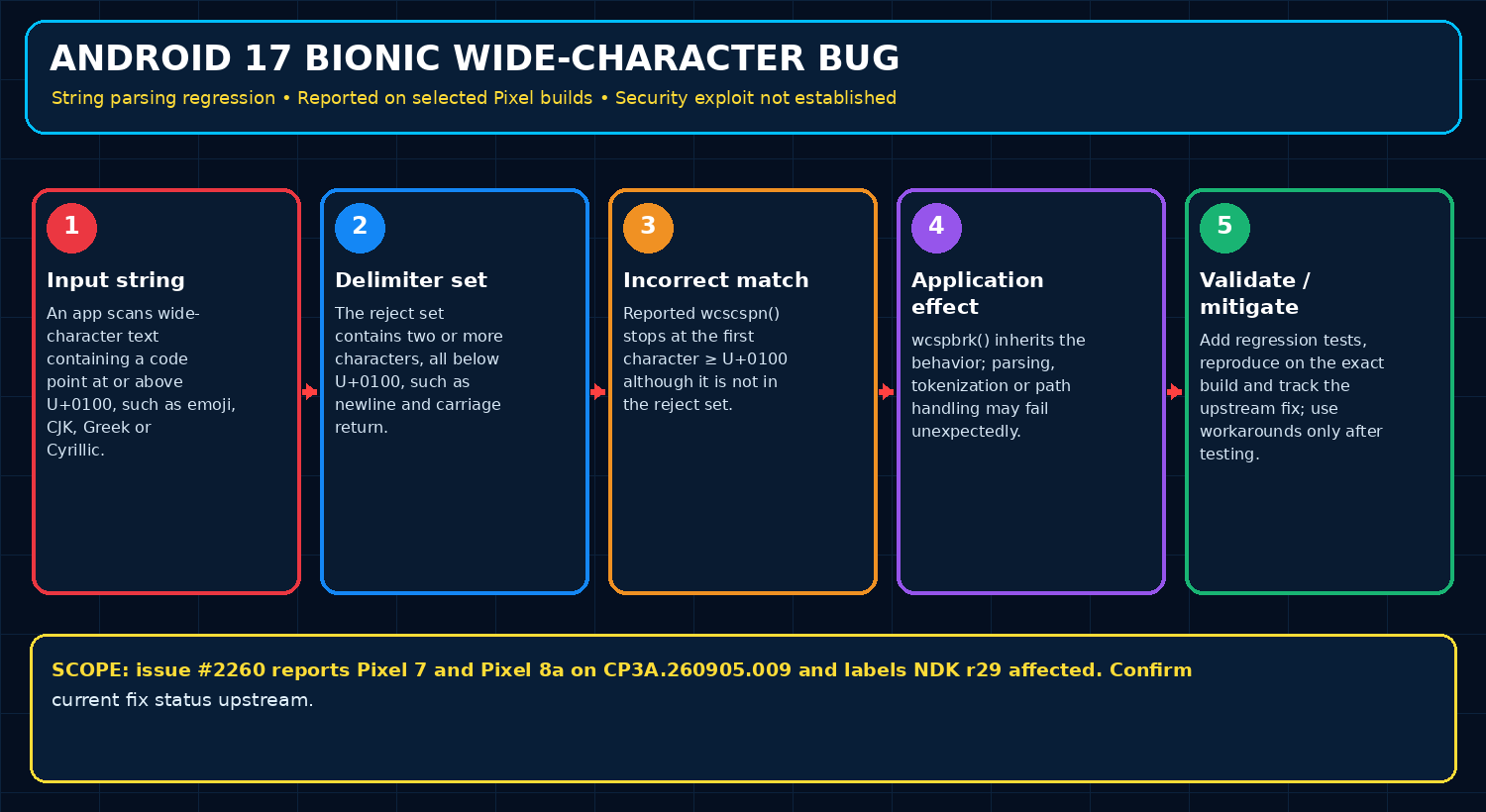
Scope shown in the figure follows issue #2260: reported Pixel 7 and Pixel 8a builds CP3A.260905.009; confirm current fix status upstream.
8. Detection and Validation — Reproduce on the Exact Build
This is a library correctness issue, so detection begins with controlled regression testing rather than malware hunting. Use a disposable test harness and non-sensitive inputs.
Use one wide character at or above U+0100 followed by an ASCII delimiter; make the reject set contain two or more ASCII characters.
Exercise
wcscspn() and wcspbrk() with matching inputs and expected results.Capture Android build fingerprint, security patch level, device model, app version, NDK/toolchain and relevant library version.
Run identical test cases on the reported build and on a known-good or officially fixed build.
Look for parser errors correlated with Unicode input, path handling or comment/tokenization failures.
Retain minimal reproducer code, test output and regression tests for later revalidation.
A parser error by itself is not evidence of compromise. Correlate it with the affected code path and expected behavior before escalating it as a security incident.
9. Mitigation and Developer Actions
- Track Android NDK issue #2260 and verify the current upstream fix/backport and vendor rollout status.
- Install official system and platform updates when available; verify the resulting build rather than assuming every device receives the same fix at the same time.
- For affected application code, add regression tests for non-ASCII wide characters with reject sets containing multiple ASCII delimiters.
- Review code paths that parse Unicode text, source comments, file paths and delimiter-separated records using these functions.
- If an immediate application-level workaround is required, evaluate a tested alternative scanning loop or approved library fix; do not deploy an unverified workaround broadly.
- Do not sideload unofficial “fix” packages or binaries from untrusted sources.
10. Timeline and Upstream Status
- June 2026: The public Android 17 source cited by the report reportedly showed a correct implementation.
- September 2026: The reported Pixel build
CP3A.260905.009exhibited the regression. - 12 October 2026: Android NDK issue #2260 was opened.
- 13 October 2026: NDK collaborators acknowledged the report and discussed missing non-ASCII test coverage and investigating a fix/backport.
- 16 October 2026: This research was prepared from the supplied DOCX and available public-source reporting. Confirm current status directly in the upstream issue before making patch or deployment decisions.
The issue discussion indicates that maintainers were investigating tests and a possible backport; the supplied source does not establish a final fixed release or completed device rollout.
11. MITRE ATT&CK and Indicators of Compromise
Not applicable based on current evidence. The primary report does not identify adversarial activity, a threat actor, malware, campaign infrastructure, indicators of compromise, or an observed attack technique. Do not force an ATT&CK mapping onto a library correctness regression.
12. Sources, Verification and Research Limitations
- Android NDK issue #2260 — Bionic
wcscspn()/wcspbrk()regression: primary report, test conditions, affected builds and maintainer discussion. - Frontier Now — AOSP source lag and the Bionic bug: secondary technical coverage dated 14 October 2026.
- SecurityOnline — Android 17 Bionic wide-character bug: secondary coverage listed in the supplied research document.
The source document is the primary basis for this article, supplemented by public-source verification. The function-level mechanism is attributed to the issue reporter and has not been independently reproduced by CyberRakshakLabs. Exact affected population, final fixed version, rollout status, and any security consequence beyond incorrect application behavior remain unconfirmed.
13. CyberRakshakLabs Assessment — Validate Before Classifying
CRL Assessment: MEDIUM. The regression is technically credible in the specific reported conditions and has downstream compatibility consequences, but available evidence does not establish a security exploit or a universal Android exposure.
Development teams should reproduce the behavior on exact builds, inspect security-sensitive string-handling code, add regression tests and follow the official fix path. Security operations teams should avoid treating parser failures as IOCs without separate evidence of adversarial activity.
wcscspn() and wcspbrk() on specific reported Android 17 builds. Test Unicode inputs, check current upstream/vendor remediation, and keep the distinction clear: the supplied evidence supports a correctness bug, not confirmed active exploitation.Think Before You Click. Stay Aware. Stay Secure.
CyberRakshakLabs — Threat Intelligence for a Safer Tomorrow.