
CVE-2026-23871: How a WhatsApp Ad-Reply Flaw May Have Helped Scammers Make Messages Look More Credible
CyberRakshakLabs | Research • Awareness • Safer Digital India
Source & social links:
LinkedIn Post ↗ WhatsApp ↗ YouTube ↗
CVE-2026-23871 involved incomplete validation of external ad-reply URLs in WhatsApp for Android and WhatsApp Business for Android versions earlier than 2.26.17.4. Under specific conditions, rendering attacker-hosted media in a crafted Click to WhatsApp ad-reply message could expose IP information to an attacker-controlled endpoint.
WhatsApp said the issue may have been abused alongside specific spam messages and believed a scammer was using it to make messages appear more credible. CVSS 3.1: 3.5 (Low). This is IP information exposure—not automatic account takeover, message decryption or remote code execution.
Executive Summary
WhatsApp disclosed CVE-2026-23871 in its November 2026 security advisory. The issue involved incomplete validation of external ad-reply URLs in WhatsApp for Android and WhatsApp Business for Android versions earlier than 2.26.17.4. Under specific conditions, a crafted Click to WhatsApp ad-reply message could cause a recipient’s device to reveal IP information to an attacker when media hosted at an attacker-controlled URL was rendered and displayed in the message thread.
WhatsApp said the issue may have been abused alongside specific spam messages. A spokesperson told SecurityWeek that WhatsApp’s team found the issue while disrupting a scam campaign and believed a scammer was using it to make scam messages appear more credible. The flaw has a CVSS 3.1 score of 3.5 (Low).
The disclosed impact is IP information exposure—not automatic account takeover, message decryption, remote code execution or theft of chat contents. The central lesson is that a conversation reached through an advertisement or business-chat entry point should not automatically be treated as trustworthy.
What Is Click to WhatsApp?
Click to WhatsApp is an advertising interaction that lets a person start a WhatsApp conversation with a business after tapping an ad. The ad-to-chat journey can provide context about why a conversation began. A message that appears connected to an advertisement or business interaction may feel more expected or authentic than an unsolicited message.
The CVE concerns validation of external ad-reply URLs and the handling of attacker-hosted media in a crafted ad-reply message. It does not mean every Click to WhatsApp ad, business conversation or media message is malicious.
How CVE-2026-23871 Worked
- Prepare a deceptive entry point: A scammer could use spam messages and a Click to WhatsApp ad-reply context to make an interaction seem more credible. Public reporting does not identify the exact scam script or a named campaign operator.
- Craft an ad-reply message: The attacker creates a crafted Click to WhatsApp ad-reply message containing an external media reference.
- Host media on attacker-controlled infrastructure: The media is served from a URL controlled by the attacker. The vulnerable app did not sufficiently validate the external ad-reply URL.
- Trigger rendering in the message thread: When the crafted ad-reply message is rendered and displayed in the WhatsApp conversation, the app may retrieve or process the externally hosted media.
- IP information may be exposed: Under vulnerable conditions, the recipient device may reveal IP information to the attacker-controlled endpoint. An IP address can provide approximate network or geographic context, but does not automatically reveal a person’s exact home address or identity.
- Use the context to support social engineering: A scammer may use the interaction to make a message feel more credible or enrich targeting. WhatsApp said it believed the flaw was used to make scam messages seem more credible; detailed downstream use of any collected IP information has not been publicly established.
Attack Flow and Technical Boundaries
The supplied attack-flow infographic on this page illustrates the conceptual sequence: a scammer prepares a deceptive Click to WhatsApp interaction, a crafted ad-reply references attacker-controlled media, the message appears in the recipient’s thread, the vulnerable Android app renders the content, and IP information may be disclosed to the attacker-controlled endpoint. The scammer may then use the interaction context to support follow-up social engineering.
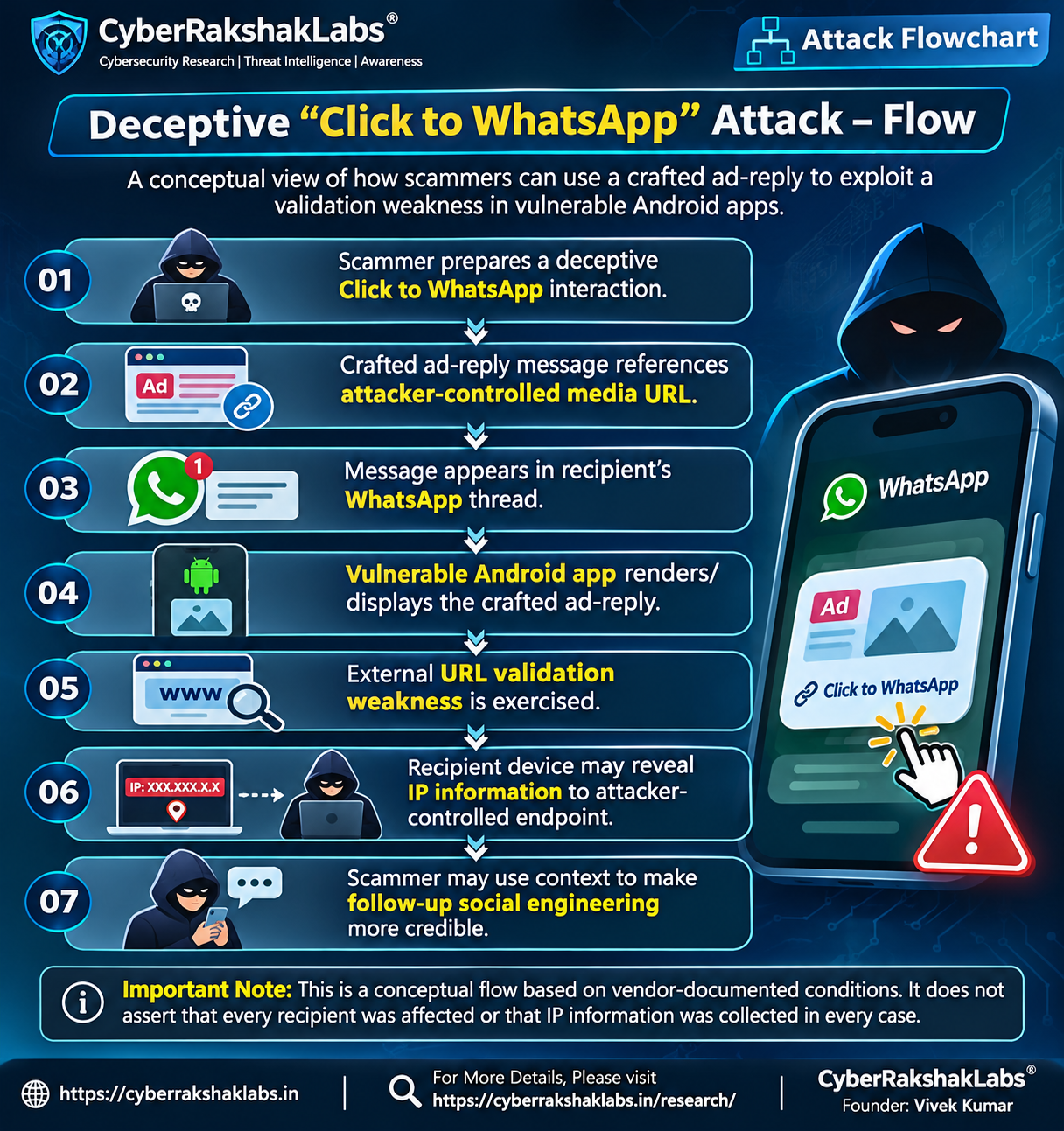
This is a narrow URL-validation and media-rendering issue. The disclosed impact is IP information exposure. It is not evidence of chat decryption, message theft, remote code execution or automatic account takeover.
Affected Products and Remediation
- WhatsApp for Android: versions earlier than 2.26.17.4 were affected; update to 2.26.17.4 or later.
- WhatsApp Business for Android: versions earlier than 2.26.17.4 were affected; update to 2.26.17.4 or later.
- Update through Google Play or another official distribution channel available for your device. Check the installed app version in settings. If the app store offers a newer release, install it.
- Do not download update APKs from links sent by strangers or unsolicited messages.
Meta’s CVSS 3.1 score is 3.5 (Low). A low CVSS score does not make a real-world scam campaign harmless, particularly when social engineering is involved.
What Is Known About the Campaign?
WhatsApp’s November advisory says the issue may have been abused in conjunction with specific spam messages. In comments reported by SecurityWeek on 20 November 2026, a WhatsApp spokesperson said the team found the issue while disrupting a scam campaign and believed a scammer was using it to make scam messages appear more credible.
The public information reviewed does not name a threat actor, criminal group or country. It does not provide a complete campaign timeline, victim count, specific scam message templates, or evidence that exposed IP information was used for account takeover, financial theft or other follow-on activity. Those details should not be inferred.
The November WhatsApp advisory also listed CVE-2026-102769 and CVE-2026-44908. They are separate issues with different technical causes and are not part of the CVE-2026-23871 attack chain.
Potential Risks to Individuals
- IP information may reveal the public network address used by a device or connection and provide approximate network or regional context.
- Attackers may combine network information with details from public profiles, leaked datasets or conversation context to make social-engineering attempts more convincing.
- A scammer may use a credible-looking business-chat context to encourage a victim to disclose OTPs, passwords, payment details or identity documents. Such disclosure would result from the scam interaction, not from the CVE itself.
- People may mistake the presence of an advertisement or a business-style conversation for proof that the sender or offer is legitimate.
How Individuals Can Protect Themselves
- Update WhatsApp and WhatsApp Business for Android to version 2.26.17.4 or later; install the latest official release available.
- Install updates only through Google Play or the official app distribution channel. Avoid APK update links received through chats, SMS or social media.
- Treat unexpected business chats, offers, refund messages, job offers and account-verification requests with caution—even if the conversation appears connected to an advertisement.
- Verify a business independently using its official website or a known customer-support number. Do not rely only on a phone number or link supplied in the chat.
- Never share OTPs, PINs, passwords, recovery codes, payment credentials or identity documents with an unverified contact.
- Do not open unexpected links or media from unknown contacts. Keep device software and security protections up to date.
- Use WhatsApp privacy controls, block and report suspicious accounts, and enable two-step verification.
- If targeted, preserve the conversation, report the account in WhatsApp and contact your bank immediately if payment credentials or money were involved.
Recommendations for Organisations and Businesses
- Maintain an update process for managed Android devices and verify WhatsApp Business version compliance.
- Train customer-support and sales teams to recognise impersonation, suspicious ad-originated chats and requests for credentials or payments.
- Publish official support channels clearly so customers can independently verify business conversations.
- Do not ask customers to disclose OTPs, passwords or full payment credentials in chat.
- Provide a clear process for customers to report suspicious messages and preserve evidence.
- Review advertising-to-messaging journeys and business account access controls; restrict administrative access and enable strong authentication where available.
- Include messaging-platform scams in security awareness exercises and incident-response playbooks.
Historical Context and Timeline
- Before 20 November 2026: The issue existed in affected Android app versions earlier than 2.26.17.4. Public reporting does not establish the precise date the flaw was first exploited.
- During scam-campaign disruption: WhatsApp’s security team identified the issue while disrupting a scam campaign, according to the company spokesperson quoted by SecurityWeek.
- 20 November 2026: WhatsApp’s November security advisory listed CVE-2026-23871. SecurityWeek reported the vendor’s comments about suspected abuse and scam credibility.
- 21 November 2026: This CyberRakshakLabs awareness analysis was prepared from the vendor advisory and public reporting.
Threat Actor Assessment
No named threat actor or group is identified in the public advisory or reporting reviewed. The available evidence supports describing the activity as a scam campaign involving spam messages and suspected abuse of the ad-reply URL flaw. Attribution beyond that would be speculation.
Conclusion
CVE-2026-23871 highlights how a weakness in a narrow advertising-to-messaging feature can support a wider social-engineering operation. The disclosed technical impact is IP information exposure under specific rendering conditions—not automatic account compromise or message decryption. Users should update WhatsApp, verify business identities independently and refuse requests for sensitive information. Organisations should keep managed apps current and make official customer-contact channels easy to verify.
Sources and Further Reading
- WhatsApp Security Advisories — November 2026
- SecurityWeek — WhatsApp Fixes Flaw Uncovered While Disrupting Scam Campaign (20 November 2026)
- Security Affairs — CVE-2026-23871: WhatsApp Bug Helped Scammers Make Messages Look Legitimate
- Tenable — CVE-2026-23871
This article follows the supplied CyberRakshakLabs research document and preserves the limits and caveats stated in the vendor and public reporting.